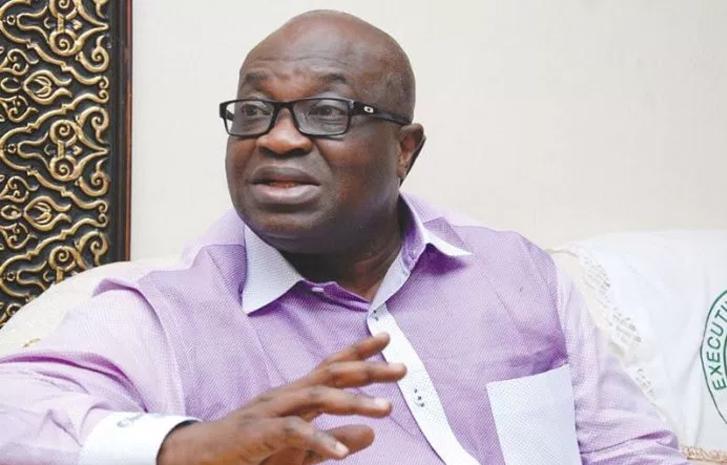
Ikpeazu
By DELE OLOWU
A POST MORTEM of contemporary events in Abia State might lead to the conclusion that Governor Okezie Ikpeazu may have been the architect of his own recent setback. Ikpeazu’s gravest error in his entire eight-year rule was to have given scant attention to the requirement to engage in robust publicity and show off his political goods to an electorate noted even at the best of times for its cynicism.
His habit of reticence and a reliance on his growing reputation as a silent achiever hurt him rather badly in the just concluded elections. However, his recent engagements with the media have been unusually expressive and have left many wondering why he kept his gemstones under wraps for so long!
The engagements have been revelatory and have shed unaccustomed light on the governor’s tenure and reversed some of the negativities that had dominated the literature of his service and sacrifice to his beloved people. Some might be of the view that the Ikpeazu response is unseasonable and late in coming.
However, the right to reply cannot be impugned or defeated either by time or by distance. Public interest issues can only be enlivened by throwing the public space open to a multiplicity of voices as well as a continuous dialectic of views.
No matter how late an intervention from the Ikpeazu platform comes, it should provide decisive materials that will assist in producing the verdict of history. But it is important to explode the caricature that holds out Abia State as a debt ridden state that is unable to meet its obligations to its employees. This is a putrid myth, that has been stylised over the years to paint a distressed image of God’s Own State.
Recently, Governor Ikpeazu stated that he has paid 29,000 civil servants in Abia and constructively owes no one. He explained that his brand of governance did not allow him to pass the buck and that when he took over, he embraced both assets and liabilities; contrary to the prevailing caricature, Abia State is not owing any core civil servant salaries of any kind. This is distinct from income-generating entities that spend their way into trouble. They are only entitled to subventions. The overbloating of the public service and government owned entities in the state has proceeded by tricks and in stealth. Many of the incumbent chief executives employ people without mandate and sometimes in clear violation of existing protocols.
In the meantime, many of the entities generate revenue, which they deploy unilaterally. So what was once a governable cluster with tidy numbers soon becomes a gross association, hemorrhaging state resources at unsustainable levels. This has been the burden presented by Abia State. For Governor Ikpeazu, the service has been a crown of thorns.
Even though the state’s purse was lean, Ikpeazu came into office with a new sense of hope, pushing up social and political expectations. There was considerable drama when, on his first day in office , he unveiled seven road projects in Aba, a long-unserviced entrepreneurial hub.
This gesture received flattering notices from the merchant class, whose faith in government rose sharply. The governor sought to create an economy driven by the private sector in order to expand infrastructure. Roads, education, and health, as well as oil and gas, and construction, became a boom, producing 200 roads in all. The governor introduced a novelty in road construction through the use of cement technology.
The technology entails casting the road with concrete over a mass of iron before asphalting it. It is a new technology that enhances both the stability and life of roads. A new bridge has been completed at Okoturo Afia Obadiah. It realigned the bridge at Umunneochie. A new policy that upheld zero tolerance for potholes was established.
Old roads in Aba and Umuahia are periodically asphalted. Some roads, like St. Michaels, Park Road, Ube, and others in Aba, were totally reworked. Trade centres were also established to revive old artisanships. Mexican and Philipino supervisors were brought in to train young children in the trades, including carpentry, masonry, and house wiring. The Friends of Abia Schools Initiative was also launched to mobilise funds from Abians to rehabilitate badly degraded schools. Governor Ikpeazu urged his friends to embrace the project.
No fewer than 200 unemployed youths have been taken in by the Abia State Traffic Management Agency to assist in the protection of public infrastructure. One of the most outstanding merits of the Ikpeazu years is the restoration of rural and urban peace. Abia has earned a new reputation as the most peaceful state in the South-East. Not surprisingly, this peace has produced an enabling learning environment that has made Abia State the top state in the annual WAEC chart. This position has remained unchallenged for years. Public school enrollment has improved significantly from 142,000 in 2015 to over 650,000 in 2022.
The state university at Uturu moved up in ranking to first place among state universities in the entire Nigerian federation. State support for education reached uncharted territory when Governor Ikpeazu provided sponsorship for foreign scholarships, with 30 of them now studying in India and Australia.
Education infrastructure has expanded phenomenally during the Ikpeazu years. While some of this may be due to the training, the pedigree, and the sensitivities of Governor Ikpeazu, it is only proper to recognise good works when they manifest in public life. The delivery of several bridges, including the Okezie Aba interchange in Osisioma LGA; the several erosion mediation projects ; the various health projects across the state; and the Enyimba economic city project, which has provided impetus for industrial development for the jurisdiction, as well as the establishment of the Geometric Company Aba, which has changed the power environment and lifted substantially the night economy in Abia, have all invested Governor Ikpeazu as a leader of service. Governance is a multilayered experience.
It is complex and governed by varied perceptions, some of which are difficult to interpret or understand. Thus, governance is not merely about building roads and constructing bridges. It also involves the building of minds, the building of peace, and the construction of communities. The elections have come and gone. Whichever direction the legal challenges go, Governor Ikpeazu’s response has been characterised by equanimity and dignity. This requires being recognised and applauded.
This relaxed understanding of public exchange has brought greater amounts of civic peace to Abia State. Throughout the elections, not a single fatality was registered; people have disagreed during the period, but they have not been disagreeable . Hopefully this can be the new nature of popular politics in Abia, thanks to Ikpeazu. The wealth of infrastructure in the state will eventually attack the tide of venom and cynicism, which sometimes threaten a more sensible understanding of the state of public works. This has not been a unique experience in Ikpeazu.
Good governments are often unable to be good self-advocates. Time will heal the wounds of misunderstanding and provide ideological rehabilitation. It is not twilight yet for Ikpeazu. The runway ahead can still produce enormous amounts of politics and yet more service. As far as public matters go, we must expect three verdicts: the verdict of man; the verdict of history, and the verdict of God. On all legs, many Abia patriots insist that Governor Ikpeazu should lose no sleep.
Disclaimer
Comments expressed here do not reflect the opinions of Vanguard newspapers or any employee thereof.