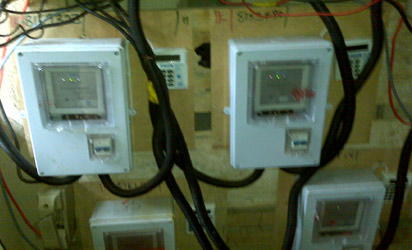
File: Prepaid meters
By OSCARLINE ONWUEMENYI
Just a few months after the Nigerian Electricity Regulatory Commission, NERC, announced a new Multi-Year Tariff Order, MYTO, the Commission is now seeking the removal of the Meter Maintenance Fund, MMF, which could reduce the monthly tariff paid by consumers across the country.
The introduction of the new MYTO led to a “slight” increase in electricity tariff charged by the Power Holding Company of Nigeria, PHCN,
According to officials of the Commission, the Distribution Companies (DISCOs) no longer have justification for charging the maintenance fee since such a charge is adequately covered by the MYTO review. The removal is meant to be reflected in the October 2011 bill, which is usually presented to customers in November.

Prepaid meters
The MYTO review in July was met with protests in some quarters due to the poor state of electricity supply in the country. Many claimed that the resultant hike would further worsen the economic gloom of Nigerians. NERC officials, however, argued that the review was long overdue since it had been proposed by the previous administration.
Before the review, DISCOs were permitted to charge certain fees including the Meter Maintenance Fund, which were aimed to help them shore up their limited funding. However, the latest MYTO review appears to have taken care of such funding, making any additional charge a burden on the consumers.
In an interview with Sweetcrude, the Chairman of NERC, Dr. Sam Amadi, sympathised with electricity consumers while noting that there has been little or no difference in the state of power supply in the country since the power reform was initiated by the Chief Olusegun Obasanjo government in 2005.
Amadi explained that the Commission was in the process of consulting with stakeholders over the need or otherwise to increase electricity tariff in the country. He urged stakeholders to be objective over the review process, noting that, “Public power supply in the country is still a standby in most homes and offices, as it was in 2005 when the reform in the sector began.”
He added that, “The state of electricity generation in this country is so terrible that one patriotic duty of every Nigerian is to speak strongly and critically about what needs to be done to review the situation. To us at the Commission, there cannot be a better time than now to put issues plaguing the sector back on the front burner. It comes as the Federal government is on the verge of divesting sole ownership and control of successor PHCN companies to allow private equity and management in line with the spirit of the Electric Power Sector reform Act, 2005.”
According to Amadi, the general belief in the electricity sector is that current MYTO prices cannot support investments therein as they are much lower than in most developing countries. He added that market imperfections as low generation capacity, low private sector participation, high and unprecedented operating costs and overheads still abound in the industry.
But he further noted that, “As daunting as these challenges seem, we cannot give in to these frustrations if we must succeed. We must confront the pricing challenge while taking into consideration the prevailing economic situation of our country folk.
“For the avoidance of doubt, there is no guarantee whether the tariff will go up or down. It is the outcome of this consultation that will determine where the electricity tariff goes.”
Amadi insisted that all over the world, prices have played a dual role in achieving efficiencies in the distribution of goods and services to consumers and in driving private investment into the economy. “Therefore, if we must achieve the goal of giving every citizen access to stable, reliable and fairly-priced electric power, a reliable and sustainable framework must be put in place to ensure the robust interaction of market forces with social policy to attain equilibrium.
“This we can do by establishing a pricing regime that will sustain massive private sector investment and guarantee a positive return on investment, while also being fair to underprivileged consumers.”
The NERC boss observed that prior to the introduction of MYTO, the industry was characterised by lack of a transparent price determination process and abysmally low tariffs, adding that the PHCN-fixed government-determined tariffs mostly based on the political whims and considerations as opposed to the economic principle of full cost recovery.
“This promoted inefficient pricing of electricity and constrained the ability of government itself to recoup costs of investment. This ultimately undermined the growth potentials of the sector because it totally distorted the economics of the electricity and deferred private sector participation until now,” he stated.
He explained that “MYTO provides for periodic review of the cost parameters through the minor (annual) and major (five-yearly) review windows. The annual review of the framework takes into cognizance changes in gas price, inflation and exchange rates while the major review considers holistic changes in major parameters.”
However, he pointed out that despite the attributes of MYTO, “the market is yet to become robust. The market has failed to achieve optimum efficiency and milestones as envisaged by the Commission. The much needed private sector investment especially in the distribution sector has not materialized.”
Disclaimer
Comments expressed here do not reflect the opinions of Vanguard newspapers or any employee thereof.