By Gabriel Ewepu and Favour Ulebor
AHEAD of 2023 general elections, political parties, Wednesday, called for true federalism and restructuring of Nigeria.
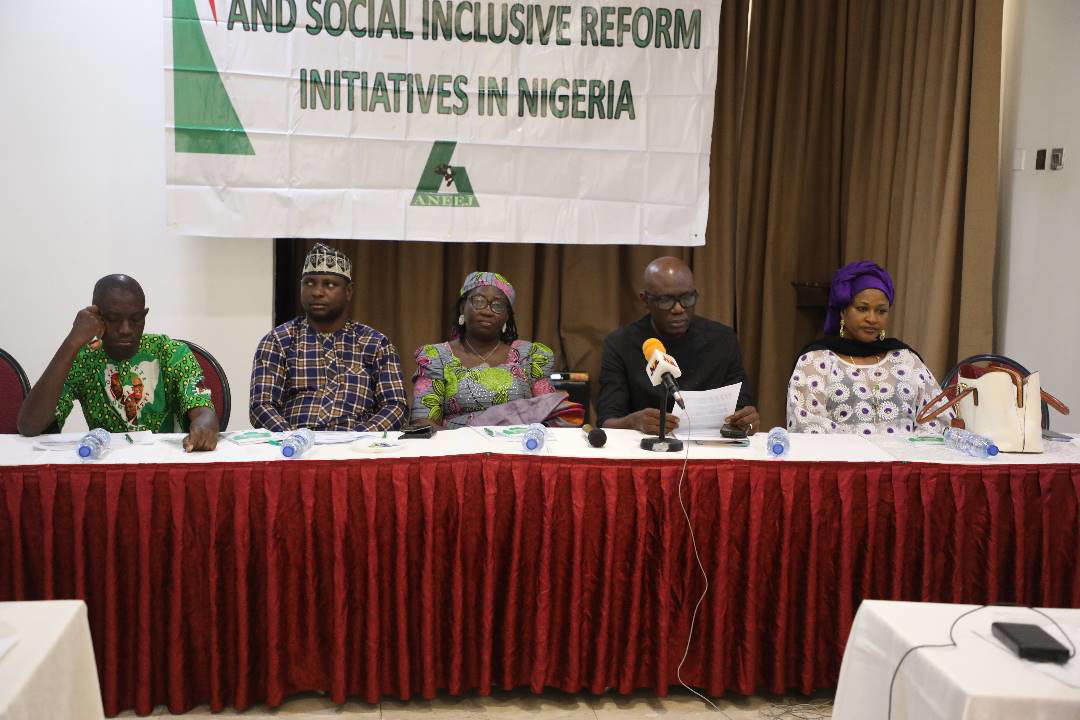
They made their position known during a town-hall meeting organized by African Network for Environmental and Economic Justice, ANEEJ, with support from the United States Agency for International Development, USAID, and Palladium.
The parties at the event included New Nigerian Peoples Party (NNPP), Allied Peoples Movement (APM), Labour Party (LP), Action Alliance (AA), Young Progressive Party (YPP) and Accord Party (AP).
The National Woman National Leader of NNPP, Dr. Maryam Bello Yasin, said restructuring is needed for inclusive government.
Bello said, “Of course, we need the dialogue, we will sit down together and discuss, negotiate, see the reality on ground and then we call from each state.
“They will be represented, there will be a dialogue, discussions, negotiations on how to run the country together. Because it is going to be an inclusive government.
“It all depends on what you mean by restructuring. Do you mean restructuring by division? We are not going to be divided, Nigeria is one; to keep the task of Nigeria, must be one, there is no lie about it, we love our self. It is the politicians that are saying all lot of nonsense about restructuring to create division.
“They don’t mean anything good for us, those ones that have had this government, they had opportunity to do it. We need to salvage Nigeria because all of us own it, we are not leaving it to anyone”
The Deputy National Chairman of APM, Rose Gyar, said her party would make systems and process work, to institutionalize the operations of every facets of Nigeria.
“APM has seen that the country is made up of more strong individuals; so what APM is bringing to the table, to make systems and process work is to institutionalize the operations of every facets of Nigeria.
“People are clamouring for restructuring because of exclusion, once you institutionalize the systems, it’s a natural thing.When you engage with the process, you yourself will know, whether you fit into the process or not.
“And of course it’s not just about eliminating mediocrity but creating a platform where such people can be groomed and strengthened to be able to have another opportunity”, Gyar said.
Meanwhile, National Chairman of Accord Party, Mohammed Nalado, said that the interest of the majority must be followed.
“Our agenda is to follow the interest of the majority. It’s only when you come to power; no President can tell you he wants to do certain policies, most especially that which affects the constitution.
“The President cannot do it alone, whoever comes in will come with the interest of the majority of Nigerians.
“That is why we fielded a very young and vibrant person to be the presidential candidate of our party because if you go by the record of Nigeria, If you go by the history, it was the youth of those days that fought for the independence of Nigeria and it was the youths that put all the structure we are seeing today, that built Nigeria.
“Let us get someone that is very young that will follow the Interest and wishes of Nigeria, so that we can move Nigeria forward”, Nalado added.
Earlier in an address of welcome, the Deputy Executive Director of ANEEJ, Leo Atakpu, said the programme aimed to secure commitment of political parties on anti-corruption for the 2023 general election.
According to Atakpu the project seeks to promote and engage in anti-corruption policy reforms at both the national and sub-national levels with an ultimate goal of strengthening governance to deliver development goals to citizens, particularly in addressing poverty and inequality amongst the people.
Atakpu said it also aimed at contributing to the eradication of corruption in Nigeria.
“This meeting is being organized under the Enhancing Anti-corruption and Social Inclusive Reform Initiatives in Nigeria project being implemented by ANEEJ and its eight partners as part of the Strengthening Civic Advocacy and Local Engagement (SCALE) project of Palladium and its resource partners which is funded by United States Agency for International Development (USAID).
“The SCALE project is a 5-year project being implemented by Palladium and its resource partners with funds from USAID. It is designed to enhance local civil society organizations’ ability to be positive and responsible change agents in Nigeria.
“The Enhancing Anti-corruption and Social Inclusive Reform Initiatives in Nigeria project is designed following the anchor cluster model adopted by Palladium to promote and engage in anti-corruption policy reforms.
“The Africa Network for Environment and Economic Justice, ANEEJ received grant as one of the anchors of the SCALE project working with eight cluster member organizations spread across six states and the Federal Capital Territory.
“The States are: Abia, Edo, Delta, Imo, Ondo, Rivers and the FCT, Abuja. ANEEJ is working with the eight cluster members located in these states including the FCT to implement and deliver this project.
“The cluster organisations are: 21st Century Community Empowerment for youth and Women Initiative, Abuja; Community Empowerment and Development Initiative (CEDI), Warri, Delta State; Community Heritage Watch for Development Initiative, (KAI) Akure, Ondo State; Christian Fellowship and Care Foundation (CFCF), Owerri, Imo State; Foundation for Environmental Rights, Advocacy and Development (FENRAD), Aba, Abia State; Gender and Development Action (GADA) Port-Harcourt, Rivers State; Joint Association of Persons with Disability (JONAPWD) Edo State Chapter; and New Apostolic Church Centre for Development (NCD), Benin City, Edo State.
“Together, we consider this project as an important one that seeks to promote and engage in anti-corruption policy reforms at both the national and sub-national levels with an ultimate goal of strengthening governance to deliver development goals to citizens, particularly in addressing poverty and inequality amongst our people.
“It is also aimed at contributing to the eradication of corruption in Nigeria.
“The project is also designed to address reform issues within the development commissions set up to develop the Niger Delta region such as the Niger Delta Development Commission (NDDC) and the oil and gas producing areas development commissions in Abia, Delta, Edo, Imo and Ondo”, he said.
Meanwhile on the restructuring debate, he said, “Restructuring has been given all type of interpretation; I have heard of people who talked about devolution of powers, because there is so much concentration of power at the center. So for me my understanding of what restructuring should be is that the center should be made less attractive in the next dispensation.
“They should divulge power to the various states and then states that are not viable can be merged with the others. You can merge two states together, in such a way that the federating states can also contribute to the center.
“For instance the center has no business with education, everyday students are held ransom because ASUU is on strike, devolve all these powers.
“What business does government have to do with water resources? They can concentrate on national security and then allow the states to function effectively and that way they will reduce all these unnecessary competition of who wants to be President of Nigeria.
It will also stop this act of laziness where everybody wants to collect government contract to survive.
“That will bring about the revival of the economy in such a way that those states that are federating will now be in a position to begin to boost the economy of their states.
“There will be employment, there will be job creation, and then there will be food sufficiency because right now there is no food sufficiency. We are still depending on Ukraine that’s at war to get grace to feed our people; that tells you how we are backward in this part of the world.
Disclaimer
Comments expressed here do not reflect the opinions of Vanguard newspapers or any employee thereof.