.
By JideAjani, General Editor
Perhaps, everything revolves around the economy.
There are those who still debate which one engenders the other, economic development or political stability? In human affairs, something must always lead to the other. Any economic growth, without the necessary political stability, can never be sustainable.
Therefore, whatever solutions are proferred with a view to creating a pathway for Nigeria’s economic growth, the essence of sustainability remains imperative. And that is the crux of the matter.
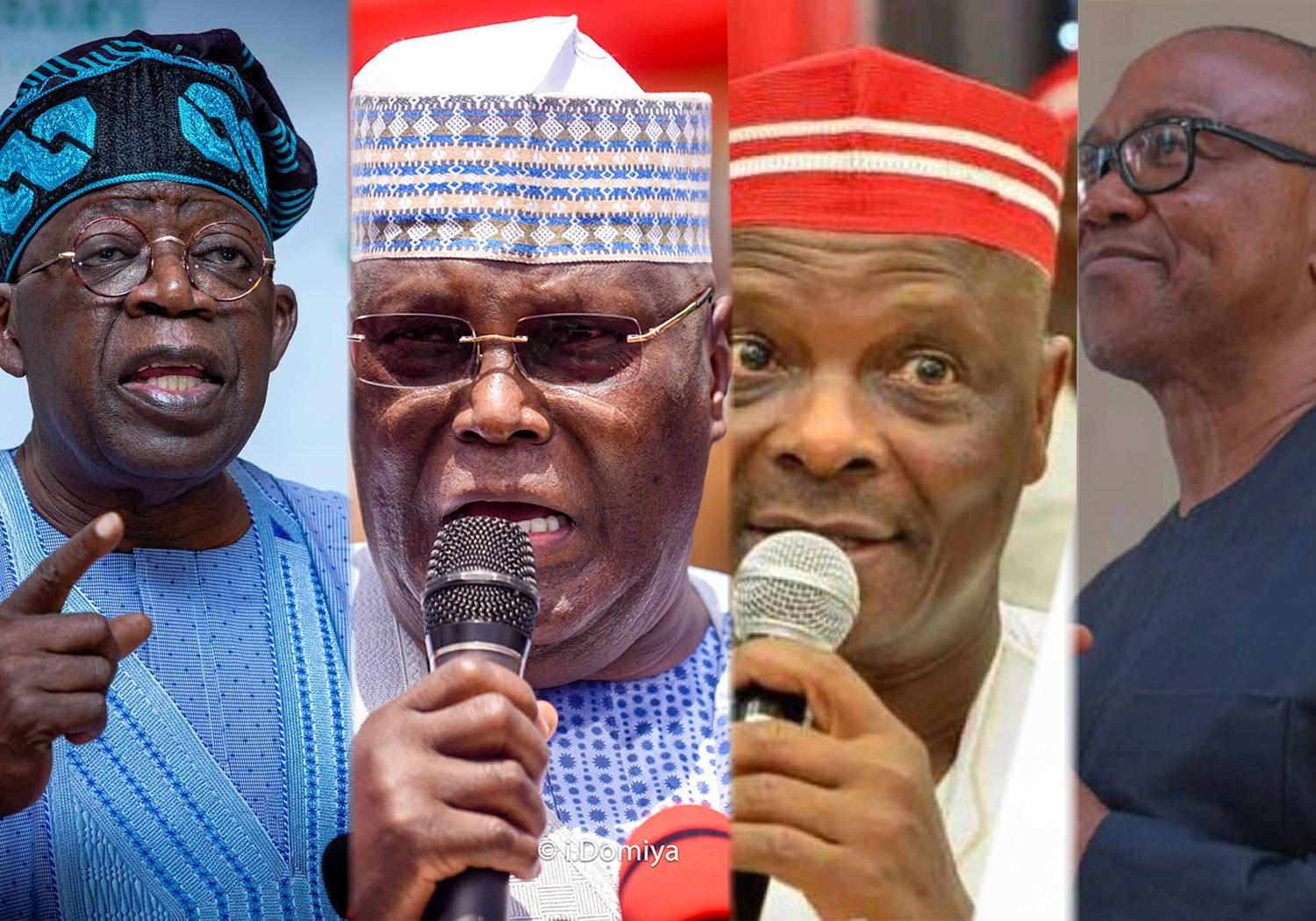
In Nigeria, since independence, there has been a plethora of policy documents which, given the required effectuation, should have catapulted Nigeria to olympian heights of economic growth. But something almost always gives. Is it in the power and steel sector? Or the oil and gas? Or industrial policy? Something always throws a spanner in the works. And that is the inability of successive administrations to engage the sustainability mode. Condisdered as a country with “the least competitive economy in Africa with very low total factor productivity (TFP) and export competitiveness index (ECI)”, there is much work to be done. So, when the four leading presidential candidates in next year’s election take on any and everything economic in their manifestos, with commitment and pledge to turn the Nigerian economy around for the better, their sentiments should be understood.
General commitment to deliver
Atiku Abubakar, the Peoples Democratic Party, PDP, presidential candidat,e says his “Agenda is guided by three basic principles: (1) Re-affirm the criticality of private sector leadership and greater private sector participation in development; while repositioning the public sector to focus on its core responsibility of facilitation and enabling the appropriate legal and regulatory framework for rapid economic and social development.
(2) Break government monopoly in all infrastructure sectors, including the refineries, rail transportation and power transmission and give private investors a larger role in funding and managing the sectors, thus emulating the benefits accrued in the oil & gas and telecoms sectors.
(3) Allow the market greater leverage in determining prices. This way we shall eliminate the persistent price distortions occasioned by the current interventionist exchange rate management policy. Government intervention, where absolutely necessary, will be done responsibly and judiciously.”
The agenda is hinged on his five
point agenda to Restore Unity in Diversity, Ensure Safety and Security of life and property, Build a dynamic economy for prosperity, Re-structure the policy to foster unity and stability, and Provide qualitative education”.
For Rabiu Musa Kwankwaso of the New Nigeria Peoples Party, NNPP, he says Nigeria is at a consequential crossroads and generally insist that ”After 16 years of PDP and 8 years of APC leadership resulting in persistent insecurity, unprecedented economic crises, mass unemployment, increased poverty and destitution, growing and uncontrolled inflation, collapse of social services including education and health services, increased corruption and graft, and increased mistrust and division, the Nigerian citizens are dissatisfied and disappointed and are yearning for a positive change. The choice in 2023 General Elections is clear: A New and Better Nigeria that the NNPP is poised to put in place or the continuation of the status quo.”
Kwankwaso then goes ahead to declare that he will restore fiscal discipline. ”To achieve this”, he says, “the size of FG recurrent expenditure needs to be immediately reduced, which, along with measures to improve revenue, will bring down the level of deficit. This we have achieved in Kano State where we reversed the capital to recurrent ratio of 30:70 in 2011 to 65:35 in 2014.”
The Labour Party candidate, Peter Obi, says the ”vision is a secure, united and prosperous Nigeria that works for everyone and that realises the hope of black people of the world as a city on the hill. Shift emphasis from consumption to production by running a production-centered economy that is driven by an agrarian revolution and export-oriented industrialization”.
Introducing the concept of macroeconomic restructuring, Obi says ”the following anomalies in the management of the macroeconomy have progressively plagued the Nigerian economy: The pursuit of multiple objectives by CBN, some of which appeared to be in conflict with the Bank’s core mandate; The loss of fiscal viability by the Federal Government, as revenues are now consumed entirely by debt service; The financing of excessive fiscal deficits through Ways and Means Advances; Exchange rate stability has also become a mirage, as foreign exchange can only be accessed at the artificial official exchange rate by a handful of privileged persons and businesses; The prevalence of repatriation risks and other supply side constraints have significantly dented investor confidence, whilst also encouraging capital flight.”
For Bola Tinubu of the All Progressives Congress, APC, he adopts the approach of prosperity viz: “Review Federal Budgetary Methodology Budgetary custom which bases our annual budget and fiscal policies largely on the dollar value of projected oil revenue. Not only does this practice artificially restrict the Federal Government’s fiscal latitude, it also unduly attracts the nation’s attention towards a single source of fiscal revenue to the detriment of others.
To achieve optimal growth in the long term, we must wean ourselves from this limitation. A more efficient fiscal methodology would be to base our budgeting on the projected level of government spending which optimizes growth and jobs without causing unacceptable levels of inflation.
As part of this prudent growth-based budgeting, we will establish a clear and mandatory inflationary ceiling on spending. However, we must break the explicit link between naira expenditure and dollar inflows into the economy. National Infrastructure Campaign; Import Substitution; Tax Reform; Fight Corruption, Inefficiency and Waste in Government; and Optimisation of Government Revenue”, are areas he wants to either improve on or introduce.
Now, for any economy to attain growth, certain things must be in place. Among all the factors, power remains key in any pursuit of industrialisation; presence of critical infrastructure to drive growth; and an educated and productive manpower.
Multi-sectoral solutions: Power
So, what is the position of these candidates in revamping Nigeria’s economy tackling the power crisis?
We start from Tinubu: In his ‘way to a brighter Nigeria’, the APC candidate acknowledges Nigeria’s growth continues to be stifled by the structural constraints of the power sector. At present, the nation has approximately 12,000MW of installed capacity, generates only 8,000MW and is only able to distribute a maximum of 4,500MW to consumers. Our economy is, accordingly, constrained by our inability to generate, transmit and distribute power efficiently.
Indeed all the candidates agree on this point. Tinubu says he will engage the Generation and Transmission Targets, Eliminate Estimated Billing, Support For Domestic Manufacturing of Electricity Meters, Renewable Energy Plan, Rural Electrification, Power Sector Governance Reform and Nigeria First Power Policy.
Obi’s power solution will tackle the issue of transmission, generation and distribution.
In a bold, revolutionary declaration, he says his administration will successfully complete the $2.3b Nigeria-Siemens network improvement deal (technical upgrade and strengthening) to achieve 7,000MW stable capacity by 2023, 11,000 megawatts by 2024, and 25,000 megawatts by 2025, launch a solar power revolution across Nigeria, particularly Northern Nigeria, with a view of ensuring that all cities and industrial parks in Northern Nigeria have uninterrupted power by the end of 2024. Within 3 years, each of the southern states should develop and construct embedded power plants of capacities ranging from 5MW to 30MW up to a total of 300MW per state from locally-sourced gas in and around the states.
We will develop 100,000 mini-grids across the country by the end of 2024 which will provide a reliable power supply for up to 750,000 rural SMEs; provide uninterrupted power supply in all federal universities and university teaching hospitals; support the private sector to deploy 15 million solar standalone systems for residential and SMEs use by end of 2025.
Kwankwaso’s solution is goal is to generate, transmit and distribute 20,000MW of electricity by 2023 – 27. Specifically, the overall target for our administration is to increase electricity generation, transmission and distribution from less than 6,000MW capacity currently to 15,000MW- 20,000MW by 2027; and make significant investments in distributive power and alternative energy technology such as developing coal and other renewable energy sources (like Solar, Wind, Hydro and Biomass).
Atiku says his “goal shall be to double our infrastructure stock to approximately 70% of GDP by 2030. This quantum leap would require a commitment to invest a minimum of US$35 billion annually in the next 5 years to ûnance all the core public infrastructure projects. We envisage this will come substantially from the private. 25,000 MW – Target Power Generation Capacity mix of non-renewable energy (hydro, solar, nuclear) and other thermal fuels (coal, biofuel) in addition to natural gas. 10,000 15,000 MW – Transmission Capacity over the Short-Term. Target 25,000 MW over the long-term.” He says “power sector reform will be a critical policy priority” and that “by 2030, Nigeria shall make giant strides in diversifying its sources of power and delivering up to 25,000 MW”.
Making thingswork
Atiku then promises that his economic agenda will seek to alter the current trajectory of the Nigerian economy and: Build a competitive, and resilient economy and remain the largest in Africa and 15th largest globally with a GDP per capita raised from the current levels of approximately US$2,000 to US$5,000 by 2030. Achieve inclusion: An economy that provides opportunities for jobs generates incomes and lifts the poor out of poverty. Africa’s leading FDI destination. Processed goods 25-40% of total exports. The stock of Infrastructure 65% of GDP. The refining capacity of 2m barrels of crude. 3 million new jobs, 10 million poor lifted out of poverty annually.
Per Capita GDP raised to US$5,000. Manufacturing: 30%of GDP. We envision a new Nigeria without crude oil in which agriculture, manufacturing and MSMEs shall be the growth drivers. Specifically, A fast- growing and productive non-oil sector economy with strong linkages amongst key sectors notably agriculture, manufacturing and MSMEs to strengthen the productive base of the economy.
Intersectoral linkages must be created for resilience and sustainability; a commercially driven, technology-proûcient and competitive agriculture that will ensure food and income security for a growing population and contribute significantly to Nigeria’s quest for economic diversiûcation and export of non-oil commodities; food security index to improve to 70% from current 40.1%. Food import share in total import is currently estimated at 20% to reduce to 5-10%; a manufacturing sector that is competitive, nationally, and globally, looking inwards to promote value-addition.
This development will be key to reducing informality among MSMEs and to linking the rural primary economy to that of the city; a dynamic oil and gas sector that is fully integrated into the economy through linkages with agriculture, manufacturing and MSMEs; a knowledge-based economy with wide application of ICT in health, education, commerce, agriculture and industry.
For Tinubu, his economic blueprint, in broad terms, seeks “to achieve optimal growth in the long term”, with a view to focusing on or building the following:
National Infrastructure Campaign, Import Substitution, Tax Reform, Fight Corruption, Inefficiency and Waste in Government and Optimisation of Government Revenue”. The Monetary policy “must focus on the exchange rate, interest rate and price levels. This trio must serve the objective of fiscal policy, which is broadly shared prosperity; our fiscal strategy is to spend public money in a way that maximises employment of people and resources, especially those previously idle”.
He also plans to improve Exchange Rate Management, Inflation Targeting and Management, and Limit Foreign Debt Obligations. To grow the economy, Tinubu’s manifesto proposes an industrial development plan. In the agriculture space, he says, ”we shall continue the (Buhari) progress by enhancing agricultural productivity, agro-allied industry, food security and farm incomes.
To achieve our goals, we shall pursue the following initiatives: Commodity Boards, Grain Reserves and Food Storage, Rural Infrastructural Development, Irrigation and Water Catchment, Farm Cooperatives, Access to Finance and Large-scale Land Clearing. He also plans to introduce reforms in the oil and gas sector, while doing the same in the health, education, transportation and housing spheres; just as he plans to harness the potential of a digital economy for sustained growth.
Obi plans to “functionally redesign our fiscal architecture such that revenue mobilisation and allocation will be bottom-up like most federations across the world, and the federal government will now rely on revenues from taxes collected by states to drive the right incentive for efficiency and optimal allocation of resources.” That is not all.
He proposes to ”leapfrog Nigeria into the 4th Industrial Revolution (4IR), through the application of scientific and technological innovations to create a digital economy; build expansive and world-class infrastructure for efficient power supply, rail, road and air transportation, and pipeline network, through integrated public–private partnerships, and entrepreneurial public sector governance; and enhance the human capital of Nigerian youths for productivity and global competitiveness through investment in world-class scholarship and research, quality healthcare, and entrepreneurship education.”
In a bold move, he proposes an ‘hourly national minimum rate’ which will ensure that people get paid based on the hours they put in; and to cut waste, he proposes equal pay for politicians and civil servants through his Common Regimentation Emolument Structure Table, CREST’. He, too, makes a pledge to tackle the exchange rate issue, debt overhang.
Kwankwaso believes that a reformation of Nigeria’s tax system is necessary. He says ”the current 30%, plus 2.5% education tax, plus 1% NITDA tax and 0.25% NASENI tax means some firms, such as banks and telecommunication firms, have a tax rate of 33.75%, one of the highest in the world, making Nigeria uncompetitive for business and investments and also encouraging tax evasion.”
To tackle this, he plans a “Reforms in key revenue generating agencies; improve crude oil and gas production; deal with foreign exchange policy; target inflation; improve trade, investment and the business environment; while at the same time preventing corruption. With this, he projects the following macroeconomic stability, strong and credible financial institutions, a healthy economy, a productive and career-driven youth, ending endemic poverty, new businesses to sprout, a fertile market for business, a functional and result-driven oil & gas industry, a diversified economy, strong enough to absorb unexpected shock, the next industrial hub and unlimited opportunities”.
Time is running out
On Friday, December 17, 2010, Tarek el-Tayeb Mohamed Bouazizi, set himself on fire in Sidi Bouzid, Tunisia, ”in response to the confiscation of his wares and harassment and humiliation inflicted on him by a municipal official and her aids”.
This set off the Arab Spring of 2011. Why is this important to this discourse? It is because Nigeria’s economy has been shrinking, with over 133 million people living below the poverty line and the attendant hardship continues to create consequential challenges in every sphere.
There have also been stories of suicide in Nigeria, occasioned by the inability of some to meet economic demands.
This is why time seems to be running out and the economic blueprint of the leading candidates is vital to a possible revamping of the Nigerian economy.
In WHY NATIONS FAIL, THE ORIGINS OF POWER, PROSPERITY AND POVERTY, by Daron Acemoglu and James A. Robinson, we are made to understand that ”inclusive economic institutions that enforce property rights, create a level playing field and encourage investments in new technologies and skills are more conducive to economic growth than extractive economic institutions that are structured to extract resources from the many by the few and that fail to protect property rights or provide incentives for economic activity.
Inclusive economic institutions are in turn supported by, and support, inclusive poitical institutions, that is, those that distribute political power widely in a pluralistic manner and are able to achieve some amount of political centralisation so as to establish law and order, the foundations of secure property rights, and an inclusive market economy.
Similarly, extractive economic institutions are synergistically linked to extractive political institutions, which concentrate power in the hands of a few, who will then have incentives to maintain and develop extractive economic institutions for their benefit and use the resources they obtain to cement their hold on political power”.
Therefore, creating wealth for all and revamping Nigeria’s economy, can only be achieved if there is elite consensus in that direction, no matter how well-packaged the manifestos of the leading candidates are.
TOMORROW:
Security: The leading candidates agree on the need to have a secure nation. However, the security challenges in Nigeria require political will and a determination to be patriotic. What are the candidates putting on the table?
They have all presented similar solutions but theoretical concepts do not a solution wrought. Will they have the will to confront the monster of insecurity? Read their suggestions tomorrow.
Disclaimer
Comments expressed here do not reflect the opinions of Vanguard newspapers or any employee thereof.