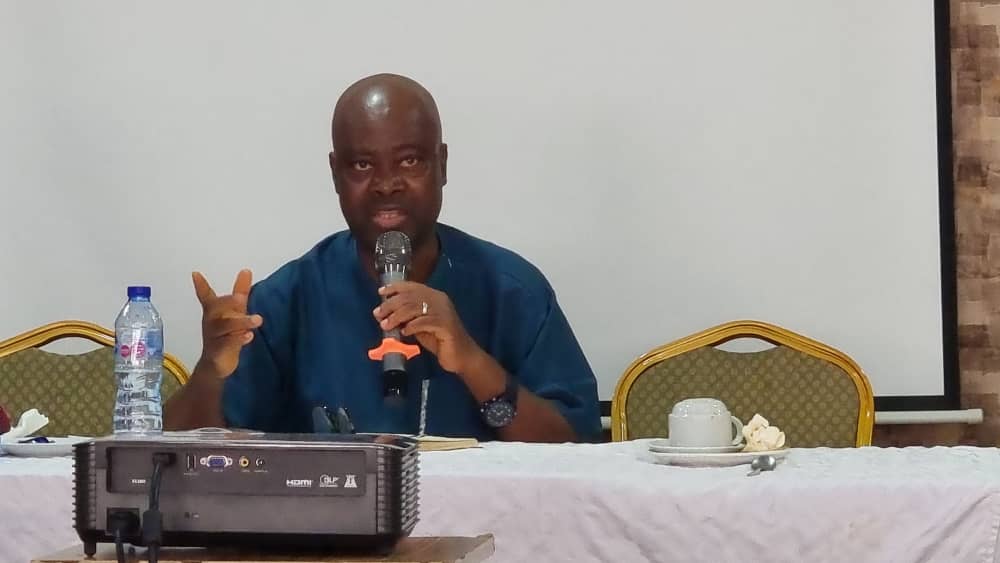
By Gabriel Ewepu, Abuja
In this this interview, the Executive Director, for Environmental Rights Action/Friends of the Earth Nigeria, Chima Williams, and also a member of the International Legislative Committee of Friends of the Earth International, and the 2022 Goldman Environmental Prize winner, the Green Noble Prize for Africa, spoke with Vanguard exclusively on why Nigeria needs to speak with one voice in tackling polluters.
Excerpts:
In southern Nigeria, Ogoni land and other places, and in the northern part of the country, mining has degraded and devastated so many States, what is your organisation doing really to actualise remediation?
I think concretely, to a certain point, this question is purely for Nigeria, it is not for COP and if Nigeria thought it well, possibly other African countries can take queue from there.
Now what can we do differently, first is that it we take the courage and independence of the regulatory authorities to start with, who will identify and agree with the damages and destructions that are caused by these negative operational conducts of both the petroleum and mining sector operators and of course, I like using the word extractive operators because extractive does not only start and end with petroleum and mining because every Nigerian community has one sort of extractive resource or the other.
And extractives includes petroleum, solid minerals, water, timber, land itself is resource that is why we have land grabbing and then under solid mineral we just have as we heard today over 30 different of solid mineral resources including sand, granite and the sands that comes from shore drilling and silting, when we take our sharp sand from the river, it is an extractive resource.
But people think when you talk about extractive resource, where people’s mind centres on is petroleum, oil and gas and the solid minerals, gold, coal, granite, limestone and the rest.
First is the various regulatory authorities coming together to work together to look at issues of extractives and then have a courageous and independent way of relating with operators and ensuring and guaranteeing that it is only licenced operators whose activities can easily be monitored and regulated and who can be held to do the right thing and pay, whether it is royalty, tax, whatever it is and pay it accurately.
And in this, of course we know there are still the artisanal miners that operate, those artisanal miners should be registered, recorded and identified so that we are able to at one look see the illegal miners and once we begin to address that, we begin to sanitize the sector, that is one thing that has not been happening, that can happen to bring these issues to a different kind of handling.
Then secondly, is that as I always say it, no one person is able to achieve everything and what I teach my colleagues both at national and international level is that if you must face the multinationals, you must be multinational in your own dimension, in your own approach, in your own design, in tour own operations.
So this brings me to, they should be a decided concerted conscious effort of having an integrated partnership between the government and government agencies, civil society and civil society group, community organisations, community leadership, state and local government structures including federal government because none of us can do it alone.
Once those kind of strategic partnership and alliance building is created, where we have this structure, where all of us bring our ideas, our knowledge, our professionalism, our expertise and then forget about territorial protection and when we talk about Nigeria as one community then we will be able to identify where the challenges are and suggest processes and opportunities that exist and processes towards actualizing the opportunities and recreating or changing the narrative in the challenges, that is the second.
Then the third is that my experience have shown, our experience have shown that certain things that are not possible to change politically, can change through litigation.
But in this, we have to look at what are the possible options of litigation, there are two; they could be national litigation and then they could be international litigation and that will still dovetail to the partnership that I talked about.
If there is a concerted litigation for instance it just happened in the BP case in the US where the national government was interested working with everybody and leading.
If the national government of Nigeria becomes interested and then working with everybody not working to compromise Nigeria, not working sabotage Nigeria but working for the progress and good of Nigeria and Nigerian citizens.
Of course the corporate that operate in Nigeria, if they do well, they are Nigerian citizens, so we want them to be good corporate citizens to benefit from the abundance that Nigeria has to offer.
Nigeria resources is like the elephant and as Ghandi said, “the sky is large enough to accommodate all our needs but not big enough to accommodate our greed”; so it is only when people become too greedy that they lose out.
So if we have such synergy, any erring company whether multinational or national or domestic, can be brought to account before the law court, either in Nigeria, which is the host country or in their various home countries and that can help in also changing the narratives and changing the course and direction of things.
Your organisation is involved in a campaign on the divestment that oil companies in the Niger Delta region, what influenced this?
What influenced this is the fact that we know that our work may have forced the oil majors to start doing wholesale divestment offshore and then investing deep onshore and the shallow waters.
Why do I say this? We have been doing all manners of campaigns for good operational practices in terms of management of by-products of operational activities of the multinationals which includes the negative land which is oil spill, gas flaring and the rest of them.
And we had in 2005 secured a judgment that ordered Shell to end gas flaring in Iwerika community in Delta state and because that judgment was hinged on constitutional violation, so we transpolate that judgment to mean end gas flaring in Nigeria because the constitution does not apply to people differentially, it applies to everybody in Nigeria one and the same way.
So steering from that success even though gas flaring continues, we moved to the next level which is the home country litigation and we dragged Shell before their own home country court in the Netherlands and then litigation processes commenced.
Out of the three cases that we took, we lost two at the high court level and we appealed against those two judgments, Shell lost one, at the high court level they appealed against it to the court of appeal.
And in January 29, 2021 the court of appeal in Hague upturned the lower court decision in the two cases that Shell won at the lower court and agreed with us that Shell was in the wrong or at least to an extent there were negligent in their duty of care to the victims.
So from that judgment of 29th of January 2021, we think it spurred the UK Supreme Court, who delivered a similar favourable judgment or ruling in 12th February 2021 in favour of some Ogoni communities.
And then now possibly that emboldened the Nigerian judges and justices too that between that January 29 2021 to I think around March or thereabout or January thereabout of 2022, the court in Nigeria have made a resounding judgments in terms of our monetary awards against multinationals in favour of small communities in the Niger Delta including giving a favourable judgment to the federal government of Nigeria against Mobil and the rest of them.
So now, we now reviewed and looked that our case is the foundation of this, when the oil majors now began to now talk of, of course we know that divestment process has been on for over a long period of time but it’s been asset divestment, portions of facilities divestment but from after January, February, it became an issue of wholesale divestment, they were divesting totally, selling off everything that we have onshore and then they are going deep offshore where they think Nigerians don’t have the resources, the capacity to look at what they are doing.
And now, with already the successes recorded in litigation it is going to open up more vistas of opportunities for communities to drag them to court; In order to run away from those futuristic possibilities, is for them to say we are divesting to live their legacy, negative environmental footprints in our communities to run away.
So when they have divested, you come after them, they will tell you, well, he who buys asset buys liabilities, so we are no longer the operators.
So spurred by this, we needed to alert Nigerians on the real reasons why the multinationals are divesting and the things that we need to do as victims of their over 50years negative operational practices and then what government of Nigeria should do to make sure that they don’t run away without putting us back to the way we were before they came.
At least, if they cannot make our lives better, they shouldn’t make it worse. They have taken the profits, and it is time for them to plough back part of those humongous profits that they have made out of our sufferings to restitute the victims and recover our environment for us to continue to use it for what we used to use it for fishing and farming activities.
So this is what informed our opening up the vista on the divestment discourse so that Nigerians will understand the lies of the corporations who are divesting and equally to warn our domestic oil companies that want to invest in this divestment process, conduct your due diligence, be on the alert, make sure that the facilities you are buying is not problematic, is not the one that will create problems for you immediately before you start operation because at the end of the day, if that happens, Nigerians are the total losers as we have seen.
So you mean you have been engaging them?
We tried to engage everybody in that direction so that we all see and of course the fire has been caught by most civil society groups and community groups who now after following us on the divestment discourse now are expanding the divestment discourse and applying the principles that we have laid for them in their own work even in engaging the multinationals that are on ground on their communities who is telling them about divestment to ask the critical questions necessary for everybody to be on the same page.
So this is what informed us into leading the divestment discourse and we are happy to say that the fire had been caught, even though the government is not telling us it is because of our divestment discourse and our suggestions to them.
We are not saying that you cannot divest, no, you can but do the necessary things first. If you want to go as I have always said it, if you want to go in the name of divestment, well, if you cannot do what Nigerians are asking for so that you will be a good corporate citizen and then you think that you want to pack your load and go home, we would be glad to say bye-bye but we are not telling you to pack your load and go home, we are telling you do the right thing at the right time and within the right place.
The way you will operate and do things in your home country so that you would be applauded as a good corporate citizen, do same here in Nigeria, nobody is a lesser human being than the other, we are all equal, so long as we are human beings we are equal in humanity; so our humanity must be respected, our dignity must be respected and the sanctity of our human persons must be respected by whoever and there is no compromise for some of us on that.
If you do not respect that, then you are an enemy to this country and her people and you should be treated like an enemy because once you place profit before humanity then you are no longer a human being and there is no company that operates without human beings.
So if you consider yourself a human being and then you don’t consider your neighbour as a human being, God will never be happy with you.
Disclaimer
Comments expressed here do not reflect the opinions of Vanguard newspapers or any employee thereof.