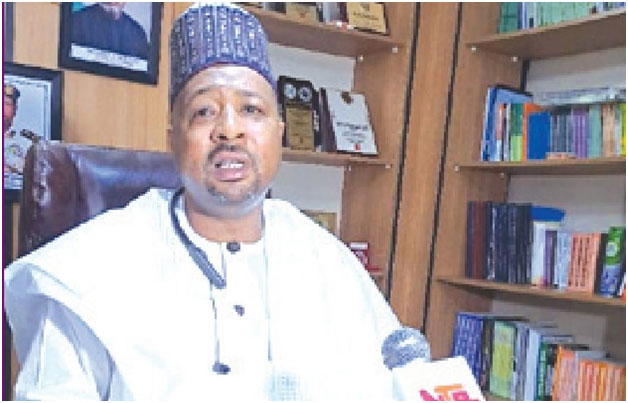
Dr. Yakubu Mohammed Baba is the registrar and chief executive officer of the Environmental Health Officers Registration Council of Nigeria, EHORECON, an agency under the Federal Ministry of Environment that sets standards for environmental health professionals in the country.
In this interview with Soni Daniel and John Alechenu, Dr. Baba discusses the agency’s efforts to improve environmental health and reduce common ailments in Nigeria. Excerpts:
AS the legal body charged with the responsibility of regulating environmental health standards in Nigeria, how has the job progressed with Nigerians?
For the sake of clarity, let me start by saying that the Environment Health Officers Registration Council of Nigeria was first established in 2002, and due to the dynamic nature of the practise of environmental health, President Muhammadu Buhari, in his wisdom, amended the law on August 6, 2022, to give the agency more relevance, a stronger legal framework, and to strengthen the regulation of environmental health in Nigeria.
Basically, when you look at the legal framework provided by government, as far as the regulation of standards of practise is concerned, I think we are up to date, and the onus now lies on us, the regulator, to really see how we can implement this law to the letter. The first legislation that guided our operation had a lot of lacunae because it only gave the council teeth, but we could not bite.
But with what we have now, we have the teeth, and we can also bite. That is why we started in earnest with the training of practitioners, because we have to get it right from a training perspective as part of our genuine effort to effect the required professional change in the country.
As part of that change, we have started litigating against 93 illegal colleges of technology that are training manpower at the grassroots, and we want to follow up on that litigation to the letter.
Our next course of action will also include ensuring that those who practise are subject to regulation in order to meet the necessary standards of the practice. For example, there are so many people who are into public health pest control now but have no idea what the profession entails or the residual effects of the fumigation they go about doing in the community.
Some of the chemicals they are using are banned chemicals, and that is why you see an increase in respiratory tract infections in our society. So, part of what we intend to do is also to start litigating against those who are illegally practising as environmental health officials in Nigeria.
We know the issue of air quality monitoring is capital intensive, and we are reaching out to development partners who are ready to support the council by providing the necessary equipment for outdoor air quality monitoring. So in terms of the legal framework for standards, we are fine and good; but I want to draw your attention to the issue of sanitation, which is the constitutional responsibility of the local government as enshrined in the 1999 constitution as amended.
If we may ask you, is the local government really up to its responsibility?
The answer is no. Local governments are not doing the best they can in terms of sanitation, which is why the society is calling for the reintroduction of the sanitary inspector of old. Unfortunately, as we speak today, there is no agency that is responsible for the coordination of sanitation from the federal level to the state and local governments, and this is the problem we are having.
But we have also discussed this with the National Assembly, and very soon we are proposing to have legislation for the creation of the National Environmental Health and Sanitation Development Agency.
And you know we are paying dearly because of that lack of coordination. We need that national coordination agency because over 75 of the diseases that cause hospitalisations in Nigeria are sanitation-based, and if we are able to address the issue of sanitation, I believe we will not be overstretching the health facilities that we have today.
And so sanitation is very necessary, and we are also proposing to the Ministry of Environment that that legislation see the light of day so that sanitation will be coordinated and responsibilities will be shared among the federal, state, and local governments. If that is done, opportunities would also be created for the private sector to participate in sanitation projects and programmes in Nigeria.
What is the level of inter-agency cooperation between your agency and others in Nigeria?
I think this also brings to bear the issue of having a strong legal framework. You know the profession of the public health inspector came with the colonial masters, and I also want to recall and let you know that even during the amalgamation of Nigeria, the chief sanitary inspector was among the six most important professionals that participated in agreeing on the issue of amalgamation. Why was it so important for the chief sanitary inspector to be there?
It was because of the strategic importance of environmental health to the community. Remember that when the colonial masters came, they did not want to spend money on curative health even when there was no university in Nigeria, but they were more interested in creating a training institution for sanitary inspectors in three geopolitical zones of Nigeria.
They established the Schools of Hygiene in Lagos, Aba, and Kano for the training of sanitary inspectors when there was no university offering any formal education at the time. They came with a regional law called the Public Health Law, which was fantastic legislation because it gave so many powers to the sanitary inspector to enter any premises without a warrant for the purpose of the inspection. That same public health law gave him so much power to seize and condemn food that was not considered fit for human consumption.
That same law gave the sanitary inspector the power to arrest an infectious disease patient and send him to quarantine. But despite the passage of time, that legislation has not been reviewed. And that is why it is difficult for the present day sanitary inspector to be able to impose any serious sanctions on anyone because the penalty stipulated in the prevailing law is stated in the outdated Nigerian shilling, which does not make any sense at all.
We do not have national public health laws, so it may amaze you to know that the sanitary inspector, after all his necessary sanitary litigation, is going to fine the offender in shillings, so it doesn’t make sense. That is why we have been working with the National Assembly to be able to have national public health legislation that will empower the environmental health officer to do his job.
At the council level, we have tried to come up with a sub-legal framework. We came up with a guideline called the Environmental Health Practice Guideline, and I think that is the law that is currently being adapted by the states to be able to use to prosecute sanitary offenders. The regulation is not as powerful as an Act of Parliament. That is why we are urging the National Assembly to move quickly to pass the environmental health control bill that has been introduced to replace the colonial authorities’ public health law.
Presently, who are your officials supervising or monitoring, even in the FCT? Is it AMAC or the six area councils, or is it across the 36 states in Nigeria?
I think Nigerians must know and understand the responsibility of the council. What is the responsibility of the Ministry of Environment? What is the responsibility of the state environmental protection board? And what is the responsibility of the local government?
Our job is to regulate the practitioners, set standards for them to make sure that the professionals are working within the ambit of the standards laid down by the council. It is also the responsibility of the council to issue regulations from time to time in the area of environmental health.
Then the Ministry of Environment’s responsibility is to issue policy guidelines on how we can make our environment clean and safer. Then the creation of an environmental protection agency came as a necessity because of the gap created by the local government. The constitution is very clear that environmental sanitation is the responsibility of the local government.
Sanitation alone has 17 components, including abattoirs, markets, refuse disposal facilities, schools, etc. But you find a situation where refuse disposal is politicised and given by local government officials to their cronies, who have neither the experience nor the right facilities to do the job in the interest of society. But I want to assure you that with the new law of the council, anyone who does not have the minimum facility cannot partake in waste collection in major cities, and we are going to address this so that we make it more professional.
When you see the billing system, we are always having a series of complaints from AEPB. Their billing system is faulty because you cannot just hand me a bill and ask me to pay N500,000 for waste without giving me the scientific evidence of what I have generated. We have criticised this, and we believe that we will file numerous lawsuits against the AEPB because we are here to regulate the practice and what practitioners do.
So for you to tell people to pay for the waste, you must come with scientific evidence that this is the volume of waste that they generate in their houses and that it is commensurate with the bill they are being given. If that is done, Nigerians would be happy to pay for this service. So this is part of what we are coming up with, and we have started engaging them because we believe in dialogue first as a regulator. The government has given us the legal instrument, and we are ready to really implement this legal instrument to the letter.
You mentioned the issue of health technology institutions at the state level. What minimum standard should a school of health technology meet to be seen as attaining minimum standards?
It is a very serious issue, and you know we are taking it very seriously also. The practitioners are in two groups: There are people we call private practitioners, and we have individual practitioners. The council, in its own wisdom, classifies the public practitioner or the personal practitioner into five categories. We have what we call specialists – these are people who have a PhD, and most of them are in academia, where they are teaching and mentoring the younger ones.
There are those who have a master’s degree or below and are called consultants. When you graduate from the university, you are a scientist. When you graduate from the school of health technology with an HND, you are a technologist. Then there is a cadre of subordinates known as technicians and assistants. It is the responsibility of the council to set the benchmark for minimum professional accreditation for the school of health technology and universities.
We have an excellent collaboration with other co-regulators, including the NUC, because they set the benchmark for minimum academic standards for any bachelor’s degree. We have developed the first one and have reviewed the second one for environmental health with the NUC. And also, we normally visit during accreditation with NUC to make sure that the universities that are teaching or offering environmental health, meet the academic and professional standards. The guidelines are there, but these are the minimum benchmarks.
Unfortunately, so many individuals and groups are now establishing what they call ‘school of health technology’ because they see it as nothing but a money-making business. You will see somebody with one bungalow who will write ‘school of health technology’ and they will be training half-baked professionals because they do not have the minimum standard, and you know the issue of health should not be compromised at all. That is why we have taken up 93 of these schools, and we are going to clamp down on those without our approval in the interest of the people’s health.
When are we going to see your officials on the ground to ensure that the standard of sanitation is maintained everywhere?
This requires a lot of advocacy. Like what I mentioned earlier, the bulk of the practitioners are supposed to be working in the local government areas. But for us to create the needed visibility, we have started giving free uniforms to our licenced officers to wear and showcase their presence wherever they go for operations.
We also urge states and local governments to recognise the importance of hiring more licenced environmental health officers to improve sanitation and health care in their respective areas. And if we are able to do that, that means we can break the vicious cycle and reduce our spending on curative health.
An average Nigerian suffers malaria at least twice or three times in a year, with huge implications for the cost of treatment. If we take an average of N2,000 and multiply by three, that is N6,000. Do N6,000 times the population of Nigeria and you see what the country is paying each year on malaria alone, which can be controlled with proper sanitation and hygiene. So as far as the council is concerned and as far as the Ministry of Environment is concerned, we can eliminate malaria in Nigeria. It is not the responsibility of the health sector, whose duty it is to treat and return people when they are sick.
It is the responsibility of the Ministry of the Environment to take care of the environment. And if we continue to invest in the health sector without investing in preventive health, the narration will never change immediately.
Disclaimer
Comments expressed here do not reflect the opinions of Vanguard newspapers or any employee thereof.