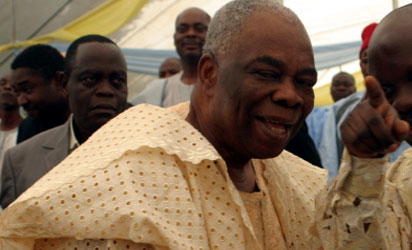
Late Augustus Aikhomu
*Recollections of the man people called “Gus”
By Dr. Joseph O. Okpaku, Sr.
The telephone at my New Rochelle, New York residence rang one afternoon in late September 1990. The familiar voice at the other end simply said, “Joe, I dey your town, o!” “Gus”, I answered, a bit surprised as I had not had prior intimation of his visit. “Welcome,” I said. “How now?” “We dey!” He replied. “Shey you go come house?” I quickly followed. “How I go come New York and no come your house?,” He responded. “How long you dey town for?” “Only a few days,” he answered. “Okay. We go arrange. Where you dey stay?” “For Helmsley Palace”. “Welcome,” I repeated, “I go come see you.”
That was Admiral Augustus Aikhomu, Vice-President of my country, in town, I surmised, to give Nigeria’s address to the 45th Regular Session of the General Assembly of the United Nations.
He had come on behalf of President Ibrahim Babangida in an annual ritual that brings Head of States and Governments from around the world to New York every autumn at the beginning of the General Assembly to promote their ideology and put on record their country’s position of current global issues.
As I waited for him to hang up before dropping my receiver (a conscious small gesture of deference to his stature), I felt a sense of quiet thrill, one that one gets from hearing out of the blue from a dear friend whom one simply likes, admires, respects and actually treasures.

Late Augustus Aikhomu
That call, and subsequent conversations that followed during that visit, were so quintessentially Aikhomu, also Nigeria’s first Navy admiral and the man we all called simply, “Gus”.
In a world in which office and power, especially of the political brand, tend too often to negatively transform people and undesirably alter easy communication and communion between and among old friends, “Gus” stood out in exceptional relief, and pleasantly so.
Aikhomu’s devotion to keeping in touch with his friends and ensuring easy, appropriate and respectful access to and for those close to him in earlier days, the bureaucracy and paraphernalia of present office notwithstanding, was a bit extraordinary and quite refreshing.
This attribute not only protected Aikhomu from the awkwardness that often threatens old friendships and weakens very special bonds that would otherwise automatically propel old pals to reach out to friends in power if only to ensure that all is well, but it also significantly reduced his risk of being isolated and undermined by the sycophancy that would otherwise grow like weed around him. Enabling his friends to exercise the right and responsibility of friendship to care, to observe and to honestly share with him their genuine thoughts and insights in camera was one of Aikhomu’s strengths.
His friends admired him for that while he, on his part, had the benefits of their knowledge, expertise, opinion, and enlightened confidential counsel.
To ensure Aikhomu’s success and that of those other friends of ours who either served or advised him and, for that matter, of Babangida himself, many of us not only addressed the challenges of government and, of Nigeria, on our own, but willingly gave free advice to them and their surrogates as if we were extensions of the Vice-President and the President.
On that visit to New York in 1990, Aikhomu proceeded to put a visit to my home on his agenda. The Vice-President would call me the next day or so to inform me that his U.S. Secret Service detail was resistant to the idea of his visiting my home because they did not have sufficient time and notice to secure my premises. I lived in the suburb of New Rochelle, a good half hour outside Manhattan itself which they could more easily manage having routinely swept it clean in anticipation of the presence of most of the world’s political leaders.
Their concerns were legitimate and reluctance quite understandable. The safety and security of my Vice-President and friend was also of paramount importance to me. But before I could graciously accept their position while trying hard to hold back my disappointment, ”Gus” continued in his characteristic matter-of-fact manner. “I told them I am coming to your home no matter what,” he said. “The rest is up to them to decide how to do their job.”
I concurred. Preparations for his visit to my home had already gone into high gear. Many Nigerians were excited over the prospect of meeting their Vice-President in the comfort and leisure of a private home. It would be easier to chat with him and share their thoughts and dreams about their country without the constraints of officialdom. I was glad that we did not have to abort it.
Aikhomu went on to list the terms he had negotiated to allow him come home to me. Principally, the day and time of the visit would be told to me on very short notice, virtually at the last minute. The other terms would be unveiled to me as and when needed. The deal was typical ”Gus”. He had successfully negotiated the desire to come home to me while honouring and respecting the right and responsibility of his Secret Service detail to do their job of protecting him as a guest of the U.S. government. He had given honour and respect to whom both were due in return for having his way.
For me and the rather large number of family, friends and even near-virtual strangers who lived with me all those years, the challenge now was how to feed and entertain the Vice-President in commensurate style and elegance without knowing when it would take place. But given the opportunity and joy of having Aikhomu at home, our response to the challenge was quintessential Nigerian, “No problem.” And everyone set about executing a grand party that would be open to any Nigerian who managed to find out about it. In all my years of entertaining, I have never turned back anyone at my doors, definitely not an African and absolutely not a Nigerian, and I would not do so now. I knew that that also would be Aikhomu’s disposition.
The next day or so was October 1, and the Vice-President was hosting an official reception at the Helmsley Palace to celebrate the anniversary of Nigeria’s independence. Aikhomu and I spoke a couple more times in-between. There was a time when the Nigerian independence anniversary celebration in New York was the party of the season to attend. Invitation cards were at a premium. It was a bonanza for the boys as the girls sought them out to be their companions.
On this occasion, when I arrived at the Vice-President’s suite at the Helmsley prior to the reception, he informed me that he and his delegation would be coming to my residence that same evening right after the Independence Day celebrations.
“Na today!” he announced to me after we greeted each other, and I watched him as he waited for my surprise. Determined that he would not have that pleasure, I camouflaged my reaction with a warm smile.
Instead, I simply asked him, “Can I call home?” “You have to do so in the presence of security,” he said, a bit of an apology in his eyes. “Okay”, I said. I dialled home and borrowing his own words, announced, “Na today!” And, so the wheels went into rapid spin. He also informed me that a security agent would have to ride in my car heading back home. That was part of the deal he had negotiated. Again, “No Problem.”
While people enjoyed themselves at the reception, I was busy activating all the switches. I quickly informed my younger brother, Tom, that the party was on. Given his popularity among his Nigerian peers in the New York area, I should have known that that would trigger the broadcast. But that would not be a problem as we had planned for all configurations.
The independence anniversary reception over, the vehicles lined up and the motorcade headed eastward towards the East River past the UN headquarters and north on the FDR Drive onto the Major Deegan Expressway for the half hour ride to New Rochelle.
As we entered New Rochelle, turned unto Forest Avenue and approached the house at 222, the entire area was packed with people and cars. How word got out so fast and people found their way there from the reception only served to confirm the efficiency of Tom’s network. Taken aback by the share multitude, the security detail decided that we should circle the block a couple of times before pulling up in front of the house. Aikhomu stepped out to a heart-warming ovation by his people. The party began in earnest with lots of food, music, dancing and conversation.
As used to happen in those days, the Nigerian women were resplendent, decked out in the latest fashion from home. Somehow, watching them so attired and so happy and self-assured always gave me a sense of pride and satisfaction, and the hope that with such people, all will be well with Nigeria.
Halfway through the joyous entertainment, the Vice-President sought a quiet moment to say a few words. After appropriate and genuine felicitations, he turned serious. “I am happy to be here in this home and to share this time with all of you,” he said. “I could not come to New York and not come here.” Referring to his government, he continued, “We know those who have helped to build Nigeria’s good image abroad. We honour them. We are very proud of Dr. Joe Okpaku. That is why I declare this home “Nigeria House, USA.”
He went on to give those present a brief account of the stewardship of his government and the happenings at home. For the rest of the evening, he mixed with the crowd, spoke fervently and earnestly with them and simply had a good time. When much later he said his farewell and took his leave, I drove in front of the motorcade until it was on the Major Deegan Expressway headed in the right direction back to The City, as locals fondly refer to Manhattan.
Back at the residence, the party continued well into the night while my neighbours wondered what was going on at 222 and who was this obviously very important guest that everyone came out to honour. It was good. It was fun. It was gratifying.
The next day or so, ”Gus” would underscore another important part of his being that we will always remember him for —his candor and forthrightness in matters serious, yet without malice of forethought. He was scheduled to depart for home at or shortly after mid-day. I had promised to come say good bye to him at the Helmsley Palace and, if logistically feasible, see him off to the airport. As I prepared to leave home, I got a call. He had been informed by his protocol officers that he had been rescheduled for an earlier take-off because his plane would be arriving earlier than anticipated from where it had gone for servicing. He requested, therefore, that I meet him at the airport instead at the special wing set aside for departing Head of States and Governments or their deputies.
As I drove into that section of John F. Kennedy Airport, a couple officials from the Nigerian Mission rushed up to me and said. “Thank God, you are here, sir. The Vice-President has been asking for you. We need your help. He is angry and only you can save the situation.” As I left the car for my friend, Pamella Foster, who had hosted the party for me and had come along to say goodbye to park properly, I was rushed towards the limousine in which Aikhomu sat and before I could ask just what he was angry about, they opened the door and literally pushed me in, and shut the door behind me.
Once in, it was clear that my friend was visibly not happy. “Can you see how they embarrass people?”, the Vice-President said, after we exchanged greetings and he apologised for having to divert me to the airport. “They rushed me out of the hotel saying my aircraft would soon land and be ready for take-off and when we got here I am told that the aircraft is still airborne.” What riled Aikhomu most, for a man who so much valued dignity, decency and self-respect, and who as a military man took matters of protocol and form seriously, his humility and modesty notwithstanding, was the embarrassment he felt for himself and for his country.
“Can you imagine,” he continued. “Other dignitaries have driven up here, disembarked from the limousine, said their goodbyes and simply boarded their planes and taken off. They have me here waiting in this limousine as others come and take-off.”
Disclaimer
Comments expressed here do not reflect the opinions of Vanguard newspapers or any employee thereof.