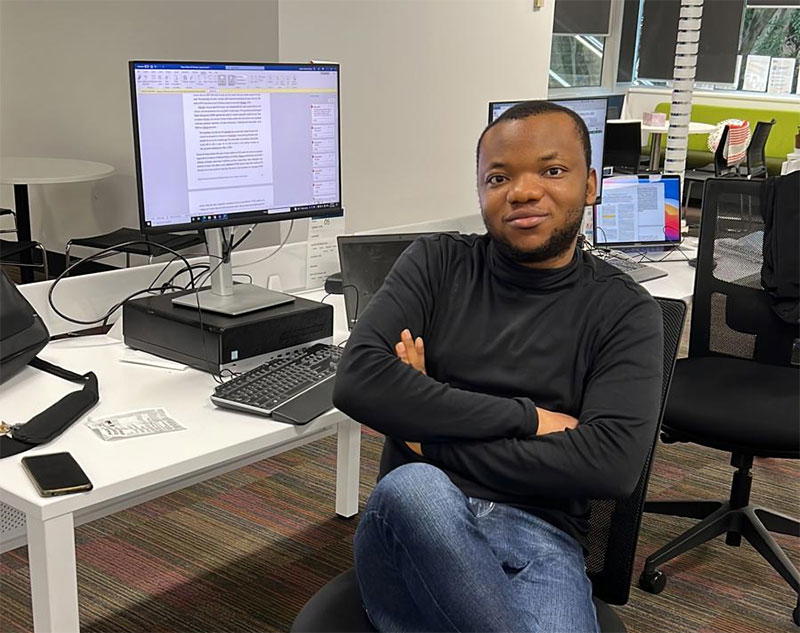
Simon Godwin Iretomiwa
After studying Mass Communication up to Masters Degree at the University of Lagos, Simon Godwin Iretomiwa, who migrated to Australia for his Doctoral Degree, shares his experience on his academic and work sojourn outside the shores of Nigeria. He says it is important to experience how things work in other climes, especially when one is assisted by education consultants like Mel Educational Services and the professional guidance of its founder, Mrs. Olufolake Adeniyi, who remains committed to ensuring that Nigerian and African student migrants succeed in Australia and other countries.
What was your background before you left Nigeria to study in Australia?
I studied Mass Communication for my first two degrees at the University of Lagos and was a media researcher in Nigeria. But I came to Australia through the Mel Educational Services in 2019 to study for my PhD at the Queensland University of Technology (QUT), Brisbane, Australia.
Of course, I have always wanted to study and explore other opportunities abroad to see how things operate elsewhere apart from Nigeria. Having examined the situation at home, I thought it was necessary to expand my horizon beyond the Nigerian educational space.
How did you find out about Mel Educational Services in the first place?
I got to know about the QUT from a friend, who told me about the Digital Media Research centre where I eventually completed my PhD.
Again, the motive for studying abroad is mainly to explore how education works elsewhere and also to make broader connections regarding education and partnering with people all over the world, because I have always wanted to become a researcher.
How can you describe the experience so far?
Coming to Australia provided a good opportunity to network with other researchers worldwide and to get it done, Mel Educational Services proved very instrumental to my admission process. I was referred to Melody Krishna Services by Queensland University of Technology, which was quite impressive. And because of the referral, I really had confidence in the services.
And eventually, when I interacted with some executives of the company, the managers, their friendliness, professionalism, openness and transparency, my confidence doubled. So, it didn’t take me too long to pay my service fees and other documentation that I needed to do with Mel Educational Services. It was a good experience as Mel helped me to process my documents and certified them before I submitted my application to QUT. And I believe they did a good job because the results came out quickly with a positive response from the university.
What were some of the challenges you faced as a Nigerian seeking foreign education?
I think the key challenge was funding, because without the scholarship I got I won’t be here. So, I must appreciate the Australian Government for awarding me the research training programme through a fully funded scholarship.
Funding is a key challenge I faced, but thank God for the scholarship. Housing is also a big issue international students face and again I must commend Mel Educational Services for helping me to handle my housing in the process. In fact, I must specifically appreciate the CEO and Founder, Mrs. Olufolake Adeniyi.
She is very productive and was instrumental to my getting an apartment in Australia and because of the confidence I had in her and Mel Educational Services, I transferred my money to her account and she handled everything transparently. So, I really appreciate Adeniyi and Mel Educational Services. Housing was not a problem for me as she assisted me to get a place where I stayed temporarily before I eventually got an apartment through Internet search within a week.
How is the work experience like in Australia?
It is rewarding, because I was able to work in Australia even though I studied on scholarship. Although I was restricted to 10 hours per week, but interestingly, I was able to get some jobs on campus. So, throughout my academic programme, I worked as a research assistant, I currently work as an academic.
I also worked as an editorial assistant in a top journal in the Digital Research Media Centre of the QUT School of Communication. So, essentially, I did all my work on campus. That was very helpful because it helped me to better coordinate myself and get things done.
Having shared your experiences, what do you wish you knew before migrating to Australia?
I think I sort of had a good knowledge. I really had a good rapport with Mel Educational Services and as such, everything I needed to know I asked them from accommodation to job issues and some expected behavioral patterns.
I had good conversations with some managers of Mel Educational Services and I came in with full understanding.
So, what are some of the benefits of studying abroad?
There are several benefits studying abroad. One of them is that one can network and get certified from reputable institutions. For instance, the QUT School of Communication where I studied is among the top 20 in the world and the first in Australia.
So, when you have that kind of exposure where you have the privilege of working with the best and in a dynamic environment, definitely your view of life will be different and you become more refined to face higher tasks.
I think it is a good way to get some necessary skills for employment and whatever one wants to do based on his area of studies. Overall, I think it is good to study abroad to get the necessary skills, connections and exposure.
Were there also some challenges with food and other items, being a completely different environment from Africa?
Yes. Adjusting in Australia can be challenging to the extent that in the first few weeks here, I had to struggle with food, but eventually I got to know about African markets, which Adeniyi told me about that we can have access to some African food.
So, I did Google search as follow-up and I have been buying stuff from the market and as such, feeding was no longer a problem.
How did you cope with issues of racism, especially as it relates to African students?
Well, quite frankly, I didn’t experience any racism issues throughout my stay, because right from my second year I have been teaching in the University, which gave me full support to teach to the extent that I handled over five units.
The coordinators and supervisors were very supportive. Even at the centre, generally, I was not deprived of anything based on my background. We were all treated equally in my opinion and to that extent I didn’t see any racist tendencies. I can’t speak for others but from my interactions, I didn’t experience any racist tendencies.
And I believe it was a culture in my university because I wasn’t the only student. We Africans students here have good things to say about the centre where we studied. The funniest thing I saw was how the younger ones call the elderly people by their names.
I remember the first time I met the owner of the house I lived in, what we call landlord in Nigeria. I usually called him Mr. and was even bowing to show respect, but he said I shouldn’t do that, that “my name is Mr. XYZ, just call me that.” I said really, you are a grandfather and he told me that it didn’t matter.
Also, my supervisor is obviously older than I am, but when we talk, we do as friends, we don’t call ourselves names. To me, that was shocking because I have been in a country where we must respect our elders or even prostrate.
How do you rate the Nigerian educational system compared to the experience you have had in Australia?
Yes, the Nigerian educational system is unfortunately epileptic at the moment. In fact, as we speak, there has been a long strike for some months now and because of the situation, most students desire to travel abroad for alternatives. I can only say that it is a better option to travel abroad for studies and get the needed support.
But it is also important that those seeking education overseas should get their documents ready before applying because some units require presentation of transcripts, results and sometimes they have to do some English Language tests. They also have to familiarise themselves with the requirements for each unit and comply accordingly.
It is also important to engage professional agencies like Mel Educational Services. I know Mel is in charge of Australia and some other countries and I really recommend them to those wanting to travel to anywhere including Australia because they will get the best service than you can ever get anywhere.
The interesting thing is that they won’t just leave you alone, after getting admission they will still monitor you. After defending my thesis, I sent a message to Adeniyi to tell her, because of the kind of relationship we have built. It is not only about work, one could also get ongoing support.
There are a couple of times I called to ask questions about some updates for free. As such, I like the social and human relations that can result from dealing with Mel Educational Services. I, therefore, recommend them to anyone who wants to travel to Australia or elsewhere for educational pursuits.
Disclaimer
Comments expressed here do not reflect the opinions of Vanguard newspapers or any employee thereof.