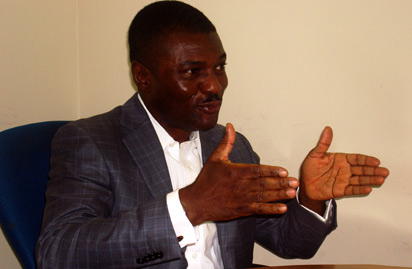
DG/CEO, NESG, Frank Nweke Jr.
*‘Boko Haram, militancy, kidnapping are products of unemployment’
Those who know him well enough would have observed that virtually everybody he comes across is referred to jovially as BROS.For this multi-lingual Igbo man who speaks the Yoruba language with some deliberately twisted fluency, Frank Nweke Jnr. came to national limelight when he served as former President Olusegun Obasanjo’s Information Minister between 2003 and 2007. Quick-witted and sharp-minded, Nweke Jnr. is today Director-General of the Nigeria Economic Summit Group, NESG.
In the wake of the warning strike being proposed by the Nigeria Labour Congress, NLC, Sunday Vanguard went after Nweke Jnr. to assist in shedding light on why the economy is being said not to be able to support the N18,000 minimum wage.
…..
By Jide Ajani, Deputy Editor & Anthonia Onwuka
At a time when the Nige rian economy is the way it is, what would you say is the significance of the Nigeria Economic Summit Group, NESG?
I have often made this point that NESG is a private sector-led economic think-tank and advocacy group. It is a platform for public private dialogue between Nigeria’s private sector and government. And one of the most important achievements of the NESG is that it has succeeded in creating that platform of exchange of ideas between the private and public sectors.
You would agree with me that during our military past, it was common place for the military to issue decrees but we had to say ‘yes, we agree that as leaders they had the political power but we were the ones in the private sector managing the economy in a way; that we believe it is necessary for us to interface; that it would be nice to seek and get input before they issue their decrees just so at the end of the day, the output and outcome would be the desired thing’.

*Nweke (Jnr)
And, in a civilian administration, that need is even re-enforced because if you are my representative either in the legislature or the executive, and having got my mandate, it makes sense for you to interface with me regarding the expectations of the people
Therefore, NESG has made significant contributions to the public governance and economic administration of this country and its progress.
Let me make this point clear, we are not an implementing agency neither are we a government agency. We receive no funds from government; our interest is the good governance of the country. And when we say good governance of the country, we are not talking about good governance for the elite alone, it is the good governance of Nigeria and Nigeria include the masses, the economic elite and the political elite.
…
Look at what is happening now: The issue of minimum wage has now been linked with revenue formula and the removal of subsidy but do these things really mix?
For me, any economy or country that will not consciously seek to embrace clear vision and a disciplined approach to public governance cannot make progress. If we continue to perpetuate inequities, if we continually seek to mismanage our economy and our country, we can only have ourselves to blame and we cannot make progress.
I believed very strongly that government must take its hands off some of these public companies and public assets and allow the private sector to manage these assets in a clear and well regulated way – let there be regulatory agencies that are allowed to function independently.
Talking about the minimum wage, it is not a lot of money but because of the structure of our economy, it is a huge burden and that it’s going to be a Herculean task for governments around the nation to continue to pay that money. Nigerian workers even need to be paid more but you and I know that keeping up with that expenditure is going to create and cause a lot of problems in the future.
If you remove the petroleum subsidy and you allow the structure of the economy to continue, if you do not diversify the economy and if you continue to depend on oil and gas as major sources of this economy, we are going to be back to square one and so for me the key is not just removal of petroleum subsidy but a conscious diversification of the Nigerian economy – investment in information and communication technology, investment in critical infrastructure, an environment to make business thrive and the investment in the value chain of agricultural produce are all that we need.
The answer you have provided does not address the question I asked in specific terms. If you give the workers N18,000 and you remove the subsidy, what have you done?
I said what I said mindful of the fact that you cannot make an omelette without breaking egg…
Read the full interview in tomorrow’s edition of Sunday Vanguard.
Disclaimer
Comments expressed here do not reflect the opinions of Vanguard newspapers or any employee thereof.