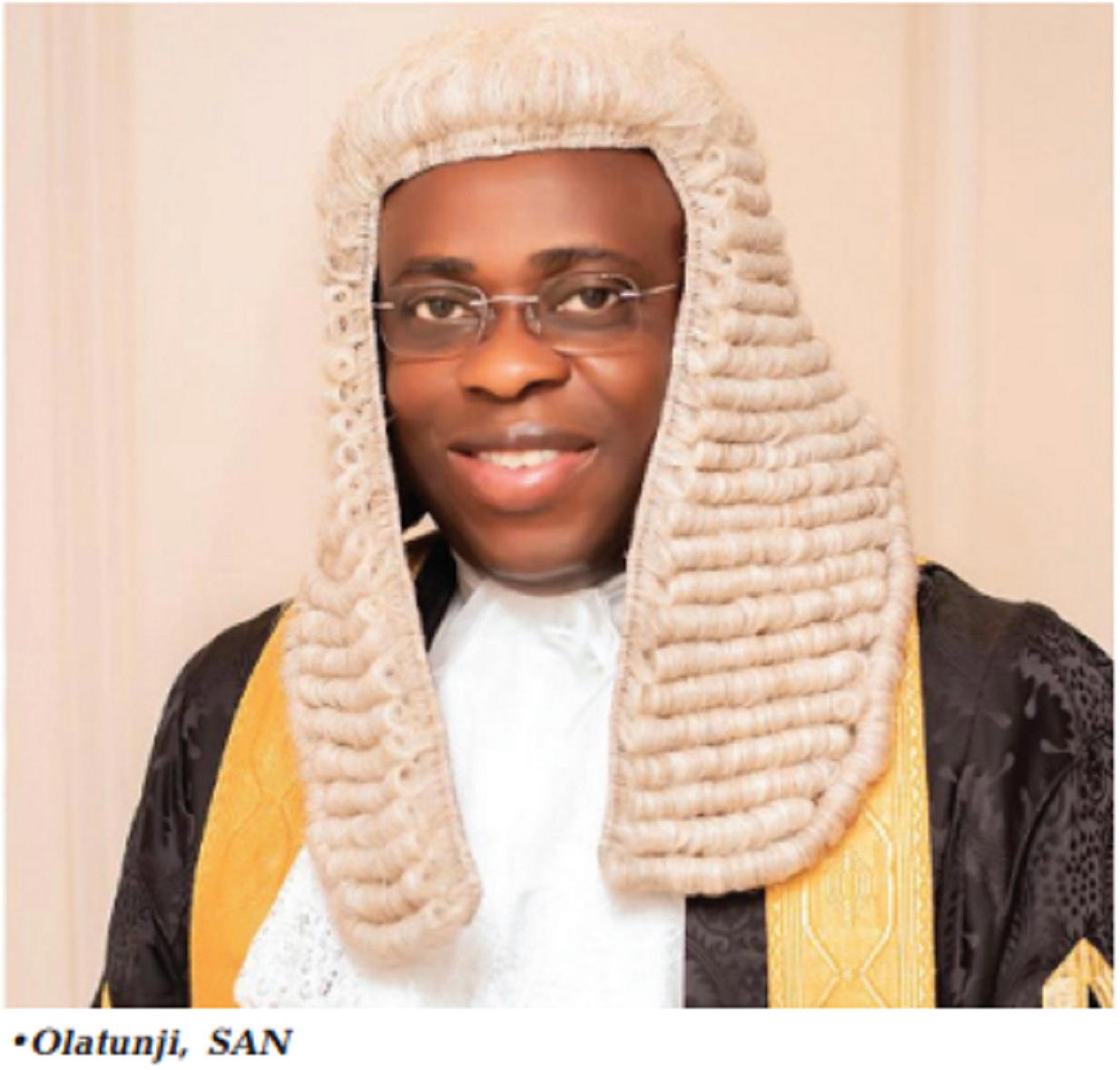
By Innocent Anaba
Mr. Abiodun Olatunji, SAN, is a partner at Abdullahi Ibrahim & Co. In this interview, he spoke on Abuja Federal High Court judgment sacking Ebonyi State governor and his deputy, the 2022 Amended Electoral Act now in force, House of Representatives positions on bills on affirmative action for women in political party and polity among others.
Excerpt:
A Federal High Court, Abuja has ordered Governor David Umahi and 16 lawmakers of Ebonyi State to vacate their offices after defection from PDP to APC. What lesson(s) can we, especially politicians learnt from this judgment?
The judgment delivered in the action by the Peoples Democratic Party, PDP, against Umahi, his deputy, Dr. Eric Igwe of the All Progressives Congress, APC, and the Independent National Electoral Commission is currently being tested at the Court of Appeal and whatever the decision of the Court of Appeal would be, a further appeal to the Supreme Court for a final determination of the issues raised in the action will certainly be made by any of the parties to the action.
The same goes for the judgment of the Federal High Court in a separate action filed by the PDP against 16 members of the Ebonyi State House of Assembly, who defected alongside the governor and his deputy from the PDP to the APC. So, it is imperative that we wait to see how the pendulum will swing at the appellate courts. Suffice to say at this point that the decision of the Federal High Court was like a bolt from the blues. Nobody saw it coming.
This is so because no governor has been removed from office by judicial order on the ground of defection since the return of democratic rule in 1999. This was so, notwithstanding the fact that there had been several defections by governors from the party that sponsored their election to the opposition party.
The fact that no governor had been sanctioned by way of removal from office for defecting from the party on the platform of which he got to power to another party, had emboldened many governors to defect or threaten to defect at the slightest provocation or even where there was absolutely no reason to justify such defection or threat of defection. You will recall that in the build up to the 2015 general elections, about five of the then sitting PDP governors pulled out of the party, the party that sponsored their elections, to join the newly registered APC without suffering any legal consequence.
Interestingly, one of the five governors then is the current Minister of Transportation. He was at the time, the Governor of Rivers State. It was in the course of his judicial battle to regain his mandate from Celestine Omehia, the candidate that the PDP presented as its nominee for election to the office of governor of Rivers State in 2007 and who was returned elected and sworn in as governor of Rivers State that the Supreme Court in its decision, stated clearly that it is the parties that contest and are voted for during elections and not the candidates.
It was on the basis of that decision that the Supreme Court ordered that Mr. Rotimi Amaechi, who did not campaign as a candidate for election to the office of governor of Rivers State in the 2007 general elections, be sworn in as the duly elected Governor of Rivers State being the validly nominated candidate of the party [PDP] that won the election. When Amaechi and others then defected and nothing happened, it was a signal, albeit, dangerous one, to others that future defections will go unpunished. Similar defections happened during the 2019 general elections. It is, therefore, a political event that has come to be associated with every general election in Nigeria. When the governor of Ebonyi defected to the APC, what reason did he give? He said he was defecting to the ruling APC because the PDP which sponsored his election has not guaranteed that its presidential ticket for the 2023 elections will be given to a candidate from the South- East. That has nothing to do with good governance, it has nothing to do with the provision of dividends of democracy to the good people of Ebonyi State, it has nothing to do with the implementation of the manifesto of the PDP which the people of Ebony bought into and on the basis of which they voted massively for the PDP and its candidates. It simply shows that the governor defected in pursuit of his personal ambition. He had since gone ahead to inform Mr. President of his desire to succeed him in 2023.
The 16 members of the State House of Assembly, who defected with him to the APC did not do so because they were convinced that the APC manifesto is superior to that of the PDP or has more to offer the people of Ebony or because they believe that the APC will handover its presidential ticket for the 2023 general elections to a candidate of Igbo extraction, they defected with the governor because they knew from experience that if any of them should take a principled stand against the position of the Chief Executive of the state, the member or members is/are not only dead politically, but dead and buried financially. So, for them, it was a question of political and financial survival.
The control that the governors have on members of State Houses of Assembly is unbelievable. In fact, virtually all the State Houses of Assembly owe their survival to total submission to the whims and caprices of the governors. They sit only to give legislative approvals to what the governors have decided.Talking about lessons for politicians, I should say that politicians are poor students of history. They are only concerned about the spoils of the office.
Umahi said the judge lacks power to sack him from office, noting that Justice Inyang Ekwo, has put judiciary on trial. Do you share his view?
Interestingly, the National leadership of the NBA has issued a strong rebuke of the governor and his unwarranted vituperations on the judge and the judiciary. Although, the governor later denied ever attacking the judge or ridiculing the judiciary, his denial notwithstanding, his widely reported vile reaction to the judgment and the order that he immediately vacate the office of Governor of Ebonyi State showed the level of his arrogance, contempt for the judiciary, the rule of law and how power drunk he is.
Ironically, it is the same judicial process that he has employed, through the exercise of his right of appeal, to put in abeyance, pending the determination of his appeal, the effect of the judgment and order of Justice Ekwo.
On whether or not Justice Inyang has power to sack the governor from office, I will only say that the judicial power of the federation vested in the courts extends to all matters between persons or between government or authority and to any person in Nigeria and to all actions and proceedings related thereto for the determination of any question as to the civil rights and obligations of that person.
If in the exercise of that judicial power, Justice Ekwo in the determination of any question brought before him in accordance with due process of law, he found on the facts and applicable law and judicial authorities that the governor should be removed from office, he will be justified to make such order and heaven will not fall. If Umahi is removed from office, he will not be the first governor to be removed by an order of court, he will only have the unenviable record of being the first to be so removed on ground of defection from the party that sponsored his election to another party.
Prior to this judgment, a High Court in Abakaliki, had dismissed a similar suit challenging the defection of the governor and his deputy. What is your take on the conflicting judgments coming out from the same court of equal jurisdiction?
It is rather sad. I blame both the political class and some pliable members of the bench. The political class in their desperation to cling on to power at all cost will do anything to achieve their purpose, including forum chopping for judicial determination of their political cases.
Unfortunately, there exists in the judiciary, especially on the bench, individuals who are open to compromise and who either in awe of the powers of the executive or in gratification of their financial or economic desires, are ever prepared to do the biddings of the politicians. You must not lose sight of the fact that the High Court of Ebonyi State which sat in Abakaliki and dismissed a similar suit, could possibly not have reached a different decision given the prevailing circumstance and the crushing weight of political influence that governors exercise over the administration of justice in their respective states. That is one of the reasons why financial autonomy in the real sense of it, for the judiciary is a sine qua non for the administration of justice that commands the respect and trust of the people. For as long as governors continue to play prominent roles in the appointment of judges and the funding of the judiciary, citizens will continue to express doubt in the quality of judgments such as the one that emanated from Abakaliki and Umuahia in Ebonyi and Abia states recently.
There is, however, a ray of hope, the National Judicial Council, JNC, recently meted out appropriate sanctions to members of the bench who were adjudged to have been found wanting in the exercise of their judicial discretions. The judges that have been disciplined will serve as a deterrent to others who are still within the system that they have nowhere to hide, the system will smoke them out. I must, however, add that judges only decide matters based on facts placed before them. Where facts are suppressed, the courts can do little except the suppressed facts are subsequently brought before the court in which case, the same court has the power to set aside its order which has been made on the basis of the suppressed facts.
The governor had petitioned Justice Ekwo before the National Judicial Council, NJC. Is the NJC the appropriate place to challenge the judgment?
The National Judicial Council does not sit as an appellate court on decisions of the Federal High Court established under Section 249 or the High Court of the Federal Capital Territory established under Section 255 or the High Court of each state established under Section 270 or any other superior court of record established under the Constitution. Appeals from the decision of the Federal High Court, High Court of the FCT, High Court of a State or its equivalent under the Constitution, lies to the Court of Appeal and not to the NJC. The powers of the NJC as enumerated under paragraph 21 of Part 1 of the third schedule to the Constitution, do not include taking appeals from decisions of the Federal High Court or any other court established under the constitution.
ALSO READ: Ortom furious over armed herders killings in Benue communities
The appropriate court for the governor to challenge the judgment of the Federal High Court is the Court of Appeal which he has done anyways. I believe Umahi’s petition to the NJC is without merit to the extent that it is based on perceived biases fuelled only by frivolous allegations of underhand dealings or what he called “hatchet job.”The petition was just an attempt to intimidate the judge and others who might in future be called upon to adjudicate on similar case. The petition is nothing but an irritant meant to distract and possibly shake the Judge and others of his like.
The 2022 Amended Electoral Act is now in force. What is your take on the Act?
By assenting to the bill, the President has assured Nigerians that his administration is committed to his promise to bequeath an electoral system that guarantees that citizens’ votes will count, an electoral system that will produce a government that is truly representative of the people.
The President and the National Assembly have done their part. Section 50[2] of the Electoral Act, 2022 is now the law of the land. The ball is now in INEC’s court to come out with a procedure of voting and transmission of results that guarantees transparency and integrity of the exercise. INEC has assured Nigerians that it has the capacity to transmit election results electronically. It now has the statutory backing to do so. We all look forward to a transparent election come next year.
There are several innovative provisions in the Act which are designed to deepen our democratic experiment. The provisions relating to electoral offences, nomination of candidates by parties, limitation on election expenses and others, are very interesting. One of the major challenges with our democratic experiment is internal democracy. As the parties geared for the 2023 contests, their compliance with the provision of the Act relating to nomination of candidates will be keenly watched.
Any failure on the part of any of the parties to strictly comply with the provisions of the Act will only result in such party not having its candidate included in the election for the particular position.
Another challenge with our democratic experiment is the fact that electoral contest is quite expensive and it appears that with the limit placed on election expenses by candidates, as long as any candidate for any particular office is within the limit and he has the money, he can buy his way to such office. For the office of the President, the maximum is N5 billion; for the governor of a state it is N1 billion; Senatorial seat is N100 million and N70 million for House of Representatives member.
While the Act makes provision for the maximum amount allowed, it has simply by implication, closed the door to patriotic individuals with good ideas and programmes on how to develop this country but who unfortunately do not have the humongous amount allowed as such candidate will be no match for the moneybags who can afford to reach the maximum limit allowed by the Act. This is a major concern.
The House of Reps rejected a bill seeking to provide special seats for women at the NASS, affirmative action for women in political party administration and inclusion of at least 10 per cent affirmative action in favour of women in ministerial appointment. What is your take on this?
The initial votes of the House of Representatives to reject the bills on indigeneship, citizenship and 35 per cent affirmative action for women was rather a sad one. It is, however, gratifying that the House had since rescinded its earlier decision and has now voted to recommend the bills for consideration as part of the proposed amendments to the Constitution.
Nigerian women deserve better treatment. They are the ones that attend party meetings, campaigns and vote during elections but unfortunately, they have the least representation in government and party administration. The bill on citizenship seeks to amend Section 26 of the Constitution to provide for citizenship by registration for foreign spouses of Nigerian women while the bill on affirmative action seeks to amend Section 223 of the Constitution to ensure that at least, 35 per cent of political party offices are constitutionally guaranteed for Nigerian women.
These two bills and the bill on indigeneship which seek to allow women to become indigenes of their husbands’ states after five years of marriage, should immediately be passed by both Chambers of the National Assembly and concurred to by the states. Citizenship for the foreign spouses of our women, indigenship of the states of their husbands and 35 per cent seats in the administration of political parties should be guaranteed as fundamental rights for our women. They deserve no less.
Due to the contradictory judgments coming from the Federal High Court and the State High Court in Abakaliki, stakeholders have called for the removal of governors from the appointment of judges. Do you share this view?
The conflicting judgments from the Federal High Court and the High Court of Ebonyi State on the same subject matter is the unfortunate result of the very powerful influential roles played by the Executive arm of government in the appointment of judges and the general administration of justice in this country. The courts at the state level are heavily dependent on the Executive for their day-to-day survival.
This is not healthy for the smooth administration of justice. The judiciary has to be financially independent. The appointment of judges has to be totally insulated from any form of political influence.
A judge who owes his appointment to no political godfather and who knows that his promotion, his salary, his entitlement, his retirement benefits and even the day-to-day running of his courts are not dependent on the ego, the whims and caprices of any political actor, will not hesitate to declare the law as it is or give judgment against any government where the facts and the law come to no other conclusion.
Disclaimer
Comments expressed here do not reflect the opinions of Vanguard newspapers or any employee thereof.