By Chris Onuoha
It was an electrifying display of energy, intelligence, artistic dexterity by the young students from Laurel International School, Otta in Ogun State as they performed a play called “Caged Bird”, a poetry adaptation from a book authored by Maya Angelou titled, ‘When a caged bird sings.’ After that, came another performance of Leopold Senghor’s poem, “Black Woman’ by a theater group, which was equally followed by another play titled, ‘Binsey Populace’ written by Hopkins.
The last among the lots was “Land of Africa”, a cultural bastardisation of African soil by the white invaders whose mission was to colonise the blacks beyond its missionary agenda. The play was such a scintillating one that got an arousing applause from the audience because of its story line and dexterity of the cast in depicting how the white invaders were eventually overpowered by some resilient Africans.
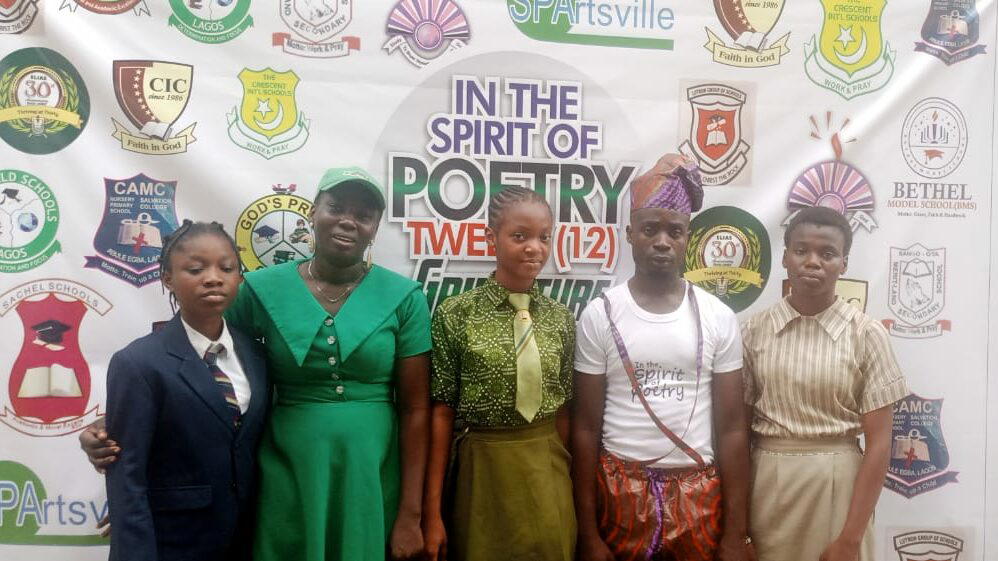
This, however, is one way to describing the scene, mood and noise that went down at the grand finale of secondary students’ poetry competition held at Mao Event in Otta, Ogun state, themed; “Grievature” a National Poetry Demystification Initiative by Saint Psalmstar Artville Theater Organisation tagged ‘In the Spirit of Poetry’ season 12.
The spirit of poetry is a dramatic and literary poetry performance workshop designed to allay the fear students have for poetry as well as reward excellence among the neglected Nigerian students of Humanity studies. The contest in its twelfth edition is exclusively for students in the secondary school category offering literature, art and drama as a subject.
According to the founder of SPArtsville, Adeoluwa Samuel Jolaosho, who doubles as the creative director of ‘In the Spirit of Poetry’ revealed that the vision came about in his first year at the University of Nigeria Nsukka having noticed that art students at the secondary school level are relegated and were never given scholarships and other educational grants.
“I came about the idea in my first year at the university studying English and Theater art when I realised that art students are relegated. Then, I see that science and other departments are getting scholarships from government agencies like PTDF and others while art students are not. There were no competitions or incentives to boost the morale of art students. This alone sparked the vision in me to do something and change the narrative,” said Jolaosho.
Speaking further, he said, “By 2011, I started the annual competition which is in its twelfth session now. It is a national competition but however, we have not been able to reach out to all the states for now because of low budgets and funding which is basically funded by my organisation alone.
However, you ask how we fund the projects. For me as a theater practitioner, I train actors and carry out shows that generate funds including theater art coaching in schools and private individuals. I also work as theater project instructor for professional bodies like Theater for Development (TDF) against migration.
“We also do a lot of projects that deal with real life issues, especially on climate change and the environment. We had a performance on climate change back in 2015 at ECOWAS complex in Abuja. Apart from this literature pro-educational initiative where we dramatise poetry to help students get more knowledge about theatre art and literature, we also do other art performing programmes to let art students in the secondary school appreciate the course without a regret posed by the rush for science courses,” he added.
Jolaosho laments that the low budget funding of the project is the cause of not reaching out to other schools at a nationwide level which he hopes might come if government, private and corporate organisations could key into the vision and support the initiative.
Speaking about participation in the project, Jolaosho said that participants are sourced from schools who indicated interest to be part of it. “The response from all the schools we invited is overwhelming as many who did not get our invitation are clamoring for it. The programme is a rich one because when you come and write your poems, you understand the poetry better.
Responses from the subsequent one we have carried are quite impressive. Participated students and their schools were happy, seeing it as an extracurricular activity that helps to shape and prepare students’ minds for the WAEC and NECO exams,” remarked Jolaosho.
“Art is not about the classroom, but it is saddening that the government has limited art to classroom work alone. There are no digital laboratories, no theatre spaces with regular art activities for art students in secondary school level, just like their counterparts in science, agriculture and biology whose laboratories are ever equipped. This is the reason why art competitions are lacking in our schools.
“We organise and structure the contest from past examination questions. When the participants face these questions at the competition, they feel challenged to do more in their exams. We organise the contest from phases one to four. In the first phase, we set 80 standard questions on literature and documented text.
Phase two comprises spotting figures of speech in a sentence. We also give knock out questions for those who did not qualify in the early phases just to keep their spirit on to the next phase. In phase three, they dramatize their poem while in phase four, they compose their own poem. These are all the phases that produce the overall winner alongside other runners up,” he said.
Furthermore, he said, “Looking at what we have done so far, my belief and message to the government and school owners is not to limit literature studies only in the classroom alone. Let the students have a feel of what literature is all about in the real practice. Let’s have a project and test the practical aspect of their studies. Practical education is good for students which go alongside theoretical learning,” he said.
Meanwhile, winners emerged after a long hurdle of contests that featured theatricalisation of poems, analyses of poems, rhythmic and electrifying poetic games, including dramatic poetry clinical workshop, poetry icon contest and workshop for answering WAEC, NECO exam questions.
Having withstood all pressure to remain resilient in the contest, Adeshile Anjola Oluwa from GoldBeam College, Otta, Ogun State emerged as the overall winner with score points of 106 garnered from all the phases. She cruised home with a cash prize of N100, 000, plaque and other gift items.
The second prize winner is Ogunshola Tenioluwa from the Learning Land Comprehensive College, Otta, with cumulative score points of 105 while the third place went to Adeyemo Goodness from God’s Pride College, Otta with cumulative score counts of 95.
Speaking with some of the students who participated in the contest, they unanimously agreed that the competition is a good and healthy one for them. “The contest has broadened my understanding of poems. From the dramatised poems to the point of writing our own poem instantly, I have become conversant with the style of expected questions in exams,” says one of them.
Another, also said that the competition has made her change her mind of career choice, because she has discovered that drama lives in her. For some parents and teachers who accompanied the students, “this is a welcome development. Its sustainability is important so that students will not lose touch even in exams.”
Disclaimer
Comments expressed here do not reflect the opinions of Vanguard newspapers or any employee thereof.