By Adisa Adeleye
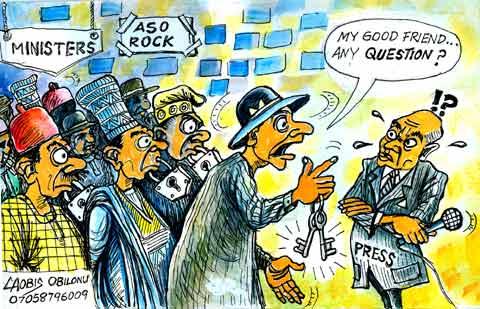
Having slightly recovered from the grand illusion of an expected radical cabinet, following a robust election in which the presidential candidates promised political and economic transformation, I am now faced with reality. The truth of a federal cabinet, many of whose members are re-cycled ministers and party loyalists, to be driven by the hands of father destiny.
Many analysts of Nigerian events would be shocked, if not depressed, that the calls for radical change and approach to national events have fallen on blocked ears. Perhaps, by divine grace, the new Team would perform wonders to confuse the skeptics and pessimists: if the ‘NEW TEAM‘ has made up its mind to work diligently to impress the celebrated critics, the better it would be for the development of our yet to be great country.
For the sake of love for the fatherland, it is not bad to go over past ideas and reconsider crucial economic and other national issues under the prevailing circumstances. At the risk of repeating the articles already written under this column, it is necessary to re-state that no meaningful political transformation could be possible without effective electoral reforms.
It must be recognized that under the present regime with the President relying only on what the Legislature (dominated by his party) passes into law, there is little room for radical changes. Unless the President is bold enough to submit the salient aspects of electoral reforms to a referendum, it would be impossible to expect the ruling party to legislate reforms that could send it packing. A modest electoral reform has witnessed the erosion of the PDP‘s majorities in the National Assembly during the last elections.
It is in the interest of Nigerians that the future elections are conducted in a free and peaceful atmosphere that would make the results to be generally acceptable.
Another familiar problem which the new government in the Federal, State and Local government levels will battle with is increasing unemployment. This menace, as it has been pointed out in the past, is a potent force in the fast race towards economic and political instability.
Perhaps, my article written in 2002 during the reign of President Obasanjo would be more relevant under President Jonathan in 2011, considering that the Nigerian economy is in a flux. Since the former President as a war hero was more familiar with tanks and pieces of artillery than valued principles of political economy, perhaps President Jonathan, a Zoologist would not need a box of matches to grasp the essence of applied economics.
In the new dispensation, the President and his Economic Team should consider the thoughts of Keynes on the world‘s economic depression of the 1930s. His thoughts on unemployment should be carefully chewed, digested and not spewed out as unsuitable to a modern economy. It should be properly analysed and refined to suit Nigeria‘s peculiar situation.
‘It is that a serious government in the pursuit of full employment policy must ensure that there is enough effective demand in the whole economy through a monetary policy that encourages more investments and a fiscal policy that allows households to spend more on consumption‘.
In a situation of high rate of unemployment, such a serious problem according to Prof. R. G. Lipsey is best solved by encouraging governments, firms and households to be spend-thrifts as much as possible because, other things being equal, the more prodigal and spend-thrift the households are, the higher will be the level of national income and employment. Generally, unemployment for any length of time could be sad and soul destroying. Prolong unemployment, especially among graduates could be an invitation to chaos and general instability in the country.
If the Federal government wants to eradicate unemployment and achieve a policy of full employment, it has no other option than to vary the volume of aggregate expenditure. If government spends more than its income, there will be a net increase in the demand for resources.
If total spending is high, the level of output is bound to be high and the level of employment will also be high. A policy of budget deficit in a well managed economy will create a higher rate of real income and a higher level of employment. Thus, in order to achieve full employment, government should interfere through its fiscal and monetary policies to stimulate effective demand by increasing consumption and investment of individuals and firms under a regime of cheap money (low interest rates), generous investment allowances and lower income and profit taxes. It may be argued that under the Nigerian condition, a policy of budget deficit may not be the true answer to economic expansion judging by the events in the past.
An advocate of a full employment policy will advise the government against wasteful expenditure but would suggest massive expenditure on building new roads, repairing old ones by filling numerous pot-holes, clearing overgrown weeds on both sides of the roads and clearing the blocked drains or creating new drains on both sides of the roads. This type of exercise will engage thousands of youths (like the public works (PWD) daily paid workers of the colonial era). The wages paid to them will help to sustain demand through increase in consumption of food items and general goods.
In the quest for full employment, it is necessary for the federal civil service to expand its activities in order to embrace more qualified youths. Agriculture, which was the mainstay of the economy before oil, remains stagnant and underdeveloped while thousands of graduates in Agricultural Science roam the streets instead of being engaged in plantations and farmlands. This calls for additional expenditure on agricultural development. Many government institutions, universities, colleges, research centers, hospitals are sadly understaffed and need the vigor of young graduates; the employment of these youths with their spending power will not only keep the economy active and buoyant but will also bring the services of governments nearer to the people.
Home industries need protection from foreign competition not through discriminating high tariffs but through large reduction in duties on imported raw materials and allowing free duty on spare parts and necessary machinery for production. There is no doubt that domestic firms will react to the increase in effective demand for their goods by increasing capacity utilization through increase in employment and investment in new equipment.
The reproduction of this article on unemployment is relevant because of government‘s expansionist policy to tackle the problem of unemployment, and the Central Bank‘s existing tightened Monetary Policy in order to control inflation.
Disclaimer
Comments expressed here do not reflect the opinions of Vanguard newspapers or any employee thereof.