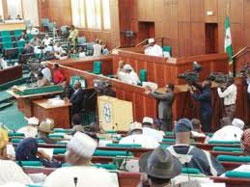
*House in session
By John Amoda
THE appointment of the principal officers of the houses of the National Assembly is the occasion of this discourse on contexts that facilitate the institutionalization of the separation of powers of the three arms of government and in the Nigerian case, of the three tiers of government.
From 1999 to date, the PDP has been able, through its majorities and the enforcement of party discipline, to effect party cohesion to make appointments a matter internal to the PDP. For this 2011 session of the National Assembly the PDP’s zoning of office was upheld for all but the choice of the Speaker and Deputy Speaker of the House of Representatives.
By the decision of the party, the office of the Speaker, the choice plum, had been zoned to the South West. But contrary to this zoning decision, Alhaji Aminu Waziri Tambuwal from the North West emerged the Speaker. How is this event to be understood? Is the election of the Speaker a spillover from the politics of electing the President? The PDP has shown that the setting aside of zoning for the office of the President did not entail the end of zoning of offices.
Is the election of Tambuwal then a playing out of “backlash” politics or is it evident of something much larger than the politics of “an eye for an eye”? What determines the choice of the platform for the revolt against “the party”?
Why one and not all offices? In this piece I have chosen to examine one out of several competing theories and explanation for this significant defeat of the ruling party in the House of Representatives. My interest is exploring the contexts that facilitate the institutionalization of the separation of the powers of the three arms of government and by implication of the three levels of government.
To ensure clarity in this discourse I will summarize my understanding of the rationality of the practice in an effort to explain the antecedents and contexts that facilitate stable and sustainable separation of powers. We must therefore not confuse formal and lateral specialization of functions of government for separation of the powers of the three arms of government.
The first, that is specialization of functions, is compatible with unitary centralization of power and authority. Specialization is a common feature of governments in which efficient effectiveness is highly prized. Separation of powers is protective of the autonomy of each of the three arms of government. What this immediately implies is the separation of the spheres of each arm of government and the autonomy each enjoys in the exercise of their powers as apportioned to each by the constitution, conventions or evolution of practice in the course of the sovereign existence of the group with power.
This strategic choice in the organization of government also implies a supervisory oversight of each arm over the other two arms in the areas of their institutional responsibility. Thus, for example, if the executive in the course of the exercise of its powers were to promulgate a policy that undermines the rule of law, the judiciary upon the show of cause for a review of that policy, can decide that that policy is to be set aside in defence of the rule of law.
Each arm is therefore not merely separate and autonomous but acts as check upon the other two arms in order to maintain the balance of power between the three arms. This is why separation of powers implies mutual oversight by each of the entire affairs of government as it relates to the integrity of their functions and place in the system of government.
Three questions arise from the above exposition of the concept. The first is what kind of sovereign would establish its government according to the model briefly presented above? And is the sovereign of Nigeria such a sovereign? And is the election of Tambuwal an indication of the emergence of a Nigerian “separation of powers” sovereign? We can answer the last question immediately: there is yet no such Nigerian sovereign.
The PDP rulership saw the election as a slap in the face and are now engaged in “damage control” consultations. The course of Nigerian politics does not yet present contexts for strategic choice of a separation of powers arrangement of the functions of government. Why is this the case? It is the case because Nigerian politicians are still divided on who constitutes the sovereignty.
This being the case, Nigerian politics is still about the forging of strategic alliance for the establishment of the sovereign.
The fact that the departing colonialists left behind the institutions of state, government, security organisations and the colonial economy continues to mask the fact that control of these institutions have been utilized by Nigerian politicians to facilitate partisan constructs of sovereign rulership. Nigerian politics from the First Republic to date still revolves around control of the institutions of state in the service of partisan projects of sovereign rulership.
In other words, Nigerian politics is still largely about the advancement of partisan paradigms or concepts of sovereignty. This accounts for the alliance coalitions of putative sovereigns under “party umbrellas”.
Disclaimer
Comments expressed here do not reflect the opinions of Vanguard newspapers or any employee thereof.