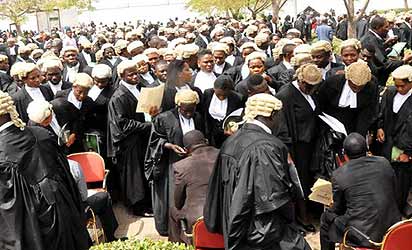
File: Lawyers
•Regret NASS now rubber stamp of the executive
•Say citizens have right to take legal action against the president
By Emma Amaize, Regional Editor, South-South; Dayo Johnson, Regional Editor, South West; Sam Oyadongha; Festus Ahon; Gabriel Enogholase; Rotimi Ojomoyela; Peter Duru; Marie-Therese Nanlong; Ikechukwu Nnochiri; Emmanuel Unah; Harris Emanuel; Chioma Onuegbu; Emem Idio; Ozioruva Aliu; Henry Ojelu; Steve Oko & Chinonso Alozie
Despite public outcry across the country against open grazing of cattle by herdsmen, President Muhammadu Buhari last week directed a committee to review the data on all the Grazing Reserves in the country and assess among others the extent of encroachment. The president’s insistence to go ahead with his plan in the face of stiff opposition to it provoked angry reactions from Nigerians who argued that it would only benefit the herdsmen to the detriment of the generality of other residents.
Another sore point among Nigerians was the decision by the President Muhammadu Buhari-led administration to construct a $2b rail line from Kano to Maradi in Niger Republic when critical rail lines and other road network connecting different regions of Nigeria have been abandoned. They were outraged that the president easily imposed policies and initiated projects that are of personal interest to him and not the general interest to the totality of Nigerians.
But where the citizens are convinced that their president has not acted in their best interest, what options do they have?
Opinions of lawyers were therefore sought on the steps the citizens can take to ensure that the president does not act unilaterally and impose on them unpopular policies and projects.
Most lawyers agreed that the courts are always there for the citizens to challenge the president for his actions and inactions as many courageous Nigerians like late Professor Ayodele Awojobi, late Chief Gani Fawehinmi and others had done and the courts in many cases had ruled in favour of the people. Many lawyers also argued that the representatives of the people at the National Assembly have the powers to check the President if he tries to impose any unpopular policy but they expressed regret that the lawmakers had failed in their constitutional responsibility and had turned themselves into a rubber stamp of the President.
They wondered if the legislators were acting on behalf of themselves or on behalf of the people who elected them. Others suggested mass protests by the people and civil disobedience as other means which the populace can employ to compel the president to retrace his steps in the best interest of the large majority of his people.
The legislative, judiciary arms should checkmate the president—Chief Malcolm Omirhobo, Human rights activist, Chief Malcolm Emokiniovo Omirhobo, said: “Notwithstanding that the President of Nigeria is the most powerful president in the world with enormous powers he cannot run the government single-handedly whereas the legislative arm of government and the judiciary arms of government are supposed to check mate him through the principle of checks and balance. But this is not so regrettably and unfortunately because both arms of governments are now subsumed under the executive. The Nigerian Senate is a rubber stamp chambers and the judiciary an appendage of the executive. The construction of rail line from Nigeria to Niger Republic is supposed to pass through the appropriation process .
By the constitution no money can be taken out of the federation account without appropriation. It is at this point that the National Assembly is supposed to objectively, in the interest of Nigeria, object to any project that the President intends to carry out that is anti people and unpatriotic . How can Nigerians allow the president build roads and rail lines in another country to the neglect of infrastructures of their own country. Now that the president is talking of open grazing, the Nigerian public must reach out to their representatives at the National Assembly to ensure that the Land Use Act is not secretly amended or one funny law on open grazing passed through the back door. Nigerians must ensure that their representatives, at the risk of being recalled, do what the people want and not what they want or what the president wants”.
Nigerians should challenge the president in court—Abeny
According to a Senior Advocate of Nigeria, SAN, Mohammed Abeny: “Although by bilateral agreement between Nigeria and Niger Republic, the President may extend railway to Niger republic which must be approved by the National Assembly, it must be strictly subjected to the national interest of Nigeria and not for the personal interest or whims and caprices of the president as is the case in the controversial railway extension to Niger Republic, particularly when various parts of the country, which are in dire need of railway have not been attended to. The National Assembly is complicit and blameworthy for this worthless railway extension to Niger Republic because the national assembly may have surreptitiously approved the appropriation for the project, which has no economic value to Nigerians, save perhaps the people of Katsina state which share boundary with Niger Republic. Of course the unilateral decision of the President to extend railway to Niger Republic notwithstanding the loud and clear protestation by majority of Nigerians is a reckless abuse of office and power, actionable in the law court. Ideally, the National assembly ought to have refused to approve the appropriation for the wasteful and worthless project, but presently, we have the worst ever rubber stamp Senate in the history of this country. The present Senate only exist to approve whatever is presented to it by the president. It is doubtful if it understands its functions under the extant presidential Constitution.
“Therefore the only remedy left for Nigerians is to challenge the abuse of power and office by the president in embarking on the wasteful and worthless project. Secondly, the Southern governors in whom the lands in their states are vested in trust for the people of the States under the Land Use Act, have taken the right and lawful decision to outlaw open grazing in all its ramifications in the Southern states. That is the right thing to do in a democracy. I dare the federal government to go to court to challenge the decision”.
Residents can resort to civil disobedience — John Mafo
John Ola Mafo, legal practitioner and former Commissioner For Information, Ondo State said, “in every democracy, the chief executive wields enormous powers, especially in a Presidential system where the President is like an Alpha and Omega.
With particular reference to Nigeria, where our leaders operate without caution, with impunity and reckless abandon, the words of the President are like law, carrying heavy authority and force of power. But in every democracy worldwide the powers in a given country are vested in three arms, namely, the executive, the legislature and the judiciary. The constitution, which varies from one country to another, makes provisions to guarantee the famous principles of separation of powers, which provide checks and balances in the discharge of the duties and responsibilities of each arm of Government.
As powerful as the office of the President appears to be in practical reality, its powers are limited by provisions of the constitution. According to the constitution, the President can only act based upon the laws of the National Assembly and subject to judicial actions in terms of review and interpretations. The meaning of this is that, the President can only be as powerful and as authoritarian as the citizens and national institutions allow him to be.
The citizens have the right to challenge the actions of government at all levels and to seek appropriate reliefs in court, but we mostly sleep on our rights. The legislative arm, on behalf of the people have every opportunity to checkmate the executive, represented by the President through the appropriate exercise of legislative powers, but they mostly act as rubber-stamp to the President, turning their back to the electorate when it matters most.
Moreover, there are so many other institutions within the democratic system that can advise or influence the actions of government towards compliance with legality and in accordance with the will of the people, but these bodies are all weakened by corrupt practices and only dance to the whims and caprices of the President. But for the masses, there is always hope through the courts, if they can summon the courage to approach the courts like some courageous Nigerians did in the past.
The heroics of the likes of Ayodele Awojobi, Gani Fawehinmi, Odumegwu Ojukwu and others remain evergreen in the memories of Nigerians. Apart from legal options, the people also have the alternative of civil actions or if you prefer, civil disobedience, to stop the excesses of a President. All said and done, when all other options fail, the general populace have the power to change a bad government at the polls, at the interval of every four years. This is the ultimate power of the electorate in every democracy the world over
Legal action can be taken to stop president’s impunity— Ejimofor
Umuahia based lawyer, Mr. Jasper Ejimofor, argued that the actions of the President could be checkmated through court action. “His primordial thoughts on grazing route is against the Constitution of Nigeria. The land use act of 1978 hands over every land to state government. From where did he now derive his powers on this issue? His action can be challenged in court for being inconsistent with the provision of the Constitution. Secondly any individual whose land is taken can bring a fundamental right action against the government. Individual lands have a procedure for acquisition and strictly for public purpose. Cattle rearing is a private business and cannot qualify as reason to acquire land for public purpose. Nigerian law does not recognize grazing route and such law will be a state legislation and there is none presently. Public protests are ways the President’s excesses could be checkmated. When so much pressure is mounted through public protest, he will bow”.
NASS can checkmate president’s excesses — Chief Chukwuemeka Osuoha,
Abia-based legal practitioner and former Commissioner for Environment, Chief Chukwuemeka Osuoha, said that “in an ideal democracy, all the three arms of government were supposed to act as checks and balances to one another. But regrettably, the National Assembly which is supposed to be speaking for the people, is rather too lame to checkmate the excesses of Mr President. Since the emergence of the APC administration in 2015, the President has been acting with impunity but unfortunately the National Assembly which has the powers to call him to order is too weak.
How can he be building rail lines to link a foreign country while the local rail lines are not functional? He is now pursuing grazing route that is outdated and overtaken by the 1978 Land Use Act which put governors in charge of land for their state. But instead of stopping the President from his unlawful quests in this direction the National Assembly is helplessly watching the illegality. The governors’ Forum as well as some elder statesmen could however intervene in advisory capacity. States are components of the country, hence the governors as critical stakeholders could stand against some excesses of the President.
The people’s representatives can initiate impeachment process — Ogbonna
Similarly, another lawyer, St. Moses Ogbonna, said the only way for the masses to stop the President from acting with impunity was for their elected representatives at the National Assembly who have their mandate to move for the impeachment of the President. He regretted that the current NASS is a lame dog that would never bark at the President. According to him, if members of the National Assembly truly feel for the masses, they would have since called the President to order. He said that no President had the right to act with impunity otherwise the legislature would invoke the instrument of impeachment.
What the president did is an impeachable offence — Akpan
Abuja based human Rights lawyer, Chief Nkereuwem Akpan said: “In exercising his powers as vested upon him by section 5 of the 1999 Constitution of the Federal Republic of Nigeria (as amended ) the President should not allow his personal interest as a Fulani man with roots in Niger Republic to affect his official decisions because the insistence on construction of a multi billion naira rail project to Niger Republic when the railway system in Nigeria is in a mess leaves a sour taste in the mouth.
Charity should begin at home. If our roads and rail network is in shape, then extending same to neighboring countries wouldn’t have generated such uproar and opposition from the public. It seems to me that clearly this President is in breach of his Oath of office which is an impeachable offence. On the vexed issue of attempting to force the medieval open grazing on Nigerians, the President can only try but will not succeed.
Nigerians should hold their governors responsible— Onu
A constitutional lawyer, Mr. Silas Onu, said: “Today, we have a government that has demonstrated that it cares more for the people of Niger over and above Nigerians who supposedly voted for them. It is a sad reality that while rail services are still a mirage within Nigeria, the Federal Government is spending billions of Nigeria’s money to develop Niger Republic.
On the issue of Federal Government insistence on open grazing, it is another evidence of the government’s direct involvement in the crisis that has led to the unfortunate death of thousands. The FGN has no power to appropriate any land outside the FCT as the Land Use Act already donated such powers to the State Government. So, Nigerians should hold their State Government responsible if an inch of their land is used for open grazing.
Citizens should challenge the president in court —Nwankwo
Likewise, another constitutional lawyer, Mr. Ugochukwu Nwankwo, said: “The office of the President is not absolute. It has its limitations with reference to chapter VI of the I999 constitution as amended.
The President is not at liberty to enforce or make policies or decisions which may run foul of the general interest of the citizens. Where such policies are made, the citizens are to challenge the propriety of such decisions in court via public interest suit. Also, where such decisions are considered as gross misconduct, the Senate may remove the President by way of an impeachment”.
Citizens can approach the court for redress —Barr Polycarp Aande
According to Barr. Polycarp Tersoo Aande, the immediate past Secretary, Nigeria Bar Association, NBA, Makurdi Branch, “this concern falls under the realm of public interest litigation. The citizens of this country have the lawful right to compel the president to rescind any project, policy or decision that is not in the best interest of the country or citizenry.Section. 14 (1) of the 1999 Constitution of the Federal Republic of Nigeria (As amended) provides that the security and welfare of the people shall be the primary purpose or concern of government.
This means that at every point in time the decisions of government must be aimed at promoting good government and welfare of all persons in the country on the principles of freedom, equality, equity, and social justice. The president who is the head of the executive arm of government has a duty to respect the wishes and yearnings of his people.
In a democratic government such like ours, both the president and the citizens must be in consensus as to areas of priority, and the government cannot unilaterally impose on the people its decisions and where this happens, any citizen or group can approach the court to seek legal determination or the desirability of such a project and its impact on the citizenry.”
NASS can impeach the president — Terna Agerzua
On his part, Barr. Terna Agerzua said:”in as much as the President seems to have enormous powers as can be seen from most of his actions, the presidential and executive powers as provided under section 4 of the constitution of the federal republic of Nigeria 1999 (as amended) do not operate in vacuum. Legal limits exist. Checks and balances, which complement separation of powers, are very important in a democratic system.
Even if the Nigerian President is all powerful, anyone can take the government to courts, which are under the supervision of the Chief Justice of Nigeria. At the extreme, the National Assembly can impeach the president for actions that are unlawful and unconstitutional. In the eyes of the law, no one including the president is untouchable. Without a doubt, most limits are constitutional, but beyond those lie practical and electoral checks on presidential power.
Constitutionally, the checks are endless. Above all, there’s a final limit to any president power which is the electorate. The mandate that a president receives is the source of his power. There’s no government without a political mandate. When the mandate is lost through a disillusioned electorate, more popular opponent or through increasing opposition policies, there is no height from which the president cannot fall.”
Citizens can embark on peaceful protests —Mudiaga-Odje
Delta state-based constitutional lawyer, Dr. Akpor Mudiaga-Odje, said: “The firm principle upon which democracy rest is that of freedom of expression; that is also the pillar of democracy too. In this connection, therefore, the citizenry is entitled to air its views either for or against the President’s actions as he or she leads their people.
However, where the President’s action or inaction is not in the interest of the citizenry and the nation, the citizenry is entitled to peacefully protest and constructively engage Mr. President in that regard. If Mr. President remains obstinate, then they can approach the courts to ventilate their grievances. Absolutely, Mr. President not being an imperial Majesty has no right to take any decision he likes in a democracy with a written constitution. The constitution is supreme binding Mr. President to the lowest citizen, including all institutions in the country”.
Engage him legally – Umoh, ex-A’Ibom speaker
Former Speaker of Akwa Ibom State House of Assembly and legal practitioner, Rt. Hon. Peter Umoh, said the only legal way President Buhari could be stopped from foisting his wishes as laws and regulations on Nigerians is impeachment. Umoh said, “the only way to stop Mr. President is to impeach him. But the present constitution of the National Assembly as much as I know will never impeach him (Buhari) because the majority of the members of the Senate and the House of Representatives belong to the same party (APC) with him. And since that constitutional channel is already blocked, the only option now should be the judicial channel. We have the Nigerian Bar Association, non-governmental organizations that could initiate certain legal processes in court to stop certain federal government policies. The NBA as well as NGOs can create positive actions, demonstrations within the ambit of the law to say no to certain policies of the Federal government that are not in the interest of the nation, like the open grazing. They must watch whatever he intends to do, which is not in the interest of the people and before he starts doing that thing, they proceed to the court to engage him legally.”
Buhari’s wishes can’t override national interest – Lebo, ex-C-River speaker
Immediate past Speaker, Cross River State House of Assembly, CRSHA, Hon John Gaul Lebo, who maintained that cattle rearing is a private business and not a national project, wondered why President Buhari;s government should be backing it. “I do not understand what they mean by open grazing, in Cross River for instance, we passed a bill against open grazing in 2017 or so, but the governor did not assent to it.
You cannot make rearing of cattle a national policy, land ownership is vested in the states and what the people decide through the governor is what stands. So what the Federal government is trying to foist on the people is unconstitutional.
READ ALSO: Two dreams that ‘Made’ Buhari Head of State, President of Nigeria
We had earlier proffered ranching as a solution but I do not understand where this grazing routes and open grazing are coming from again. Cattle rearing is a private enterprise, so the federal government should not force other people to provide land for private business. If an Igbo man goes to Kano or Kaduna for business, he must pay for shop or a space to do business, cattle rearing is not in the exclusive list, so it is left for the state government to accept or ban it”.
Our problems rest with our representatives —Mike Ahamba
In Owerri, Imo state, a Senior Advocate of Nigeria, SAN, Mike Ahamba, said the lawmakers have enormous powers to discipline erring governors or the President but they are not making use of their constitutional powers. Did the National Assembly approve a budget for the rail line to Niger Republic? If they did not, then it is an impeachable offence. But I don’t know if members of the National Assembly are there on our behalf or on their own behalf. If the National Assembly approves the money that is being used to construct the railway line then Nigerians agreed to do that. Our problems rest with those given the authority to discipline the governors and the President.”
No grazing routes in our laws – Hon Igbodor
On his part, former member representing Yala Ogoja Federal Constituency at the National Assembly, Hon Peter Igbodor, said: “The federal government does not have any power to allocate land for grazing route in any state, only the governors do but if the governors do so, the people may revolt on that issue. The people have rights to also go to court.
For the rail, nothing can be done because it was a FEC decision, but the grazing route can be checked. There is nothing like grazing routes in our laws, so it is alien, illegal and unconstitutional. It is time for the people to rise up and stop it with peaceful protests and mobilization, we cannot continue being treated like slaves”.
NASS has questions to answer- Edevbie, guber aspirant
Delta state 2023 governorship aspirant, Olorogun David Edevbie asserted: “We are supposed to be operating in a democracy within the framework of the 1999 Constitution as amended. As far as I know, the President has limits to his powers that are set by the constitution which also provides for a law that arm the National Assembly with unfettered oversight powers.
The first question to be asked regarding the rail line to Niger Republic is whether it was provided for in the budget of the Federal Government. If the project was appropriated, then the National Assembly must explain to Nigerians how it ranks as priority in Nigeria’s economic development over investments in electricity, education, health and internal transportation from our ports to our markets. As it is, the wishes of the President for grazing reserves all over the country remain his wishes and are not laws under our constitution”.
Buhari shouldn’t impose his desires – Mulade, guber aspirant
Environmental rights crusader and governorship aspirant in Delta state, Comrade Sheriff Mulade, said: “The President should realize that this is a democracy and not a military dictatorship where he can just dish out draconian orders and everyone is expected to obey. In a democratic society, the people have a say in government; they sometimes decide what the President should do or not do. Therefore, it will not be good for the President to attempt to force his personal wish on Nigerians.
To do so will be undemocratic and a negation of the rule of law, especially when the citizens are against such decisions in strong terms. The President should always remember that the citizens elected him into office. Therefore, he should listen to them because democracy is also a representative and participatory government in which every citizen is carried along.
He should work in line with the yearnings and aspirations of the people and take decisions that suit the majority of Nigerians. On their part, Nigerians should focus on the Ministers, Special Advisers and Governors who usually meet with the President at FEC and NEC meetings where they provide him with advice upon which he acts. Sometimes we blame the President for every of his decisions and or actions, whereas his Ministers, Advisers, as well as State Governors, may be the ones who counseled or encouraged him to resist the popular opinions of the majority”.
Let there be inclusive national planning – Sen Bassey
The lawmaker, representing Southern senatorial district in Cross River state, Senator Gershom Bassey, said: “Some of us have been advocating for a strong role for all inclusive national planning before budgeting. In most newly industrializing countries, the Ministry of National Planning is the most important portfolio with full collaboration of the legislature playing its constitutional role”.
Initiate court action – Omare, minority activist
Minority rights activist, Barrister Eric Omare, asserted: “In my view, checking the excesses of the executive President of Nigeria is primarily the responsibility of the parliament under section 5 of the 1999 Constitution as amended. For example, the rail project to Niger Republic cannot be executed by the President without parliamentary approval through the budgetary process. And this power has been donated to the parliament by the citizens during elections. However, in my view the only way citizens can check the excesses of the President apart from the electoral process and parliamentary scrutiny is through the court where there is violation of any existing law.”
It’s catastrophic- Effiong, constitutional lawyer
Akwa-Ibom constitutional lawyer and human rights activist, Barrister Inibehe Effiong, described as tragedy President Buhari’s persistence in his disregard for democratic ethos and the rule of law, adding that he was carrying on as if Nigeria is his personal or ethnic fiefdom. He said, “despite the near unanimous rejection of his herdsmen and cattle-loving policies, Buhari is determined to force his provincial and ethnic decisions on the country. Constitutionally and legally, the Federal Government only has control over land in the Federal Capital Territory, FCT. The Land Use Act is clear on this, Buhari has no authority to establish grazing reserves in any state.
State governments should sue FG – Wills, solicitor
Legal practitioner and President of Ijaw Professionals (Homeland chapter), Iniruo Wills said: “The grazing reserves debate presents a duality of contestation; policy prudence and jurisprudence. On the policy front, it is for the federal government to justify its insistence by rolling out details of what qualitative plans it may have, with a view to persuading concerned segments of the populace.
Till that happens, it is hard to see the sense in Nigeria remaining in ages past by encouraging cattle to be vectors of property rights infringements and triggers of internal conflict. On the legal front, the earlier the matter is tested in court, the better. State governments are vested with land administration under the Land Use Act, which enjoys extraordinary protection under the legitimacy-challenged 1999 Constitution. Whatever the case, Nigerian governments should endeavor to start using and optimizing the due processes of policy and law making as tools for national cohesion, rather than division”.
Coordinated nationwide protests – Morris, environmental crusader
In Yenagoa, Bayelsa state, environmental crusader, Alagoa Morris, argued that, “one of the ways democrats outside government directly play active role in a democratic dispensation is through exercising freedom to peaceful protest or going to court if they cannot wait to vote out such leaders. So, I think the options are there, a well-coordinated nationwide protest on the streets, including labour unions as it was in January, 2012.
Buhari himself had been on the streets protesting in Abuja during the administration of Dr. Goodluck Jonathan. States went to court during the offshore/onshore dichotomy issues. We should try the options available; massive protest on the streets or go to court to stop these with cogent reasons. Even in military era, individuals have taken governors to court and won. Let states come together and strategize on the more effective steps to take. When surgery is required, go for it; not first- aid,” he said.
Nigerians should rise up – Nowinta, pro-democracy campaigner
Executive Director (CEO) Nigeria Good Governance Research Centre (NIGOREC), Benin City, Edo state, Comrade Igbotako Nowinta, asserted: “The brazen construction of railway line from Nigeria to Niger Republic and the insistence of the Muhammadu Buhari regime to go ahead with open grazing only go to demonstrate that we have a government that is increasingly paranoid, vindictive, uncaring and desperately clinging to the doctrine of Fulanisation of Nigeria.
We see selfishness instead of statesmanship, we see a government universally elected by Nigerian people in 2015, consciously and deliberately turning our country into a calabash of injustice, wanton deception and unbridled imposition of Fulanism over other ethnic nationalities in Nigeria. Nigerian people must rise up against this government that is hell bent on unleashing vicious and ruthless ordeal against them”.
NASS should suspend allocation to Niger Republic rail project —Amaebi
Barrister Clarkson Amaebi noted: “This brazen act of the president again substantiate the public assertion that the present National Assembly is a rubber stamp assembly. Looking at the rail project to Niger Republic, does the project approval pass through the National Assembly? Where did funds for the execution of the project come from?
Was the funds contained in the National budget that was passed by the National Assembly? What economic value is that project to Nigeria as a country? Our roads are in terrible condition and the president is giving priority to the construction of rail line in a foreign country. The National Assembly for once should shelve its kindergarten posture and have the interest of Nigeria and stop this madness. It can invoke its powers and stop any further budgetary allocation for that project. Even if it is a loan from the almighty China, they can throw away the request in the National Assembly. But can we rely on this docile assembly?”
Residents can adopt advocacy, lobby – Aderigha
Chairman, Nigeria Bar Association, NBA, Sagbama branch, Bayelsa state, Barr. Ebinyu George Aderigha, told Saturday Vanguard: “Chapter 2 of the 1999 Constitution of the Federal Republic of Nigeria as amended has to do with the fundamental objectives and directive principles of state policy. That chapter has some mouthwatering items; provision of schools, roads, amenities and other infrastructures. That chapter ensures that the government carries out certain projects that will benefit the citizenry. But this is not enforceable in a court of law.
So you cannot compel the government to carry out any project, similarly, if they carry out any project which they deem fit, we cannot stop them, it will be taken to be that they are carrying it out in the interest of the masses because such projects are being budgeted for. Now, the masses are not being carried along, most times we do not even see the budget.
The only way to stop government from executing certain project is through advocacy, lobby, advice or protests, because you cannot compel them to stop a particular project. No court will even grant that kind of injunction, except where such project will affect the masses or cause harm or danger”.
NASS should wake up from slumber – Ewanta, law teacher
A law teacher and constitutional lawyer, Adaze Ewanta, said compromise by the National Assembly was responsible for President Muhammadu Buhari’s penchant for taking the people for granted. According to him, “tt is because we do not have a vibrant National assembly, because when Dr Bukola Saraki was the Senate President, you could see a semblance of checks and balances but we now have a National Assembly that can best be described as a rubber stamp.
They fail to realize that in a democracy, the National Assembly or parliament is the first estate of the realm, the second estate of the realm is the executive. But unfortunately the National Assembly has failed to carry out that oversight duty of check and balance imposed by the constitution. The National Assembly can say no, we have other parts of Nigeria where these railway lines can be situated. As we speak, we do not have any rail coming to Benin City, which is the heart of Nigeria. I think the time has come for the National Assembly to wake up from its slumber. I do not subscribe to the president insisting that he can now impose the old grazing routes on Nigerians”.
President ought to have consulted all stakeholders— Obeitoh
Also reacting, Barr. Onipe Obeitoh, said, “though the President meant well for good economic relations between the two countries, but he should have consulted the stakeholders including members of the opposition political parties. It was designed to open up or facilitate cross border trade between the two countries, I see it as a good step in the right direction.
Affected states should drag the FG to court—Luke Agada
In his own reaction, Bar. Luke Agada, submitted that constructing a rail line from Nigeria to a neighbouring country is a waste of money while a lot of towns and cities in the country still lack road network. He said that the matter must be brought to the floor of the National Assembly for a debate.
If the opposition political parties in the country should take the matter to court, the contract will be terminated, but as an individual you cannot challenge the government for awarding a contract. On the review of grazing sites, the affected states should go to court and sue the Federal Government.
Only remedy is resort to impeachment— Lawrence Nwaketi
Chairman, Nigeria Bar Association, Owerri branch, Mr Lawrence Nwaketi, in his own views said, “in an ideal setting where law prevails, the executive, legislative and judiciary arms are all creations of the constitution. Each is supposed to act as a check to another and there should be the supremacy of the constitution. But here, politicians play politics with everything.
Building a rail line from Nigeria to Niger and insisting on open grazing are the most reckless acts of impunity that could come from any leader elected through a democratic process. Our relationship with Benin Republic is more economically viable than Niger because of the volume of trade from Benin Republic. Benin Republic is an ECOWAS country and building such transport facility will aid movement of goods and services within the sub-region. But we don’t have such trade relationship with Niger Republic and there is no advantage such facility will confer on Nigeria. The only reason President Buhari had is that he has first cousins and relatives in Niger. Why didn’t Barack Obama use America’s resources to develop Kenya? He wouldn’t have done it because Americans would have kicked him out. The legislature has subsumed itself into the executive.
In a saner country, Buhari would have been impeached. In a democratic setting, the only remedy available, in an event that the president abuses his office, which Buhari has done several times, is to resort to impeachment. Nigeria is a peculiar case; a section of the country produces 90 percent of the money the country shares every month, you then rub it on their face. And these are loans that the next generation will be made to pay.
President taking us back to 1966 with his policies —Kunle Edun
According to the Mr Kunle Edun, Welfare Secretary of the Nigeria Bar Association, “it is unfortunate that the Nigerian President no longer respects the opinion of Nigerians on critical issues. The rail line to Niger Republic is not economically viable and makes no sense to me. The country is failing and our President and people around him seem not bothered. How can Mr. President be talking about grazing routes in the 21st century? I hope that Nigeria as a nation is not cursed with bad leaders that don’t think of the next generation. There is insecurity everywhere.
Nigeria’s foremost military institution, Nigeria Defence Academy, NDA, was attacked and three military officers were killed. Nigerians are dying by the day because of banditry and herdsmen atrocities and we are talking about grazing routes. The Federal government does not own land anywhere in Nigeria except the Federal Capital Territory, Abuja or as may be given to it by the state governors. I urge the senior lawyers in the ruling party to properly advise Mr. President because some of his policies and statements are taking the country back to 1966″.
The president must have followed due process —Ishaq Lawal
In Jos, Plateau state, Barrister Ishaq Lawal contended that, “the oath of office of any elected public office holder including the President includes a promise to discharge his duties to the best of his ability, faithfully and in accordance with the Constitution and will not allow personal interest to influence his official conduct.
By this, it presupposes that whatever the President is doing is in the best interest of the country and it will be a futile argument to claim any government policy is in the personal interest of the President, whatever that might be. No court will listen to any citizen seeking to prevent a government from carrying out its constitutional duties. In our democracy, the President cannot just wake up one day and say he wants to embark on a project without following due process by including the project in the budget, which will have to pass through the National Assembly populated by representatives of the people. This essence indicates the will and acceptance of the people to the project.
No action against such can succeed in a court of law honestly.”
FG has to beg the states for land —Dashuwar
To Barr. Nantok Dashuwar, “The President has a discretion to introduce any programme under his government. The only caveat is, those programmes must be within the exclusive legislative list which the constitution has reserved exclusively for the Federal government; like defense or within the concurrent legislative list where both Federal Government and States can legislate such as education and infrastructure. Issues of grazing of cattle will require land and land administration is in the residual list where only the state can administer. That is why the federal government has to beg state governors for land. Federal government does not have or administer land to do as it wishes.”
Vanguard News Nigeria
Disclaimer
Comments expressed here do not reflect the opinions of Vanguard newspapers or any employee thereof.