By Emmanuel Aziken, Political Editor
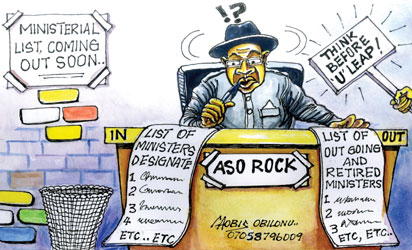
PRESIDENT Goodluck Jonathan’s order to his pre-inauguration cabinet to tarry on was a major hiccup in the vicious campaign by political stakeholders aiming to position themselves in his next cabinet.
Nigerians had expected the President to dissolve his cabinet after last Wednesday’s cabinet meeting preparatory to the re-constitution of what some expected to be a brand new cabinet.
But that hope was dashed when the President ahead of his inauguration last Sunday told the cabinet members to hold on.
If the President’s tarry on order was a let-down, his speech at the presidential inauguration lecture the following day, Thursday was a calamity for many ministerial hopefuls.
Noting his inclination to carry on with many of the outgoing ministers, the President declared:
“One thing that worries me is the duration of ministers serving. For instance from Tafawa Balewa to Odein Ajumogobia, we have had 24 foreign affairs ministers in a spate of 51 years. That means an average of two years per minister. How will a country drive its foreign policies,” he asked in a rhetorical question that would inevitably have enlivened the hopes of the Minister of Foreign Affairs, Ajumogobia.
“For a minister to be very conversant with his or her duties, it will take an average of two years to really understand the policies of his country viz-a-viz international interest. This is the problem we are having,” Dr. Jonathan continued.
“From my interaction with Ministers of Foreign Affairs of some other countries, I realized that they have to stay for a longer period. For instance, Saudi Arabia’s Foreign Minister has stayed for 30 years.”
“I am not saying that any minister should serve like the defunct Soviet Union, that had the longest serving minister for over 40 years, but at least you will expect that a minister if they must transform and if that person is performing above 60 per cent average, if you must change and develop, we expect that minister to stay for a number of years,” he further asserted.
The President’s inclination towards continuity in government comes against the mudslinging and bitterness that has shadowed the request for ministerial nominations by the ruling Peoples Democratic Party, PDP to its state affiliates.
The request was articulated by state chairmen of the PDP in conjunction with PDP Governors in states where PDP is in control and where not by major stakeholders.
In nearly every case, the submission for ministerial nominations were bedeviled by intrigues, belly-aching and vendetta.
In some cases, Governors, out to assert their dominance on the political landscape in their states, moved against ministers who they perceived would be rivals to them in Abuja.
In other cases, party chairmen, out to project themselves and their cronies, moved to also suppress those in the party that could act as rivals to them in the ministerial lists where many of them had also positioned themselves.
In some other cases as in Borno State where the PDP is not in control, stakeholders who met to ponder over the ministerial nomination could barely restrain themselves from blows even though they could not avert a shouting match among themselves.
But the willful decision of some of the Governors and PDP chairmen to de-list some of the serving ministers from consideration is itself raising issues in some quarters.
Among the ministers who were de-listed from their state submissions were the defence Minister Barrister Tokunbo Kayode (Ondo State); Minister of State (Education) Kenneth Gbagi (Delta); Minister of Federal Capital Territory Senator Bala Mohammed (Bauchi) and Petroleum Minister, Mrs. Dizzeani Allison-Madueke (Bayelsa) among others.
The absence of these ministers on the list may not have been a result of their failures in office even where they have not been 100 per cent productive, but more or less on the intrigues in their states.
In Ondo, the battle to ensure Kayode was not returned as a minister was believed to have commenced immediately after the election. At the forefront of the campaign against him are believed to be allies of former Governor Olusegun Agagu who were believed to be working to return their principal as a minister.
It was in that vein that the Minister was first suspended from the party allegedly for his failure to deploy troops to help the party during the last round of elections which had Labour dictating the pace.
In Delta, the absence of Gbagi despite his own considerable support for Governor Emmanuel Uduaghan’s re-election and his own efforts in boosting the President’s re-election campaign in Delta and indeed nationally was puzzling. Gbagi, it would be recalled was nominated as a minister by erstwhile federal commissioner for Information, Chief Edwin Clark and was appointed despite what some alleged to be opposition from Asaba.
While Gbagi’s performance in less than one year is said to be measurably eventful, notably on account of his role in the creation of the new nine universities and some other performance indicators, the decision of the authorities in Asaba to neglect him raises question on the political sagacity of the Governor.
“Gbagi became minister despite the opposition of Asaba and if he again becomes Minister for the second time with the opposition of the Governor, it then means the Delta Governor is misreading his political lessons,” one stakeholder from Delta State said last weekend.
Gbagi it would be recalled, had despite his membership of the Edwin Clark faction of the PDP had at the alleged directive of Mr. President mobilized support for the Governor during the gubernatorial election and was reportedly the facilitator who masterminded the reconciliation of the Governor and Chief Ovie Omo-Agege, the Action Congress of Nigeria, ACN gubernatorial candidate days before the election. Remarkably, Omo-Agege who had at one time waged a verbal war against Governor Uduaghan is on the list of nominees from Delta State.
Mrs. Allison-Madueke like Gbagi became minister without her Governor, Timipire Sylva’s input. She was allegedly the only nominee of then Vice-President Jonathan into the Yar‘Adua cabinet.
She was, however, left out in the ministerial list submitted by the Bayelsa State PDP, a decision that some consider as political naivety on the part of the authorities in Yenogoa.
The absence of the name of the Minister of FCT was indeed not surprising given the recent political acrimony between the minister and the Governor of Bauchi State, Mallam Isa Yuguda. Muhammad was before his election as Senator had worked as a Special Assistant to Yuguda when the later was Minister of Aviation during the Obasanjo years. He was also a central part of the Yuguda political machine that wrested political control of the state from former Governor Adamu Muazu.
However, the falling apart of the two men occurred in 2008 after Yuguda married the daughter of then President Umaru Yar‘Adua and then jumped ship from the All Nigeria Peoples Party, ANPP to the PDP. Though Muhammad was himself to jump ship from ANPP to PDP after he took up position as a minister in the Jonathan cabinet, both men even as fellow PDP members have refused to see eye to eye.
Associates of the FCT minister say that he, Muhammad, as a peace offering made financial contributions to Yuguda’s gubernatorial campaign, but when pressed to disclose the channel of contribution and amount, they budge.
Muhammad, however, counts for him his close association with the President flowing back from his role in mobilizing Senators to support Jonathan in 2010 during the sickness of late President Yar‘Adua when Yuguda and other members of the cabal as they were famed reportedly drew the lines against Jonathan.
Disclaimer
Comments expressed here do not reflect the opinions of Vanguard newspapers or any employee thereof.