By Ebele Orakpo

Famuyiwa
Pleasure in your job puts perfection in the work and removes struggles. This rings true in the case of Deaconess Ibiyemi Famuyiwa, a piggery owner at the Gberigbe Piggery Estate, one of the two piggery estates in Lagos State. In a recent chat with Vanguard in her farm, the former staff of defunct Nigeria External Telecommunications ((NET) and NITEL which was created from the merger of P & T with NET, she spoke on why she got into piggery and the challenges and appeals to government and NGOs to come to their aid as piggery can be another foreign exchange earner. Excerpts:
After 29 years of meritorious service to the nation, Deaconess Ibiyemi Famuyiwa retired in 1998 having attained the position of Manager, Commercial Training, NITEL Training Centre, Oshodi, Lagos.
“I felt it was time to leave. It’s good to leave the stage when the ovation is loudest,” she said.
“I had thought of going into consultancy (training) because I was in the training section but I found out that going into training may not be all right because you have to go cap in hand, begging the training managers for contracts so I decided to take up agriculture which I have passion for. God has blessed us but we are not doing what we ought to do as human beings. We don’t need to cry for food if we till the land and keep the animals. I love pigs so I decided to go into piggery. So after retirement, I used my gratuity and help from friends to start,” said the B.Sc. Accounting graduate of the University of Lagos.
According to Famuyiwa, she first started the business in Sango-Ota but at a point, she lost the animals, among them many pregnant ones. “I was living in Iponri but because of my passion for piggery, I go all the way from Iponri to Sango to rear the animals. Then one day, I and my assistant were not in the farm and the animals just went haywire, destroying farms. I had to leave the place without taking any of them. Then in 2000, there was a form from the Lagos State Government for a piggery estate in Gberigbe. We took the form and in 2002, I started to put up structures because in piggery, you need structures if you don’t want to do it long-range ie having a vast land, fencing it round and allowing the pigs to roam about. I needed structures for the type I am doing.”
Famuyiwa said she started with just five animals – two gilts (young ones), one boar (male pig), one pregnant animal and a sow (one that has already given birth). “A friend who was into piggery gave me three animals – one pregnant animal and two gilts. Another friend gave me two animals. Generally, I will say I started with N100,000 because of the structures. I wanted to put up a room just for me to start because there was no money. Any time I got my pension, I will run down here, buy blocks and keep. Instead of one room, I ended up building six rooms that have now been cut into 12 pens for the pigs to farrow (give birth).
Before disaster struck again in 2006, the farm had over 440 animals some of which weighed over 150kg. “African Swine Fever hit our farm not because we were careless or unhygienic but because a new farmer ignorantly came into the estate with already infected pigs. The disease quickly spread to other animals on the farm. I lost about 375 animals. Everything went down the drain. Before this time, this place was booming. Food vendors, carpenters and other artisans were really busy here until 2006 when the swine fever struck and many closed shop because they lost everything and couldn’t pick up again. We had to wait for almost a year before starting again,” she stated.
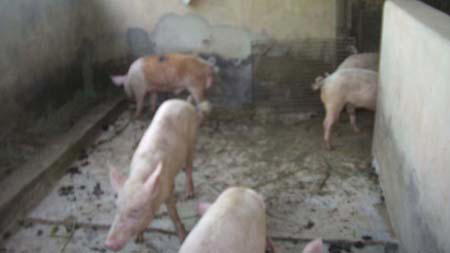
With all the disasters, the amiable piggery owner never gave up as she picked up the pieces once more and today, “we have about 100 animals believing they will quickly multiply. These animals are so interesting. They are rugged. The mortality rate is low and the proliferation is high.”
She noted that the National Programme for Food Security (NPFS), an arm of Lagos State Government, is helping them “although I will say it is the Federal Government helping us but it is the state government that tells them what is happening here as the FG will not sit in Abuja and know what is going on here. They give us stipends to fatten the animals, sell them off and pay back. We pay some charges (about 5%) just for administrative purposes. They give to only established farm owners and not starters. I got about N284,000 in January. I had paid up the one I collected and that made them to give me another one. But some farmers are given as low as N50,000 and they don’t pay back; they see it as their share of the national cake. We try to make them realise that the money is for them to work and expand their business.”
Speaking on the proliferation rate, Famuyiwa, said: “If a pig is crossed today, it will take 3 months, 3 weeks and 3 days (and if possible, 3 hours, 3 minutes) before it farrows so you can know the exact date the pig will farrow. It takes approximately four months. I learnt there are some that put up 20 – 25 piglets at a time but here, we have had 17 which died as a result of mismanagement by the attendant. The pen was always wet whereas the animals need dry, warm surface. For now, the highest we have recorded is 10. Sometimes we have 5 but if I have an animal that consistently gives me just 5, I sell it off because it is unprofitable.”
On the cost of feeding the animals, she said though the feed is generally inexpensive but bringing it to the farm costs a lot. A truck of Cadbury waste (spent grain) costs N15,000 but they will not bring just a truck-load here because it’s far so they would want you to take two truck-loads which is N30,000. You still have to buy other things like soybeans, Indomie waste at N18/kilo, groundnut cake at N56/ kilo. Piggery is a work of hope, you work and pray, hoping that at the end of the day, the animals will have put up X number of piglets and you sell them at Y amount. They are not like chickens which you nurture for four months and sell,” she said, while appealing to companies to help them by bringing these wastes to them, noting that they give the animals wastes because “we cannot afford the normal feed which consists of whole wheat, corn, sorghum and groundnut. That will bring high yield but because we cannot afford these, we give them wastes. We are not feeding them right because of lack of funds but even at that, it is still eating deep into our pockets. We pay the workers whether we make sales or not. It’s not every month we make sales,” she said.
“If we have received training in processing, that would have helped us a lot. Now, the pigs go for N230 per kilogram life weight which is still low. If we have processing centre where we can process these animals, we know everyone cannot go into processing, but let them just give us a centre and have those that are versed in it, that can cut this pork into sizes, and package them well, I know we can even export. If government and NGOs really want to help us, they can put up the necessary infrastructure for us like potable water, power supply, good road network etc. If these are put in place, I know Nigeria, not just the farmers will laugh because Nigeria will be known for exporting pork. We are yet to really feel government’s impact,” she said.
Disclaimer
Comments expressed here do not reflect the opinions of Vanguard newspapers or any employee thereof.