By Ibrahim HassanWuyo
Agricultural scientists at the Institute for Agricultural Research, IAR, in ABU Zaria in collaboration with other researchers would soon unveil to the Nigerian farmers, a new maize variety ,TELA Maize which is water-efficient, drought-tolerant and also fights insects and pest such as fall army worm.
The production of maize in Nigeria was faced by certain constraints in recent years, which perhaps, could be linked to the decline in its production and by extension, a hike in its price since the lower the supply of a commodity, the higher its price could be in the market.
It could be this reason, among others that might have led the experts in agricultural science and biotechnology, to synergies and find a way of improving the crop, through a research on the TELA maize project.
According to Professor Rabiu Adamu, Pricopal Investigator of the Tela maize project at the Institute for Agricultural Research, IAR, in ABU Zaria ,the word ‘TELA’ is derived from the Latin word TUTELA which means ‘Protection’.
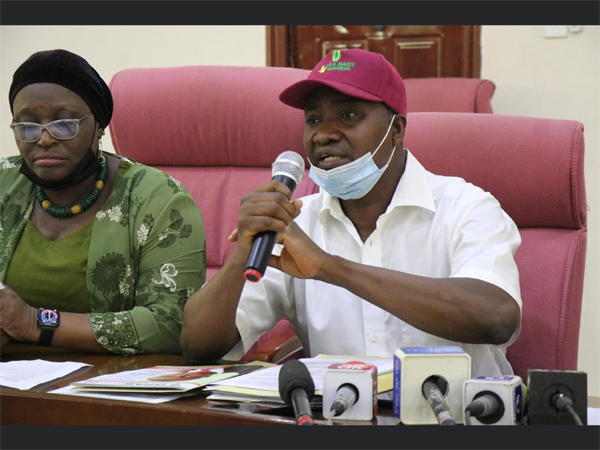
Speaking to Journalists during the harvest of the third set of trials for the TELA Maize Project in the Agricultural Research Institute in Nigeria, IAR Zaria, Prof. Rabiu Adamu said the project is currently implemented in 7 countries ,Ethiopia, Kenya, Mozambique, Nigeria, South Africa, Tanzania and Uganda, and builds on progress made from a decade of excellent breeding work under the Water Efficient Maize for Africa (WEMA) Project.
He said it’s a new maize variety which is water-efficient, drought-tolerant and also fights insects and pest such as fall army worm.
“If you don’t manage drought very well, you may not get any yield. So these 2 challenges, pest and drought, are militating against the production and increased productivity of maize in Nigeria .This project is aimed at alleviating these two major constraints of insect pests that affect maize ,stem borers and fall Army worm and when you’ve moisture deficit. When you have drought, the crop will not do well,” he said.
He explained that they have been doing the trial for the third time, did the first trial in March, during the rainy season conducted another one from June to November ,and this is the third time from November to April.
Before now ,the yield is not more than 3 tons per hectare because of the nature of the variety. But this Tela variety produces up to 8 tons per hectare, under their supervision, he said.
Expectedly, this commendable achievement from 3 tons to 8 tons will go a long way in boosting maize production in Nigeria and will alleviate or reduce food insecurity.
The Director General/ CEO, National Biotechnology Development Agency, NABDA, Prof. Abdullahi Mustapha said modern biotechnology and its tools offer a lot of benefits in agricultural productivity and therefore, could be a game changer if truly and wholly embraced in Nigeria and Africa at large.
“The Federal Government never made a mistake when it decided to invest in biotechnology by creating the National Biotechnology Development Agency as well as the National Biosafety Management Agency to promote and regulate the technology respectively in the country. This is testimony that the country is well prepared and ready with all the required frameworks in place,” he said.
The NABDA boss said as a country, agriculture is one of the major employers of labour in Nigeria but in recent times,” our agricultural processes started encountering challenges of insects / pests, drought, weediness floods ,gully erosion oil spillage etc, that led to reduced yield and made farming very unattractive especially to the youth.”
READ ALSO: Why I sponsored TETFund amendment bill – Senator Adamu
“Biotechnology and its tools ,especially genetic modification, has opened a window of opportunity for us in the country in the deployment of genetic modification in agriculture and we are proud of the institute’s achievement in modern biotechnology,” he said.
He said Nigeria through national and international partnerships, has achieved two remarkable feats in the last few years with the commercial release by the National Varietal Release Committee ( NVRC) of Bt. Cotton and PBR Cowpea .”Today’s activity has again, shown that IAR has perfected the deployment of biotechnology into the agricultural sector as it has taken on the challenges of Fall Army Worm which caused a huge devastation to maize farmers some years back,” he said.
He said NABDA would continue to work with IAR and some other institutions across Nigeria and beyond to promote biotechnology usage /research and development in agriculture as one of the most potent options available to revive agriculture and make it a net contributor to the country’s GDP.
While urging scientists to continue to search for abiotic and biotic solutions to the challenges facing farmers across the nation, Prof. Mustapha said ” now that we have tested technologies capable of providing solutions to problems that farmers face, let us take advantage of it and move forward.”
The Country Representative of Open Forum on Agric Biotechnology, OFAB, in Nigeria, Dr. Rose Maxwell Gidado ,said farmers choose biotech crops because they increase yield and lower production costs.
While assuring of the safety of the crop to man and the environment, Dr.Gidado said farmers would get a greater financial return while using such environmentally friendly farming practices.
The Executive Director of IAR, Professor Mohammad Ishiyaku, who was represented by Prof. Bitrus Tarfa, said the introduction of Tela maize to resist insects would make maize production cheaper in Nigeria.
According to him, Tela maize which is drought resistant, will not only provide stable production of maize but it would expand maize production to marginal areas where rainfall is not so high.
“The IAR is committed so that our agriculture is climate-smart, it must have the resilience to adjust to either of the two extreme conditions and also do very well under optimal environmental condition,” he said.
Some farmers who spoke to Journalists through their representative, Malam Tafida said they are waiting anxiously for the final unveiling of the variety which would not only make them to harvest more, but will ensure the sustenance of our national food security.
They however appealed to government to make subsidized fertilizer available to the farmers and provide them with incentives that would make them participate in dry season farming.
The farmers said they would continue to strive and ensure that food items are not imported into the country. “The Tela maize will add value to the product of our agricultural activity, we will earn more money by producing more ,” they said.
Disclaimer
Comments expressed here do not reflect the opinions of Vanguard newspapers or any employee thereof.