By Josephine Agbonkhese
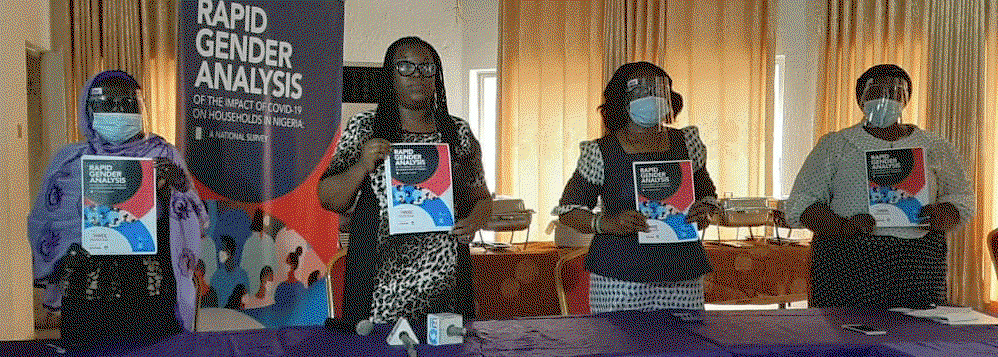
The Women Advocates Research & Documentation Centre, WARDC, report of a national survey carried out to assess the impact of the COVID-19 pandemic on households has revealed lapses in the nation’s emergency response framework.
Titled ‘Rapid Gender Analysis of the Impact of COVID-19 on Households in Nigeria’, the survey was carried out on 10 sample states including Lagos, FCT, Kano, Akwa-Ibom, Enugu, Borno, Kwara, Ogun and Kaduna.
According to Dr Abiola Akiyode-Afolabi, Founding Director, WARDC, the research was necessitated by the negative impacts of the pandemic on the society.
The report was made available to Vanguard during its recent launch supported by the Action Aid and UK-aid.
ALSO READ: Obaseki boosts emergency response with training of first medical responders
“Rapid Gender Analysis, RGA, provides information about the different needs, capacities and coping strategies of women, men, boys and girls in a crisis situation like the COVID-19 pandemic.
“The report highlights the gendered impacts of COVID-19 crisis for effective planning and implementation of national emergency response,” Akiyode-Afolabi said.
According to the survey’s report, promoting transparency and accountability in government institutions is critical for effective implementation of gender equality commitments and service delivery.
It revealed that three-quarters (75.8%) of the respondents across all selected states did not receive any support from government during the crisis, as opposed to claims that the majority of Nigerians were reached under the palliative programme.
“Similarly, none of the respondents from Akwa Ibom and Enugu received cash as form of support from the government.
“Also, only an insignificant proportion of respondents from Lagos (2.4%), Ogun (3.9%) and Borno (2.6%) received face masks and sanitisers as token palliatives.
“Accountability principles did not provide guiding framework in the management of palliatives during the lockdown.
“Accountability principle requires openness and transparency in information sharing and distribution of resources as enunciated by the World Health Organisation, WHO.
“The Nigerian experience clearly negates those principles due to the secrecy that shrouded information and sharing of palliatives,” said the report.
It also revealed that the handling of COVID-19 donations by the Federal Government and different states have not been transparent.
Rapid Gender Analysis noted that: “Women are often more dependent on basic services; healthcare, education, water and sanitation, because of their domestic roles.
“Hence, corruption in such basic services can have disproportionate and negative consequences for women and girls.”
This is as it also revealed that only 63.6% of the households across the selected states were headed by men; “with majority of respondents also living below the poverty line.”
As part of policy recommendation, the report urged the government to urgently incorporate accountability and transparency principles into the national emergency response framework.
It called for the inclusion of the media and civil society actors in the various COVID-19 task forces across board to strengthen transparency.
The Rapid Gender Analysis also recommended the institutionalisation of social support services in the state structure, condemning operation on based a “fire brigade” framework.
Disclaimer
Comments expressed here do not reflect the opinions of Vanguard newspapers or any employee thereof.