By Jeff Agbodo, Abakaliki
The Vice-Chancellor of Alex Ekwueme Federal University, Ndufu-Alike, Ikwo, Ebonyi State, Professor Daniel Nwachukwu, and a Professor of Banking and Finance, Abel Ebeh Ezeoha, have cautioned public and private institutions against borrowing for consumption, urging them to prioritise productive investments for business sustainability.
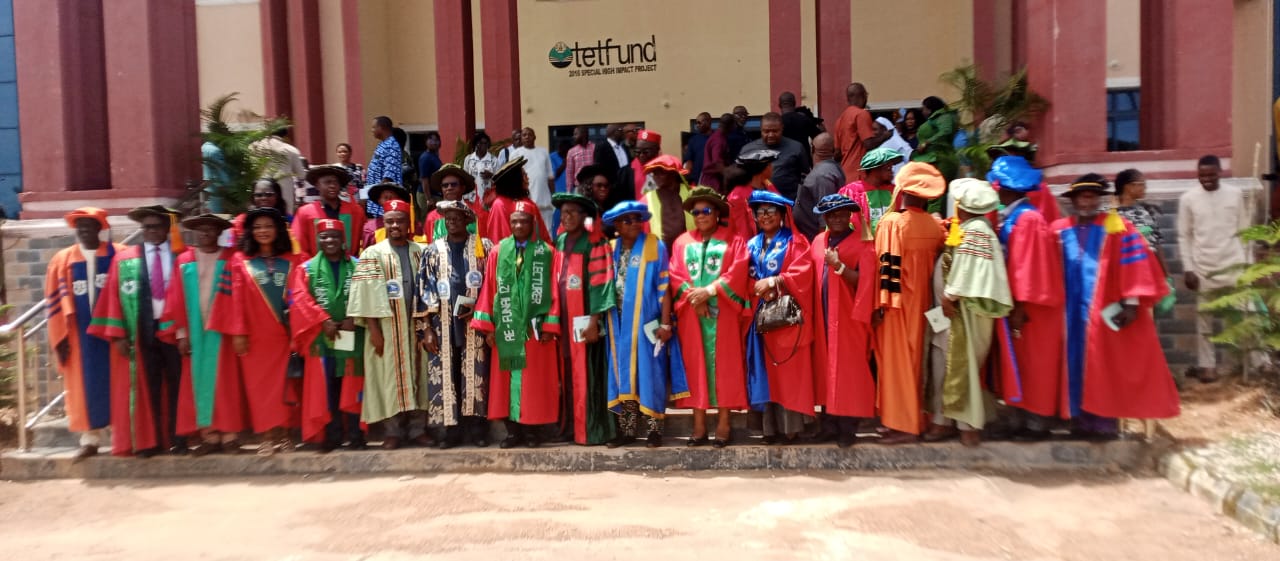
They gave the advice during the 12th inaugural lecture of Ezeoha, titled “Leveraging Under Constraints: The Act of Digging Hole to Fill a Hole.”
Speaking at the event, Nwachukwu said some businesses transformed borrowed funds into productive leverage, while others turned them into constrained leverage that threatened their survival.
He commended Ezeoha for addressing the realities confronting the Nigerian economy, particularly how households, small businesses, banks and governments survive when funds are limited.
“How do we leverage, borrow and manage risk when the entire system is constrained?” he asked.
Nwachukwu added: “Is borrowing to repay borrowing a path to growth or a trap to failure? This is the daily reality of the Nigerian entrepreneur, the banking sector, and our national economy.”
In his lecture, Ezeoha said businesses that suffered from borrowing were often those that used loans for consumption and other non-productive purposes, as well as those that experienced asset mismatches.
He explained that established studies in finance and banking had demonstrated the importance of an optimal capital structure, which involves an appropriate mix of equity and debt financing to balance the risks of losing control or diluting ownership against the risk of bankruptcy.
According to him, a suboptimal capital structure could make debt harmful to a business’s survival, particularly when the company faced a persistent financing gap.
“The process of a firm arriving at an optimal mix is largely a function of its internal structural characteristics. This was the central issue in most doctoral and postdoctoral studies,” he said.
Ezeoha added that a company’s internal characteristics determined how much progress it could achieve through borrowing.
“Firm size and investments in fixed assets are key for access to long-term debt financing and for successfully dealing with the problem of constrained leverage,” he said.
Disclaimer
Comments expressed here do not reflect the opinions of Vanguard newspapers or any employee thereof.