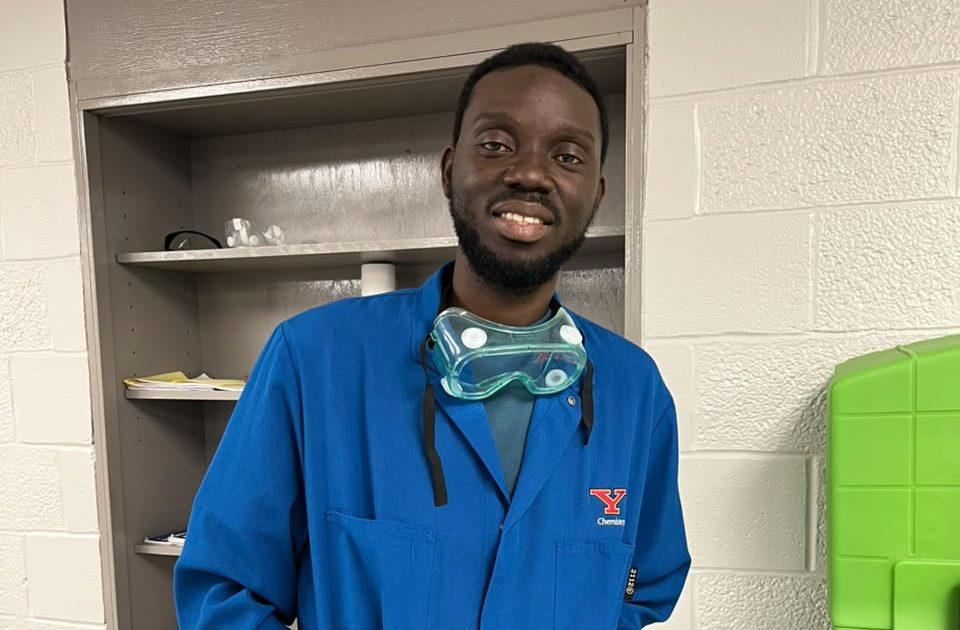
By Rasheed Sobowale
A Nigerian researcher based in the United States, Olatunde Aladegba, is pursuing a research direction that seeks to combine environmental chemistry, biochemistry and artificial intelligence to improve the understanding and early prediction of cancer risks associated with environmental exposure.
Aladegba, who is currently a graduate assistant at Youngstown State University in Ohio, USA, has developed his academic career around analytical chemistry, environmental pollutants, oxidative stress, molecular toxicology, DNA damage and cancer-prevention research.
His research focuses on understanding the molecular mechanisms through which reactive oxygen species and environmental pollutants, including polychlorinated biphenyls, can induce DNA damage, genomic instability and chronic disease development.
In an interview, Aladegba said his long-term interest was to translate biochemical research into preventative strategies that could contribute to improved public health outcomes.
“I am interested in understanding how environmental exposures affect biological systems and how we can use scientific information to identify risks earlier and develop better preventive strategies,” he said.
Aladegba’s research journey began with chemistry and analytical science at the University of Lagos, where he obtained a BSc in chemistry and later an MSc in analytical chemistry.
His MSc research at the University of Lagos examined polychlorinated biphenyl congeners in e-waste and automobile dismantling sites, investigating their distribution, environmental fate and human health risks associated with contaminated soils.
He is currently pursuing an MSc in chemistry at Youngstown State University, where his thesis focuses on oxidative stress, DNA damage and cancer prevention.
According to Aladegba, the two areas of research have helped shape his interest in understanding the relationship between environmental contaminants and biological damage.
“My research interests have progressively moved towards understanding the relationship between what happens in the environment and what happens at the molecular level inside the body,” he said.
He said his current research direction seeks to take that understanding further, by exploring how artificial intelligence-driven biochemical models could be applied to complex environmental and biological information.
The proposed approach would seek to identify relationships between environmental pollutants, oxidative-stress biomarkers and indicators of DNA damage, with the broader objective of supporting earlier prediction and prevention of environmentally induced cancers.
Aladegba said artificial intelligence could potentially assist researchers in analysing complex datasets that may be difficult to interpret through conventional approaches alone.
“The potential of artificial intelligence is in helping us analyse large and complex sets of information and identify patterns that may not be immediately obvious. However, the models must be scientifically validated and connected to reliable biochemical data,” he said.
He stressed that the use of AI in biomedical research should not replace laboratory science or professional medical judgment.
He added, “AI should be a tool that supports scientific understanding. It cannot replace proper laboratory validation, clinical evidence or the judgement of healthcare professionals.”
Aladegba said his interest in biomarker discovery formed an important part of this research direction, because biological indicators could potentially provide information about the body’s response to environmental exposure.
Beyond his academic work, Aladegba has accumulated professional experience in health, safety and environmental management, analytical project management, oil and gas operations and quality assurance.
He served as Analytical Project Manager and Health, Safety and Environment Manager at Impact Energy and Logistics Limited from October 2024 to December 2025 and previously worked as a Quality Health Safety and Environment Manager at Raven Energy Limited between February 2023 and September 2024.
He said those experiences had strengthened his understanding of the practical side of environmental risk.
According to him, research is important, but it is also important to understand how environmental risks exist in real-world settings and how organisations manage those risks.
Aladegba is also experienced in environmental sampling and analytical testing, which and has received professional training in occupational and environmental safety and health.
He said his future research interest is ultimately connected to public health, particularly the need to identify environmental risks before they translate into serious disease.
“My goal is to contribute to research that can help us identify environmental risks and biological warning signals earlier, so that prevention can happen earlier as well,” he said.
He said the proposed application of AI-driven biochemical modelling would focus on strengthening the ability to connect environmental exposure data with biological indicators of damage.
The researcher said such an approach could potentially contribute to personalised intervention by helping researchers better understand differences in biological responses to environmental exposures.
“The important thing is to build something scientifically credible. We need reliable environmental data, reliable biomarkers, strong biochemical models and proper validation before such tools can be considered useful for public health,” he said.
Aladegba said his long-term objective was to contribute to evidence-based strategies for reducing environmentally induced cancer and other diseases associated with oxidative stress.
He said his work in the United States represented the continuation of a research path that began with environmental and analytical chemistry in Nigeria and has increasingly moved towards understanding the biological consequences of environmental exposure.
He stressed, “I see the different parts of my background as connected. The environmental work helps us understand the exposure, the analytical chemistry helps us identify and measure it, the biochemical research helps us understand the biological response, and the emerging AI direction is about how these different forms of information can potentially be brought together.”
Disclaimer
Comments expressed here do not reflect the opinions of Vanguard newspapers or any employee thereof.