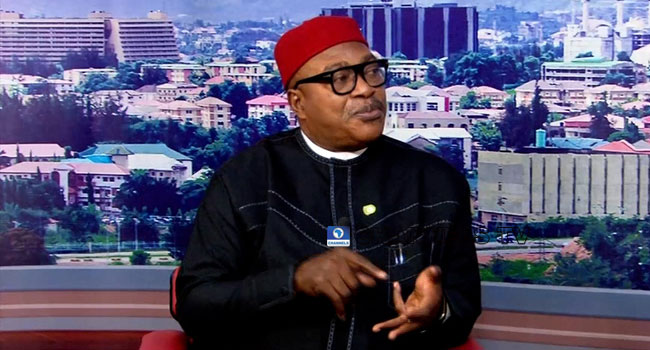
A former Director of the Department of State Services (DSS), Mike Ejiofor.
By Johnbosco Agbakwuru
Mr Mike Ejiofor, a security expert, is a former Director in the Department of State Service (DSS). In this interview, Ejiofor discusses the reasons for the upsurge of insecurity, especially in the South-West, and the challenges facing Nigeria Police, citing lack of equipment and funding.
According to him, failure to establish state police is a significant hindrance as local forces would better understand and combat terrorism. He highlights a geographical shift in terrorist activity from the North-East to the South-West, driven in part by the South-West’s larger Muslim population. He clarifies that the upsurge is not due to an intelligence failure but to a lack of capacity and resources for action agencies. Excerpts:
There is an upsurge in terrorist activity. Does this mean there has been an intelligence failure? Is security compromised? Are agencies unequipped to pursue these people? Is there any conspiracy? Does the government lack seriousness in tackling it? What is your take?
I wouldn’t say it’s an intelligence failure. I have always maintained that even when intelligence is provided, the action agencies may lack the capacity to act—not through any fault of their own, but because they are ill-equipped, underfunded, and understaffed. All these factors create the appearance that security agencies are not working, but they are. You saw the conviction of the Owo suspects—that was due to good intelligence, even though the incident happened in 2022; they were traced and arrested. When intelligence is available but becomes difficult to act on, it compounds the problem. Another factor is that many of these terrorists—Islamic fundamentalists who reject Western education and democracy—tend to increase activity ahead of elections. With elections coming up, they try to discredit the government. But until the government takes this issue seriously, you cannot blame the security agencies alone. You must ask: what percentage of appropriated budgets is actually released? What is the welfare of the security forces? What is their strength? Those are questions that need answers. Multiple factors are responsible for the surge in attacks.
So what would you say to people who claim security has failed?
If they say security has failed, that means all of us have failed. Government is primarily responsible for the welfare and security of citizens, but people must also contribute by supporting security agencies. The Director-General of the SSS said some time ago that the first line of defence is the people. Beyond public involvement, a major drawback in this fight is the absence of state police. Major stakeholders—the state governments, the federal government, and the National Assembly—have agreed on this in principle. So why hasn’t it been established? Critics argue that state police have disadvantages, just as any institution does, but establishing state police is one of the surest and fastest ways to check this menace. State forces would be drawn from local communities, know the terrain, and work in collaboration with the federal police. They would increase manpower and be better equipped. Vigilante groups lack sophisticated weapons and cannot confront marauders who possess prohibited firearms.
It appears terrorists are concentrating in the South-West. What is responsible for that—especially kidnapping and attacks on schools?
It began in the North-East, and when pressure increased there, they relocated to the North-West, and now they are moving South, concentrating on the South-West, which has a larger concentration of Muslims than the South-South or South-East. They claim to be proclaiming jihad, though they do not follow the mainstream practice of Islam; they target areas where they have followers.
But the South-West is not predominantly Muslim.
I did not say it is predominantly Muslim. I said it has a larger concentration of Muslims compared with the South-East or South-South.
Why are they kidnapping children and targeting schools?
They aim to instill fear. Beheading or abducting people is meant to terrorize the population—that is the core of terrorism—and to discredit the government.
What’s the best way to tackle this menace?
As I said earlier: insufficient funding, lack of personnel, poor welfare, and inadequate training. What is the current strength of the Nigerian police? Most importantly, we need state police to man localities. These problems are local, and the solutions must be local.
Do you think the government is doing enough?
That is for the people to judge.
As a security expert, is the government doing enough to tackle insecurity?
As a security expert, I can only offer advice; implementation is up to the government. The people who are supposed to be protected are best placed to say whether the government is doing well.
You mentioned state police, funding, and other measures. Are these immediate steps to restore order?
Yes. I don’t see why state police cannot be established immediately; that is a major step in checking this menace. The Nigerian Police Force is not well equipped in many respects. Officers are posted to areas they don’t know—lacking language skills and cultural familiarity—and are transferred again before they learn the terrain. In
Disclaimer
Comments expressed here do not reflect the opinions of Vanguard newspapers or any employee thereof.