By James Ogunnaike, Abeokuta
Ogun State government has rolled out a new set of planning regulations and a landmark Building and Construction Code aimed at ensuring orderly urban growth, safeguarding lives and property, and strengthening investor confidence in the State’s industrial hub.
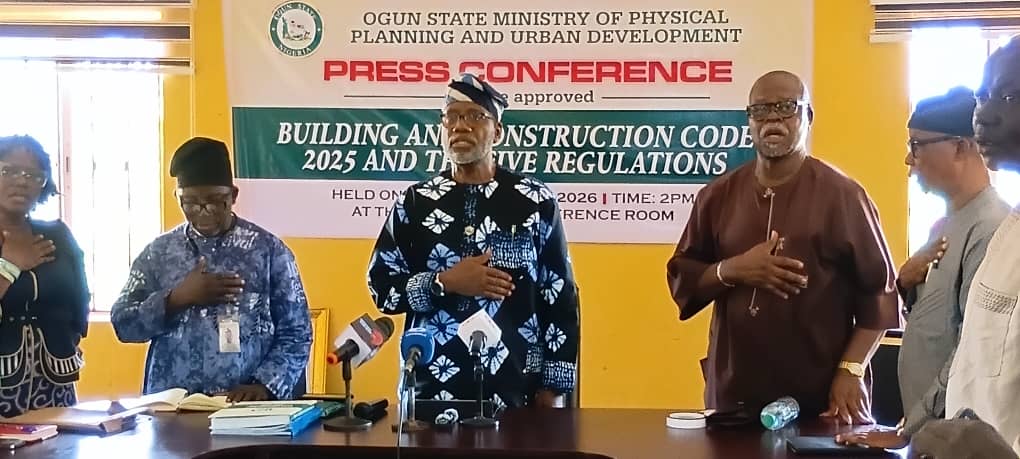
Speaking at a press conference in Abeokuta, Ogun State, the Commissioner for Physical Planning and Urban Development, TPl. Olatunji Odunlami, said the reforms mark “a significant milestone in the physical development trajectory of the State.”
He noted that the newly approved instruments include the Planning and Development Permit Regulation 2025, Slum Regeneration Regulation 2025, Building Production Management Regulation 2025, Outdoor Physical Furniture Regulation 2025, and Layout and Land Subdivision Regulation 2025.
In addition, the Ogun State House of Assembly has approved the Ogun State Building and Construction Code 2025; described by the Commissioner as the first of its kind by any state in Nigeria.
“These instruments collectively represent a bold and necessary step towards ensuring that Ogun State remains orderly, safe, environmentally sustainable, and nationally acknowledged in its physical planning and urban development activities,” Odunlami said.
The Commissioner recalled that upon assuming office in 2019, the Ministry operated under a single law and regulation — the Ogun State Urban and Regional Planning Law and the 2005 Board Regulation.
He explained that under the current administration, the system has been overhauled into a more robust structure comprising one ministry and three specialized agencies, supported by a principal law and multiple regulations.
“Ogun State remains the first and still the only state in Nigeria with such an array of legal instruments to adequately manage its physical planning and development,” he stated.
Odunlami emphasized that the reforms were necessitated by the state’s rapid urbanization and economic expansion, which have positioned the State, as one of Nigeria’s fastest-growing subnational economies and a prime destination for investors.
“As growth is desirable, unregulated development can lead to poor urban living, proliferation of informal settlements, building collapses, and environmental degradation,” he warned.
He stressed that compliance with the new regulations is mandatory for all stakeholders, including landowners, developers, contractors, artisans, and professionals in the built environment.
To support compliance, the government has introduced reforms to streamline approval processes, including the deployment of an electronic planning platform in six pilot zones — Isheri, Ota, Abeokuta Metro, Abeokuta Central, Sagamu, and Ijebu-Ode.
“It is now possible to submit planning permit applications online from anywhere in the world,” Odunlami said, adding that help desks have also been established to assist users.
He noted that the initiative is designed to enhance transparency, accessibility, and efficiency in planning approvals.
The Commissioner issued a strong warning that the government would strictly enforce the new regulations.
“Anyone who carries out development in violation of these regulations will face appropriate sanctions, including penalties, demolition of illegal structures, and criminal prosecution,” he said.
He decried the persistent encroachment on road setbacks and highways across the state, describing it as a major threat to safety, environmental quality, and urban aesthetics.
“Encroachment into these public spaces is not only illegal, but also undermines the beauty and functionality of our transportation corridors. The government will no longer tolerate such practices,” he declared.
Affected corridors include major highways such as the Lagos–Ibadan Expressway, Abeokuta–Sagamu Interchange, Sagamu–Benin Expressway, Lagos–Abeokuta Road, and other key routes across the state.
He directed property owners to immediately remove unauthorized structures within setback areas and restore them through landscaping and greening efforts.
Odunlami, while stressing that the success of the new framework depends on collective responsibility, he stated that “we need the cooperation of every citizen, every professional, and every investor. Together, we can shape a better future for our state,” he said.
He also commended individuals and organizations that have already complied with setback regulations, noting that the government is compiling a list for formal recognition.
The Commissioner described the documents as the definitive reference for all physical development activities in Ogun State.
“I encourage all stakeholders to familiarize themselves with these regulations and adhere strictly to their provisions so that we can promote a safe, functional, and aesthetically pleasing environment for living, working, and recreation,” he added.
Disclaimer
Comments expressed here do not reflect the opinions of Vanguard newspapers or any employee thereof.