By Ebunoluwa Sessou
For millions of Nigerians living with disabilities, the greatest obstacle is not blindness, paralysis, deafness or intellectual disability.
It is a staircase without a ramp. A bank counter that is too high. An elevator too narrow for a wheelchair. A hospital without tactile signs. A government office with no trained personnel to assist someone with an intellectual disability.
Every day, these barriers quietly deny millions of people access to education, healthcare, employment and justice, not because they lack ability, but because society was never designed with them in mind.
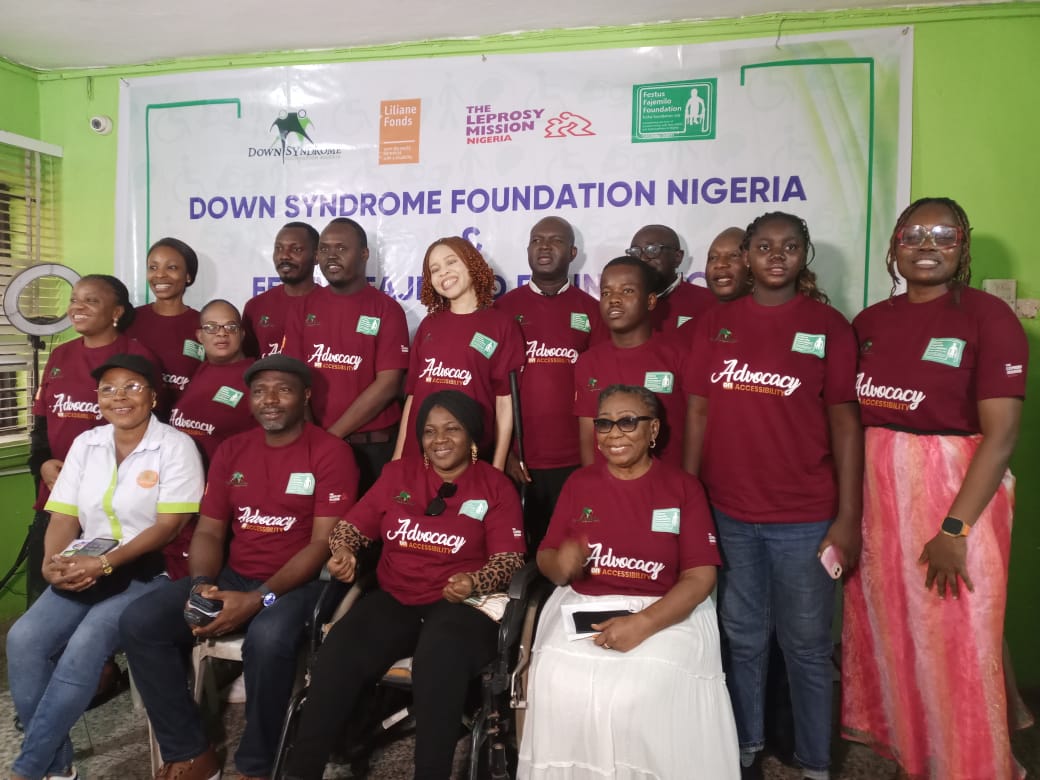
Recently, the Down Syndrome Foundation Nigeria, DSFN and the Festus Fajemilo Foundation FFF, in collaboration with disability clusters under the Joint National Association of Persons with Disabilities, JONAPWD, launched an accessibility advocacy campaign demanding compliance with laws guaranteeing access to public facilities. For them, accessibility to public facilities is not charity; it is a constitutional and human right. The campaign was themed “Advocacy on Accessibility Compliance of Public Facilities.”
The project concluded its pilot phase with what organisers described as a national first: structured, legally grounded accessibility compliance audits of public-facing corporate facilities conducted by trained representatives of eight disability clusters. The project was implemented by DSFN and FFF in collaboration with the disability clusters under the JONAPWD Lagos State Chapter, with funding from the Liliane Foundation and support from The Leprosy Mission Nigeria.
Technical facilitation and audit verification were provided by the technical consultant, Inclusive Development Consults Limited,IDCL.
Three interlocking legal instruments establish accessibility for persons with disabilities as a binding legal obligation rather than a goodwill gesture.
The United Nations Convention on the Rights of Persons with Disabilities,UNCRPD, Article 9, ratified by Nigeria in 2010, guarantees equal access to the physical environment, transportation, information and services for persons with disabilities.
The Discrimination Against Persons with Disabilities (Prohibition) Act, 2018, Section 1(2), mandates accessibility in all public buildings and services and criminalises discrimination against persons with disabilities.
The Lagos State Special People’s Law, 2011, Section 29(1)-(2), specifically requires ramps, lifts, accessible toilets, tactile signage and barrier-free pathways in all public buildings in Lagos, under the supervision of the Lagos State Office for Disability Affairs, LASODA.
Unfortunately, these legal provisions remain stronger on paper than in implementation. For years, persons with disabilities in Nigeria have fought an uphill battle against inaccessible public buildings, poor infrastructure and a society that often views disability through the lens of pity rather than rights.
Many simply accepted that if a building had a ramp, even one that was too steep or poorly constructed, it was considered “accessible.”
Speaking, President of the Down Syndrome Foundation Nigeria, Rose Mordi, highlighted the country’s accessibility challenges.
She said: “Despite the existence of disability laws, local audits in Lagos and the Federal Capital Territory,FCT reveal significant gaps. Basic accessibility features such as elevators, tactile floor paving and properly graded ramps are frequently missing. Many of the ramps that exist are too steep or improperly constructed.
“Healthcare facilities and other public institutions also lack basic accessibility features, making it extremely difficult for persons with disabilities to access essential services.
“Students with disabilities face serious challenges accessing classrooms, libraries and hostels in many public tertiary institutions. This undermines their fundamental right to education.
“Coalitions, including the Joint National Association of Persons with Disabilities, continue to advocate stricter enforcement of disability laws and the inclusion of persons with disabilities in the planning and design of public infrastructure.”
Vanguard gathered that some of the key provisions of the national disability law include a five-year transition period granted to public buildings and transport systems to modify their infrastructure. That grace period expired in January 2024, meaning all public facilities are now legally required to be fully accessible.
The Act also established the National Commission for Persons with Disabilities, NCPWD, which is responsible for monitoring compliance, issuing accessibility guidelines and deploying task forces to sanction defaulting institutions.
Public institutions are also required to reserve at least 5 per cent of their workforce for persons with disabilities.
Individuals found guilty of discrimination against persons with disabilities are liable to a fine of ₦100,000 or a six-month prison term, while corporate organisations are liable to a fine of ₦1,000,000.
The law also guarantees free education for persons with disabilities up to secondary school level, priority in public queues and first consideration during national emergencies.
A nation that excludes millions
Nigeria is home to an estimated 25 to 35 million persons with disabilities, yet advocates say the overwhelming majority of public infrastructure remains inaccessible despite existing laws.
Schools, hospitals, shopping malls, transport terminals, banks and government offices continue to pose daily challenges for persons with disabilities.
According to disability advocates, fewer than 2 per cent of persons with disabilities have access to education, while formal employment remains below 1 per cent, largely because public facilities and workplaces remain inaccessible.
Although the Discrimination Against Persons with Disabilities (Prohibition) Act, 2018, and the Lagos State Special People’s Law require accessibility in public buildings, implementation has been slow and enforcement even weaker.
It was against this backdrop that DSFN and FFF embarked on months of accessibility audits involving the disability clusters under the Joint National Association of Persons with Disabilities (JONAPWD) in Lagos State.
Four stages of domestication for state compliance
For any federal law to become fully operational and legally enforceable within a state in Nigeria, it must pass through four legislative and administrative stages.
The first is Legislative Passage, where the State House of Assembly drafts, debates and passes a version of the law suited to the state’s legal framework.
The second is Gubernatorial Assent, where the governor signs the bill into law.
The third is publication in the Official Gazette, which formally notifies the public and relevant institutions that the law has come into effect.
The final stage is Institutional Enforcement, which involves establishing a functional disability commission or board and providing adequate funding to monitor compliance and sanction offenders.
States that have fully domesticated the law
According to research, 17 states have successfully completed all four stages by passing the law, gazetting it and establishing functional disability boards or commissions. They are Abia, Anambra, Bauchi, Ekiti, Gombe, Kaduna, Katsina, Kogi, Lagos, Nasarawa, Ondo, Osun, Oyo, Plateau, Sokoto, Yobe and Zamfara.
Some other states, including Benue, have recently secured gubernatorial assent but are still finalising gazetting and the establishment of enforcement agencies.
Eleven states are yet to fully domesticate and enforce the Discrimination Against Persons with Disabilities (Prohibition) Act. They include Akwa Ibom, Bayelsa, Borno, Delta, Ebonyi, Katsina, Kebbi, Ogun, Rivers, Taraba and Yobe.
Although some of these states, such as Delta and Ogun, have passed disability bills through their Houses of Assembly, the laws remain ineffective because they have not received gubernatorial assent or been officially gazetted.
Research also identified policy challenges associated with the domestication gap, noting that Nigeria’s federal system means federal laws do not automatically apply to state-owned facilities.
Despite the expiration of the January 2024 compliance deadline, implementation remains weak. National audits indicate that only about 22.4 per cent of assessed public buildings have functional ramps.
Funding constraints, institutional capacity gaps and inadequate logistics continue to hinder the National Commission for Persons with Disabilities from effectively enforcing compliance and prosecuting defaulting ministries, agencies and corporate organisations.
Lamenting the ordeal of accessing major public facilities, Anu Oluwayinka of the Nigeria Association of the Blind said society has not been fair to persons with disabilities.
“Now, I know that it is my right to have access to public facilities. Nigerians must know that we have rights that are internationally recognised, and this goes beyond what many previously understood.
“In the past, we simply asked for accessibility. We thought that once a building had a ramp, the job was done. But we have now learnt that accessibility is much more than that. There are standards. A ramp alone is not enough. There should be handrails, tactile guides and other features that make buildings usable for everyone.
“I visited a facility recently, and I was impressed that it uses voice-assisted technology, allowing people with visual impairments to navigate independently.
“For the first time, we saw accessibility being implemented in a way that truly considered our needs,” he said.
“When blind people spoke, they only talked about issues affecting blind persons. When persons with physical disabilities spoke, they focused only on their own concerns. This training taught us that disability advocacy is stronger when we work together.”
He believes that collaboration will give persons with disabilities greater influence in demanding accountability from both public and private institutions.
“Whatever you do alone may end with you. But when we come together, our voices become stronger.”
Disability can happen to anyone
He also stressed that disability is not something that affects only a particular group of people.
“Disability is not determined by race, social class or nationality. It can happen to anybody at any time. That is why accessibility should concern everyone.
“We are moving completely away from charity-based advocacy,” Oluwayinka said.
“People should not see us as beneficiaries asking for favours. These are rights protected by law, and we now understand that we have the legal backing to demand them.”
The law must work for everyone
Jessica Hyacinth of the Albinism Association of Nigeria, Lagos Chapter, said, “We now have the confidence to challenge institutions that fail to meet accessibility standards.
“If a building claims to be accessible and it is not, we now know that it does not meet the required standards,” she said.
‘Access is my right, not a privilege’
Similarly, Oluwafunmilayo Mobolaji, a spinal cord injury survivor, said, “It is not a privilege for me to enter a building. It is my right.”
Mobolaji said she would continue advocating alongside other disability clusters, insisting that organisations and government agencies that ignore accessibility laws should be held accountable.
“We will continue our advocacy and we will not stop. Where there is non-compliance with the law, we will pursue it through legal means.”
Armed with knowledge, strengthened by collaboration and emboldened by the law, the advocates said they are determined to ensure that Nigeria becomes a society where inclusion is not optional but standard practice which includes one building, one institution and one policy at a time.
Hope for a more inclusive Nigeria
For persons with disabilities, the end of the training marked the beginning of a larger mission.
They envision a Nigeria where schools, hospitals, government offices, banks, transport terminals, shopping malls and recreational centres are designed to accommodate everyone, regardless of physical ability.
They dream of a society where accessibility is no longer treated as an afterthought but as a fundamental requirement.
“We believe that within the next one or two years,” Oluwayinka said, “we will begin to see changes that have not happened in the last five or even 10 years. People are no longer speaking for us. We are speaking for ourselves.”
Accessibility is a human right, not a privilege
For Mordi, the campaign for accessibility is no longer about raising awareness alone; it is about ensuring that government, businesses and society fulfil their legal and moral obligations to persons with disabilities.
Speaking during a media engagement following an accessibility audit conducted across several public and private institutions in Lagos State, Mordi described the media as an indispensable partner in driving social change.
“We are glad to have this media parley today because, as they say, anything you do without the media is like blinking in the dark. You are the only one who knows that you are blinking,” she said with a smile.
“But when the media is involved, the message gets to those who have the power to make decisions and influence change.”
She explained that the accessibility audit took advocates to numerous organisations across Lagos, where they assessed how inclusive buildings and services were for persons with disabilities.
According to her, the findings underscored the urgent need for the full implementation of existing accessibility laws.
Beyond buildings and ramps
Mordi stressed that accessibility should not be reduced to the construction of ramps or wheelchair-friendly entrances.
While physical access remains important, she said true inclusion also requires systems and services that accommodate people with different forms of disability, including those that are not immediately visible.
“We are not talking only about persons with physical disabilities,” she explained.
“There are disabilities that are not visible, yet they can be even more profound. Accessibility goes beyond physical structures. There must be deliberate provisions that allow every person with a disability to interact freely and independently.”
Using the banking sector as an example, she described the everyday barriers faced by persons with intellectual disabilities.
“A person with an intellectual disability may want to go to a bank, but without someone accompanying them, they may not even receive the attention they need.”
To address such challenges, Mordi advocated the establishment of dedicated disability support desks in corporate organisations and public institutions.
“What we are asking for is that every organisation should have a disability desk staffed by trained personnel who understand how to assist people with different disabilities. That is what real accessibility looks like.”
The forgotten disability
Mordi said persons with intellectual disabilities remain among the most neglected members of the disability community.
She lamented that they are frequently denied opportunities and treated as though they have no rights.
“People with intellectual disabilities are among the most marginalised in the disability community. Many people assume they have no rights and treat them with impunity, while others simply look away.”
She said changing that narrative requires collective action by government, institutions, civil society organisations, the media and ordinary citizens.
A law that must be enforced
Mordi noted that Nigeria already has legislation protecting the rights of persons with disabilities, including provisions requiring public buildings to be accessible.
According to her, implementation remains the greatest challenge.
“The government gave organisations years to make their facilities accessible, but many have failed to comply.”
She argued that compliance should no longer be voluntary.
“There should be consequences for organisations that refuse to put the required structures in place. The law must be enforced.”
No one should be left behind
For Mordi, accessibility is ultimately about recognising the dignity and equality of every human being.
She challenged Nigerians to rethink their understanding of disability.
“I usually ask people whether there is anyone who has no form of disability at all. The truth is that disability can affect anyone at any stage of life.”
She observed that those with visible disabilities often suffer the greatest stigma and discrimination despite having the same rights as every other citizen.
“The people whose disabilities are visible are often the ones denied opportunities and prevented from exercising their basic human rights.”
A call for collective responsibility
Rather than leaving the struggle to disability organisations alone, Mordi urged every Nigerian to become an advocate for inclusion.
“We should not be bystanders,” she said.
“We must deliberately create an environment where every human being enjoys equal rights and equal opportunities.”
She described accessibility as one of the most important human rights issues facing Nigeria today and called on government agencies, businesses, professional bodies and the media to work together to ensure that inclusion becomes a reality rather than an aspiration.
“Accessibility is not a privilege; it is a human right, and every Nigerian deserves to enjoy it without discrimination,” she said.
Accessibility should be the standard, not an afterthought
For the Executive Director of the Festus Fajemilo Foundation,FFF, Afolabi Fajemilo, creating an inclusive society is a responsibility that belongs to everyone, not just persons with disabilities or advocacy groups.
Speaking during the media engagement on the accessibility audit project in Lagos, Fajemilo said the campaign for disability inclusion is a collective responsibility that requires the commitment of government, the private sector, civil society and every Nigerian.
“What we are doing is not something that a few people can achieve,” he said. “It is something that every single person should be part of.”
Fajemilo lamented that persons with disabilities have remained on the margins of society for decades, with governments and institutions often treating accessibility as an act of generosity rather than a fundamental right.
According to him, one of the biggest misconceptions is the notion of “reasonable accommodation”, a phrase commonly used in disability advocacy.
“I do not particularly like using the phrase ‘reasonable accommodation’ because it suggests that people with disabilities were not considered from the beginning and are only being remembered as an afterthought,” he said.
Instead, he argued that buildings, public spaces and services should be designed from the outset to serve everyone equally.
“Accessibility should be part of the original design. It should not be something added later because someone complained.”
Equal rights for every human being
Fajemilo stressed that disability should never define a person’s entitlement to opportunities or public services.
“We are human beings first before anything else,” he said.
“Whether a person has a disability, belongs to a particular race or has any other difference, every human being has the right to enjoy equal access in every sphere of life.”
He noted that accessibility is about creating a level playing field where no one is excluded because of physical, sensory, intellectual or other forms of disability.
From legislation to implementation
While acknowledging that Nigeria has laws protecting the rights of persons with disabilities, Fajemilo said the greatest challenge remains enforcement.
He urged authorities to move beyond policy pronouncements and begin implementing existing legislation.
“When we come together and make our voices heard, those responsible for making decisions will begin to rethink their attitude towards enforcing the law,” he said.
African solutions for African realities
Fajemilo also drew attention to the African Disability Protocol, describing it as an important regional framework that complements the United Nations Convention on the Rights of Persons with Disabilities, UNCRPD.
According to him, although many African countries have signed and ratified the protocol, implementation has remained slow.
“Africa has unique realities that require African solutions. That is why the African Disability Protocol is important. The challenge has never been signing these instruments; it has always been implementing them.”
Designing communities for everyone
Fajemilo said accessibility should extend beyond government offices and corporate organisations to include residential estates, commercial centres and privately owned buildings.
He reiterated that inclusion should never be viewed as a favour granted to persons with disabilities.
“We should stop thinking of accessibility as something we are giving to people. It is not a privilege. It is a right.”
He explained that this belief has driven the partnership between the Festus Fajemilo Foundation and other disability organisations on the ongoing accessibility project.
“Our organisations embarked on this project because we believe that everyone deserves equal access. It has been running for several months, and this is only the beginning.”
For Fajemilo, the ultimate goal is to build a society where accessibility is no longer discussed as a special intervention but accepted as a basic standard that guarantees dignity, independence and equal participation for every Nigerian.
Accessibility exists on paper, not in practice
In her assessment, the technical consultant, Modinat Tijani, said that although many public and private organisations in Lagos have attempted to provide accessibility features for persons with disabilities, the reality is that most of them fail to meet the standards required for independent use.
Leading the accessibility audit across several institutions in Lagos State, Tijani said the exercise revealed that accessibility is often treated as an afterthought rather than an essential part of architectural planning.
Most buildings only tick the box
The consultant explained that many organisations appeared willing to install accessibility features but lacked adequate knowledge of the technical standards required under the law.
“We discovered that many organisations are willing to include accessibility features, but they do not understand the required specifications,” Tijani said.
“In many cases, ramps, elevators and other features were simply added after the buildings had already been completed instead of being integrated into the original design.”
According to Tijani, this approach results in facilities that technically exist but are practically unusable.
A ramp is not enough
One of the major shortcomings identified during the audit was the poor quality of accessibility infrastructure.
The consultant said many ramps were too steep for wheelchair users, while elevators were designed without considering the minimum dimensions required for accessibility.
“There are internationally accepted measurements and standards for ramps, including their gradient and width. Many of the ramps we inspected were far too steep for independent use.”
The same problem, the consultant noted, was found with elevators.
“In several buildings, elevators had been installed, but the entrances were too narrow for wheelchairs to pass through,” she said.
According to the consultant, accessibility should be measured by functionality rather than mere presence.
“It is not enough for an elevator or a ramp to exist. The real question is whether the person it was designed for can use it independently.
“If a wheelchair user cannot enter an elevator because the doorway is too narrow, then that elevator is not accessible.”
Usability should be the benchmark
Tijani stressed that the audit focused on whether accessibility features could actually be used safely and independently by persons with disabilities.
“Our findings were based on usability, not simply on whether a facility had a ramp or an elevator.
“The purpose of accessibility is to ensure independence. If someone still needs assistance to use a facility that was supposedly designed for them, then that objective has not been achieved.”
A shift in advocacy
Beyond evaluating buildings, the audit also exposed what the consultant described as a long-standing gap in Nigeria’s approach to disability advocacy.
According to the consultant, previous advocacy efforts focused largely on demanding accessibility without paying sufficient attention to technical standards.
“This audit has shown us that we need to redirect our advocacy.
“It is no longer enough to ask organisations to provide accessibility features. We must also ensure that whatever they provide complies with recognised standards.”
The findings, the consultant said, will form part of a policy brief to be presented to Lagos State policymakers.
Recommendations
The consultant urged greater collaboration among government agencies responsible for planning, construction and disability affairs.
Among those expected to receive the recommendations are the Lagos State Office for Disability Affairs, LASODA, the Lagos State Ministry of Youth and Social Development, the Lagos State Ministry of Works and Infrastructure, and the Lagos State Ministry of Physical Planning and Urban Development.
Rather than limiting interventions to stakeholder meetings and awareness campaigns, the consultant said government agencies should engage organisations directly to improve compliance.
“LASODA should move beyond awareness creation and begin working one-on-one with organisations to ensure they understand and implement accessibility standards.”
The consultant also recommended the development of detailed regulations specifying the required standards for ramps, elevators, walkways, signage and other accessibility features.
“Without clear technical specifications, people will continue installing facilities that do not actually serve persons with disabilities.”
Professional bodies have a role to play
The consultant further called for stronger collaboration between government ministries and professional associations such as architects, engineers and builders.
According to the consultant, once professional bodies adopt standard accessibility guidelines, compliance among their members will improve significantly.
“If professional associations begin promoting these standards, they will naturally cascade to practitioners responsible for designing and constructing buildings.”
Laws exist, enforcement remains weak
Responding to questions about why accessibility barriers persist despite existing legislation, project officials acknowledged that Nigeria already has robust legal frameworks protecting the rights of persons with disabilities.
They cited the United Nations Convention on the Rights of Persons with Disabilities, the Discrimination Against Persons with Disabilities (Prohibition) Act, 2018, and the Lagos State disability law, all of which contain provisions requiring accessible public infrastructure and prescribe penalties for non-compliance.
However, they noted that enforcement has remained largely ineffective.
“The penalties are there, but enforcement is weak. If there are no consequences for violating the law, people will continue to ignore it.”
Advocacy must continue
The project team attributed the slow pace of implementation partly to weak political will and institutional inertia.
According to them, enforcement agencies are sometimes unable to act because of external interference or lack of support.
Despite these challenges, the organisations behind the project insist they will continue pushing for change through sustained advocacy, public awareness and community engagement.
“This advocacy cannot stop,” one of the project leads said.
“We need government, civil society, professional bodies, the media and persons with disabilities themselves to keep this conversation alive.”
From enforcement to encouragement
Beyond calling for stricter enforcement, the project is also adopting a people-centred approach by placing persons with disabilities at the forefront of the campaign.
According to the organisers, allowing individuals to share their lived experiences helps policymakers and the wider public better understand the barriers they face every day.
“When people hear directly from those experiencing these challenges, it becomes more difficult to ignore them,” the project representative said.
“If enforcement alone is not bringing about the desired change quickly enough, then awareness, dialogue and community engagement must work alongside it.”
For the project team, the message is clear: accessibility should no longer be measured by the existence of a ramp or an elevator, but by whether every Nigerian—regardless of disability—can enter, move through and use public spaces safely, independently and with dignity.
Accessibility is more than a ramp
One of the biggest discoveries during the audit surprised even seasoned advocates.
Many organisations believed they were accessible simply because they had installed ramps.
The project’s technical consultant explained that most facilities had misunderstood the concept of accessibility.
“Many organisations are willing to provide accessibility features, but they do not know the required standards,” the consultant said.
According to the consultant, ramps were often constructed after buildings had been completed rather than incorporated into the original architectural design.
Even where ramps existed, many were too steep for wheelchair users. Elevators were another major concern.
“In several buildings, elevators had been installed, but the entrances were too narrow for wheelchairs to pass through,” the consultant explained.
“It is not enough for these features to exist; they must be usable. The audit therefore focused on functionality rather than appearance.
“If a wheelchair user cannot independently use a ramp or enter an elevator, then that feature cannot be described as accessible.”
Speaking for themselves
Perhaps the most significant outcome of the project was not the accessibility audit itself but the confidence it inspired among persons with disabilities.
Representatives of the Albinism Association of Nigeria, the Spinal Cord Injuries Association of Nigeria, the Nigeria Association of the Blind and other disability clusters agreed that advocacy would continue long after the project ends.
They pledged to monitor public facilities, engage policymakers, educate their members and, where necessary, pursue legal action against organisations that fail to comply with accessibility laws.
Disclaimer
Comments expressed here do not reflect the opinions of Vanguard newspapers or any employee thereof.