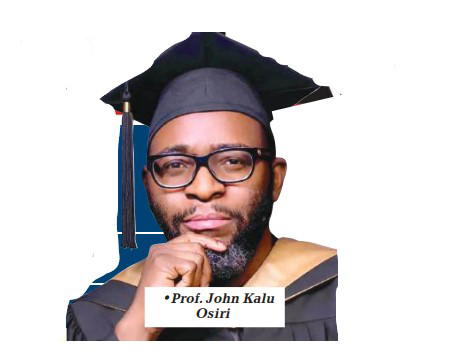
By Olayinka Latona
The Chancellor of Osiri University, Prof. John Kalu Osiri, is a scholar bridging science, leadership, and business. In this interview, he laments that Nigeria’s educational curriculum remains “designed for a world that no longer exists.” He argues that an overemphasis on theory and compliance, rather than creativity and problem-solving, leaves the nation ill-equipped for an era of artificial intelligence and global competition.
Excerpts:
What is your take on Nigeria’s educational curriculum?
Nigeria’s curriculum is still largely designed for a world that no longer exists. It emphasises memorisation over mastery, theory over application, and compliance over creativity. In a high-stakes, rapidly changing world defined by AI, automation, climate shocks, and global competition, Nigeria cannot afford an education system that prepares students for yesterday. We need a curriculum that develops problem-solvers, innovators, ethical leaders, and creators of value – not just certificate holders. A curriculum that teaches students how to think, not what to think. Education for a high-stakes world must be grounded in self-knowledge and a clear sense of identity.
How can Nigeria move from being a consuming nation to creating value?
Nigeria will shift from consumption to value creation when three things happen. First, we redesign education to produce makers, builders, and innovators – not job seekers. Second, we integrate indigenous knowledge with modern science to create solutions for lived realities. Third, we build ecosystems where ideas can become enterprises, supported by policy, capital, and mentorship.
This represents a radical departure from a system that prioritises individual survival over collective advancement. To achieve this transformation, we must embrace the Ubuntu mindset. Nations do not become prosperous by importing solutions. They thrive when they trust their own capacity to create.
You always talk about integrating African knowledge systems, what do you mean by that?
Integrating African knowledge systems means recognising that Africa has its own intellectual traditions – governance models, philosophies, technologies, and ways of organising society. It means placing African contributions to world history, science, engineering, and human knowledge at the centre of our educational experience, because Africa is the birthplace of humanity and the cradle of civilisation. To embrace Africa is to embrace the origins of human ingenuity.
In practical terms, this requires incorporating indigenous ecological knowledge, African leadership philosophies such as Ubuntu, traditional conflict-resolution systems, local agricultural practices, African entrepreneurship models, and community-based apprenticeship systems. It also means teaching African history as human history – an integral part of the global story, not a footnote. This integration does not reject Western knowledge; it enriches it, creating a hybrid intellectual model where Africa’s wisdom meets global innovation to produce solutions that are culturally grounded, contextually relevant, and globally competitive.
Can this integration move Nigeria out of its challenges?
Absolutely. When a nation builds solutions that reflect its culture, environment, and lived realities, those solutions are more sustainable and scalable.
Integrating African knowledge systems can strengthen food security, improve governance and conflict resolution, build community-driven economic models, restore dignity and identity, and inspire locally tailored innovation. Nigeria’s challenges persist partly because we keep importing frameworks never designed for our realities. When we design from within, we rise from within.
What do you mean by Nigeria being shaped by external frameworks that did not fully reflect our realities?
For decades, Africa’s education, (Nigeria inclusive)governance, economic models, and even definitions of success were shaped by external powers – colonial systems, international institutions, and global narratives. These frameworks often ignored African cultural values, overlooked communal systems of support, prioritized extraction over development, imposed one-size-fits-all solutions, and treated Africa as a problem to be fixed rather than a partner to be respected. As a result, Africa inherited systems that were never designed to help it thrive. Reclaiming our intellectual agency is the first step toward transformation.
What’s the vision behind Osiri University?
The institution is based in Lincoln, Nebraska, and we have also initiated the U.S. accreditation process. Osiri University is based in Lincoln, Nebraska, and has also initiated the U.S. accreditation process. It is a new kind of African-rooted, globally relevant institution built for a high-stakes world. Our Ubuntu-centred education – grounded in the philosophy “I am because we are” – teaches students that leadership is service and that success is communal.
Our interdisciplinary, future-focused programs blend technology, ethics, entrepreneurship, psychology, and African knowledge systems to prepare graduates for a world defined by complexity. Osiri University removes financial barriers by waiving tuition for most African students, making education a right rather than a privilege.
Our faculty come from around the world, yet our curriculum is anchored in African philosophy – a powerful lens through which students across the globe learn to navigate local opportunities and challenges. We designed our curriculum for high-stakes environments, equipping students to thrive amid economic, technological, and social uncertainty. We cultivate resilience, creativity, and ethical leadership. Our graduates are not trained to fit into old systems; they are trained to build new ones – in business, governance, technology, and community development. Osiri University is, at its core, a university built for impact.
Disclaimer
Comments expressed here do not reflect the opinions of Vanguard newspapers or any employee thereof.