…Rollout begins July
By Nnamdi Ojiego
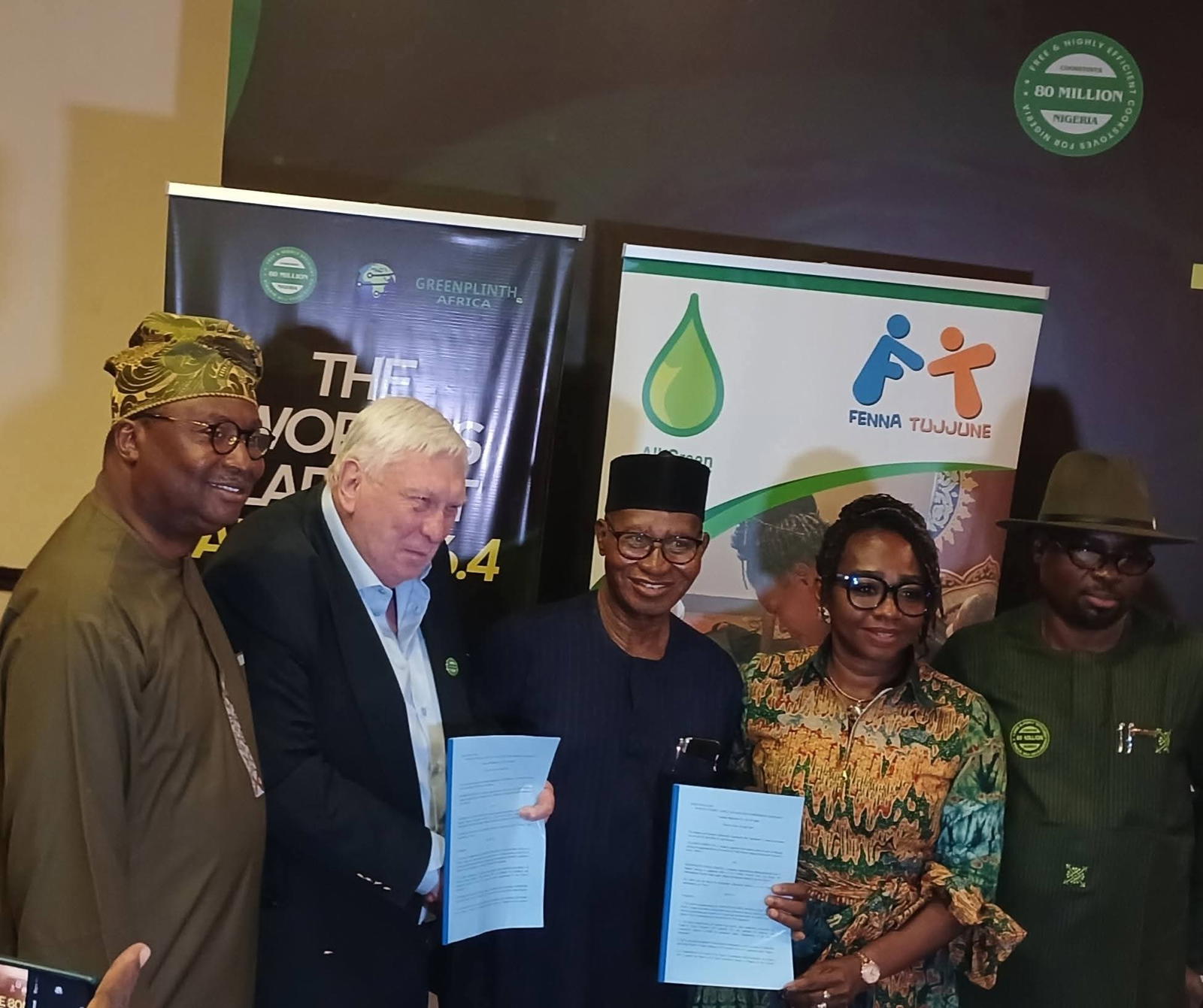
Nigeria is on course for one of the largest clean energy transitions in household cooking, following the signing of a $10 billion investment agreement between Allgreen Energy NV and Greenplinth Africa to deliver 80 million clean cookstoves across the country.
The agreement, announced on Tuesday in Lagos, sets the stage for a phased national rollout beginning in July, with the first tranche of 24 million cookstoves to be produced under a newly signed manufacturing arrangement.
Speaking at the event, President and Group Chief Executive Officer of Greenplinth Africa, Dr. Olawale Akinwumi, described the initiative as a defining step in addressing one of Africa’s most persistent development challenges.
He noted that more than 950 million people across the continent lack access to clean cooking, with over 180 million of them in Nigeria.
“This project marks the beginning of a determined effort to deliver clean and efficient cooking technologies to households at scale,” he said. “It is about improving daily life, particularly for women and children who bear the brunt of unsafe cooking practices.”
The project, first introduced in October 2024, is designed to replace traditional cooking methods that rely heavily on firewood and charcoal. These fuels remain a major source of indoor air pollution and contribute to deforestation and carbon emissions.
Under the plan, households will receive clean cookstoves along with briquettes as fuel, at no cost. Organisers say the approach is intended to remove financial barriers and accelerate adoption, especially in low-income communities.
The Lagos State Government signalled its support for the initiative, pointing to early results from pilot interventions within the state.
In a keynote presentation, the Special Adviser to the Governor on Climate Change and Circular Economy, Mrs. Titilayo Oshodi, cited a community-based study in Makoko where improved cookstoves reduced daily fuel consumption from 10 kilograms of firewood to about 1.37 kilograms of briquettes.
She said the shift represented more than an efficiency gain, noting that households recorded cleaner indoor air, reduced smoke exposure, and less dependence on multiple fuel sources. “What we are seeing is not just a technical solution, but a change in how people live and cook,” she said.
Beyond environmental gains, the project is expected to deliver public health benefits by reducing respiratory illnesses linked to prolonged smoke exposure. It also carries an economic dimension, with promoters arguing that access to cleaner cooking systems will save time, lower fuel costs, and create new opportunities within local value chains.
The scale of investment by Allgreen Energy is expected to support manufacturing, distribution, and long-term sustainability of the programme. Project partners also indicated that carbon financing mechanisms would play a role in maintaining momentum, as emission reductions from cleaner cooking could be converted into tradable carbon credits.
Speakers at the event note that such financing models are increasingly central to clean energy projects in developing economies, where upfront costs often limit adoption.
For Greenplinth Africa, the initiative forms part of a broader “Agenda 2030” framework aimed at expanding clean cooking access across the continent. The organisation is positioning Nigeria as a starting point for what it describes as a scalable model for other African countries facing similar energy challenges.
Disclaimer
Comments expressed here do not reflect the opinions of Vanguard newspapers or any employee thereof.