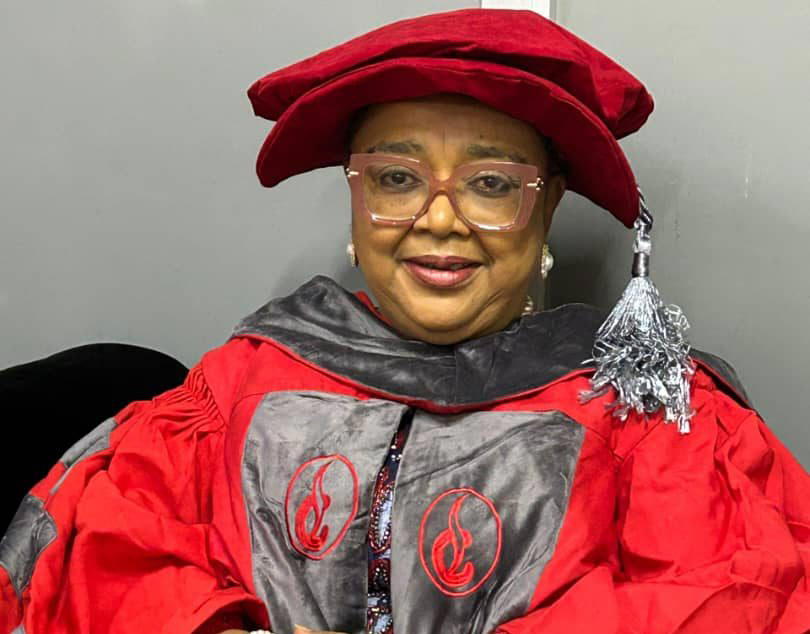
Dr. (Mrs.) Angela Ajala
By Rotimi Eyitayo
There are moments in the life of an institution when leadership must do more than occupy office; it must clarify direction, restore confidence and awaken a sector to the urgency of its assignment. For the National Commission for Colleges of Education, that moment has come with the emergence of Dr. (Mrs.) Angela Ajala, as Executive Secretary of the Commission.
Her appointment is historic in more ways than one. NCCE records her as the 7th and first female Executive Secretary of the Commission, a defining milestone for an institution that sits at the heart of Nigeria’s teacher preparation system. But beyond the symbolism of her emergence is the substance of the message she has carried from the beginning: teacher education must be repositioned, teacher preparation must be strengthened, and Colleges of Education must become more attractive, competitive, relevant and future-facing. (ncce.gov.ng)
In a country where the quality of education is often debated from the top of the system downward, Dr. Ajala is asking the nation to return to the foundation. Her argument is simple but profound: if Nigeria misses it with teacher education, it misses it with the future. At a recent NCCE curriculum validation engagement, she described the new reform moment as “a defining moment for the future of teacher education,” stressing that the dual mandate must be carefully shaped, collectively owned and rigorously validated. (ncce.gov.ng)
The Dual Mandate: A New Pathway for Teacher Education
One of the most significant shifts now emerging in the Colleges of Education system is the Dual Mandate reform. Under the new direction, the Federal Government’s policy gives Colleges of Education a more strategic role in producing teachers who can earn both the Nigeria Certificate in Education and degree-level certification through a structured pathway.
NCCE has directed Federal Colleges of Education operating under the Dual Mandate arrangement to discontinue admissions into the existing four-year degree programmes from the 2026/2027 academic session. The new model introduces a Continuous Five-Year NCE-Degree Programme, structured as three years of NCE followed by two years of degree study for eligible NCE graduates.
This is not merely a technical adjustment in academic programming. It is a philosophical correction. It protects the NCE as the foundational and minimum professional teaching qualification while creating a seamless pathway for students who desire degree-level certification. In practical terms, it gives the Colleges of Education system a renewed identity: not as a second-choice tertiary route, but as a deliberate, professional and progressive teacher preparation ecosystem.
For years, teacher education has battled perception challenges. Many young people have seen Colleges of Education as fallback options rather than places of professional formation. Dr. Ajala has openly challenged this perception, warning that the country cannot afford to treat the teaching profession as a destination for those who could not pursue “other paths.” Her point is deeply human: the people who shape the minds of generations deserve the most careful preparation, not the least.
The JAMB Waiver: Access Expanded, Standards Protected
Another major development in the sector is the clarification around the UTME/JAMB waiver for NCE candidates. The Federal Government has approved that candidates seeking admission into the NCE programme who possess a minimum of four credit passes will no longer be required to sit for the UTME. This was announced by the Minister of Education, Dr. Tunji Alausa, at the 2026 Policy Meeting on Admissions into Tertiary Institutions.
However, this is where clarity matters. The policy does not mean unregulated admission. Eligible candidates must still register with JAMB, and their credentials must be screened, verified and processed through the Central Admissions Processing System before admission letters can be issued. The Minister also reiterated that admissions conducted outside CAPS remain illegal and will not be recognized by government.
This distinction is important. The waiver reduces entry pressure and expands access into teacher education, especially for communities where Colleges of Education can serve as local engines of opportunity. But by retaining JAMB registration and CAPS processing, the policy keeps the admission process visible, regulated and credible.
In other words, the reform is not a lowering of standards. It is a widening of the door, with structure still standing at the gate.
Why This Matters Now
Nigeria’s teacher education sector is facing a real urgency. Reports have quoted Dr. Ajala as raising concern over a shortage of nearly 200,000 qualified teachers at the basic education level, alongside declining enrolment in Colleges of Education. She also reportedly noted that some states had gone five years without recruiting a single teacher, while some colleges recorded zero first-year intake.
These are not ordinary statistics. They are warning signs.
A nation with fewer prepared teachers will eventually have weaker classrooms. Weaker classrooms will produce weaker learning outcomes. Weaker learning outcomes will affect productivity, citizenship, innovation, national cohesion and economic competitiveness. Teacher education is therefore not a narrow institutional conversation; it is a national survival conversation.
This is why the new posture at NCCE matters. Dr. Ajala’s early engagements have consistently emphasized collaboration, stakeholder confidence and institutional reform. In receiving the Nigerian Academy of Education, she anchored her approach on three commitments: to listen, to collaborate and to act decisively in advancing teacher preparation, professional development and system effectiveness.
That posture is significant because reform in education cannot be imposed successfully from one office. It must be understood by provosts, owned by lecturers, trusted by unions, supported by government, embraced by students and communicated clearly to the public.
A More Attractive Future for Colleges of Education
At the centre of this new chapter is a powerful repositioning agenda: to make Colleges of Education more attractive, globally relevant and nationally respected.
The dual mandate gives the system a stronger value proposition. The JAMB waiver expands access to the NCE route. Curriculum harmonization offers the possibility of deeper professional formation. Stakeholder engagement creates ownership. Together, these signals suggest that NCCE is not simply managing the old system; it is preparing to renew it.
The future teacher must be more than a subject instructor. The future teacher must be digitally competent, emotionally intelligent, entrepreneurial, professionally grounded, pedagogically strong and socially responsive. Dr. Ajala has emphasized the need to produce teachers equipped with digital competence, entrepreneurial thinking and the pedagogical depth required for 21st-century classrooms. (ncce.gov.ng)
That is the real promise of the moment.
If implemented well, these reforms can help rebuild public confidence in teacher education, attract stronger candidates, improve the identity of Colleges of Education and create a new generation of teachers who are prepared not only to teach, but to transform learners.
The Human Side of Reform
Perhaps the most compelling thing about Dr. Ajala’s emergence is that she is not speaking of reform as a cold administrative exercise. She is speaking about teachers, learners, institutions and the future of the country. Her language reflects urgency, but also care. It is the voice of someone who understands that teacher education is not just about certificates; it is about the people who will stand before children every day and shape what they believe is possible.
The work ahead will not be easy. Policies must be interpreted correctly. Colleges must be prepared. Students must be guided. Stakeholders must be carried along. Communication must be clear. Implementation must be monitored. Quality must not be sacrificed in the name of access.
But the direction is clear.
A new conversation is emerging around NCCE. It is a conversation about access without chaos, reform without confusion, collaboration without delay, and teacher education without apology.
Getting Teacher Education Right
The message from NCCE under Dr. Angela Ajala is becoming unmistakable: Nigeria must stop treating teacher education as secondary to national development. It is central to it.
The dual mandate is not just a programme change.
The JAMB waiver is not just an admission adjustment.
The curriculum reform is not just an academic exercise.
The stakeholder engagements are not just courtesy calls.
Together, they represent a wider attempt to reset the dignity, relevance and strategic importance of teacher education in Nigeria.
And if the country listens carefully, this may become one of the most important education reform moments of this season.
Because when teachers are properly prepared, classrooms become stronger.
When classrooms become stronger, children learn better.
When children learn better, the nation rises with greater confidence.
Get teacher education right, and Nigeria gives its future a fighting chance.
Rotimi Eyitayo writes from Lagos
Disclaimer
Comments expressed here do not reflect the opinions of Vanguard newspapers or any employee thereof.