By Chukwuma Ajakah
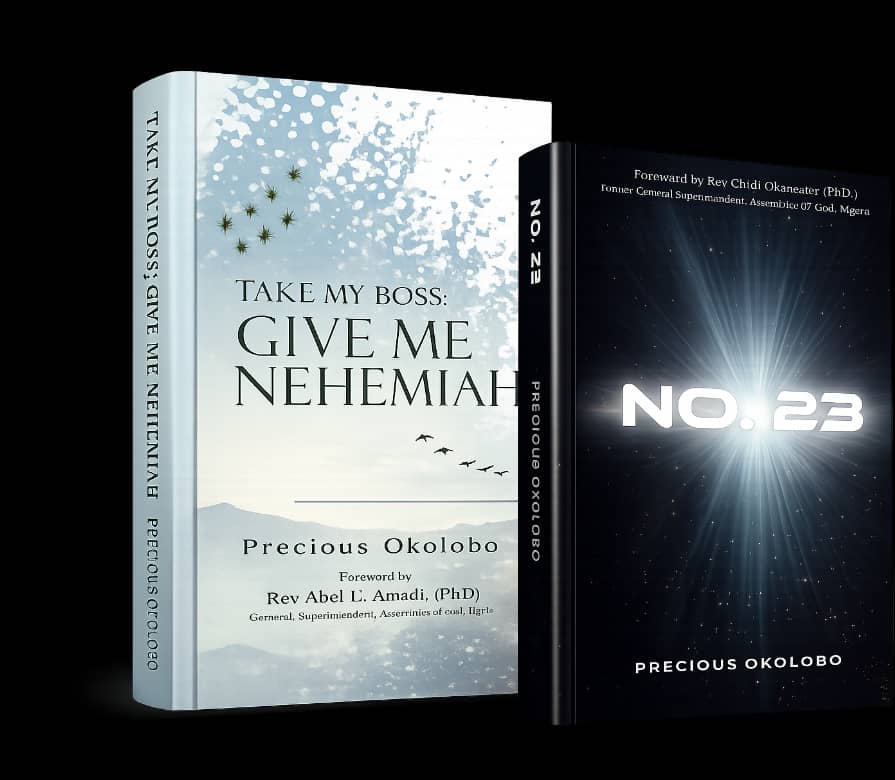
In his new book, “Take My Boss, Give Me Nehemiah”, Precious Okolobo unpacks faith-driven leadership nuggets, showcasing how challenges become triumphs and leaders rise to impact their world.
Published by Joevine Editors (2026), Take My Boss, Give Me Nehemiah is a 240-page faith-based book of 20 insightful chapters on secular and Christian leadership.
In Take My Boss, Give Me Nehemiah, Okolobo explores leadership’s complexities through 20 insightful chapters, blending biblical wisdom with real-world applications. From defining leadership to showcasing Nehemiah’s example, the book delves into leaders’ triumphs, failures, and the servant mindset that drives lasting impact.
The author explores leadership through Nehemiah’s story, weaving in multifarious themes of faith, challenges, and practical insights into the nitty gritty of leadership. Positioning Nehemiah’s leadership as a model for leaders at all levels, the author blends biblical allusions, suspense, humor, and layered storytelling in this compelling narrative that showcases Nehemiah’s enduring legacy – keeping readers hooked till the end.
The plot revolves around Nehemiah, an exiled Jew and cupbearer in King Artaxerxes’ palace, who rises from obscurity to rebuild Jerusalem’s walls in 52 days, showcasing compassion and resilience amidst fierce opposition.
In the opening chapters, the author defines leadership and identifies key traits, citing Servant Leadership Institute (SLI) and Center for Creative Leadership (CCL). Essential traits include Self-awareness, Respect, Compassion, Vision, etc. These are illustrated through the ‘Jesus Model’ in Blanchard and Hodges’ Lead Like Jesus, focusing on Heart, Head, Hands, and Habits. Delving into why leaders fail, the author identifies various factors like pride, fear, and distraction under causes of failure. Pride as instantiated in the characters of Nebuchadnezzar, Herod, and Lucifer, is depicted as a major cause of leadership failure (pp. 68-76). On the other hand, success in leadership is attributed to leaders who are so dependent on God that they have the anointing, divinely backed strategies, character, helpers or vision bearers, proper communication, and ability to manage success.
Building on Nehemiah’s leadership model, the author explores themes like challenges of leadership, nature vs nurture, and divine endowment vs self-discipline in secular or spiritual settings. Using examples of ‘born’ or ‘made’ leaders, he highlights leadership types: Leadership by Birth, as exemplified by King Charles III; Leadership by Circumstances, as seen in Nehemiah; Talents and Leadership, instantiated by Columbus Irisoanga; and Training Before Manifestation, exemplified by Joseph, Jesus, and Moses, with emphasis on the necessity of training for effectiveness in leadership irrespective of the type.
The language of the text is simple as the author adopts a conversational approach, using common expressions that can be accessed by an average reader.
To make the book a compelling read for both Christian and non-Christian audiences, the author masterfully integrates figurative language and scriptural references that may require some familiarity with Christian context, the narrative is rich in life-applicable lessons, reflection questions, and examples. Besides biblical characters, the author references accomplished leaders from music, sports, theatre, and corporate worlds, infusing ideas from famous personalities like Dolly Parton, Michael Jordan, Warren Gamaliel Bennis (Manchester United co-owner), Sir Maurice Flanagan, theatre artist Columbus Irisoanga (Nigeria) and renowned motivational speaker and leadership coach, John Maxwell.
Take My Boss, Give Me Nehemiah will inspire readers to see Nehemiah’s leadership style, built against the backdrop of the Chief Leader and Perfect Trainer (God)’s master plan, as an ideal model for leaders at various levels, as the protagonist embodies compassion, courage, integrity, selflessness, and other virtues that distinguish godly leaders.
Employing narrative techniques like suspense, humour, and allusions, the author mirrors Nehemiah’s legacy through a cohesive thematic thread that keeps readers glued to the very last paragraph
Building on Nehemiah’s example in Chapters 15-18, the author profiles notable leaders like Abraham Lincoln, Mahatma Gandhi, and Martin Luther King Jr., alongside visionary politicians Nelson Mandela, Lee Kuan Yew, and Barack Obama, who drove socio-economic change in respective countries. The author also highlights transformative figures like Florence Nightingale, ‘The Lamp that Lightened the World’; Mother Theresa, ‘Saint in the Gutter and Saint in Heaven’; and Mary Slessor, ‘Everybody’s Mother’, who challenged injustices in Nigeria and beyond.
As revealed in his introduction, the author’s motivation stems from Nehemiah’s remarkable story, sparking a passion to share insights on leadership and faith.
Setting the stage for exploring godly leadership in challenging times,
the author notes, ‘The example of Nehemiah feeds into an overarching narrative of the benefits of godly leadership at time when we badly need it. Nehemiah was a leader forged by circumstances and forced to take up a role based on a report on the situation back home. He prayed, acted and achieved more than what he had in mind when he took up the burden” (p. xi). To facilitate this journey, Take My Boss, Give Me Nehemiah doubles as a mini workbook as each chapter ends with notable remarks, reflective questions, and lessons that readers could apply to their lives.
Take My Boss, Give Me Nehemiah is a great read for readers seeking guidance on godly leadership and character. In the foreword, the General Superintendent, Assemblies of God (AG), Nigeria, Rev Abel Ukachi Amadi (PhD) lauds the author’s grand text, noting, “The book takes an incisive introspection into the leadership principles modeled by Jewish exile, Nehemiah, who accomplished his assignment with stunning speed and tenacity of purpose. This was a no mean feat in an era when might was right and the king or his representative could not be questioned. The example of Nehemiah demonstrates the benefits of godly leadership at a time when we badly need it.”
Okolobo’s other works include: No. 23, The Bethel Experience, Done: hints and insights on Divine Restoration, Why You Trust God When You Shouldn’t: Fear God, and The Sheep Who Became a Shepherd.
No. 23 as Revelatory Guide
In a poignant exploration of faith and vulnerability, prolific author, Precious Okolobo’s latest work delves into the timeless wisdom of Psalm 23, weaving a rich tapestry of scripture and personal insight.
With Precious Okolobo as guide, readers are invited to walk with David through the darkest valleys, embracing the paradox of strength in surrender as they discover anew the Shepherd who leaves no sheep behind.
Published by Joevine Editors (2025), the book with the sublime title, “No. 23” is a 183-page narrative, crafted into 13 chapters of lucid prose, serving as guideposts to the Psalm’s insights on God and humanity, inviting readers into a personal relationship with God, amidst tumultuous circumstances of life.
No. 23 opens with a foreword by Rev Chidi Okoroafor, former General Superintendent, Assemblies of God (AG), Nigeria, who notes: “Psalm 23… is the commonest psalm. It’s readily and constantly in the mouth of every Christian… I am enthused that the author has painstakingly done an in-depth study, digging out treasurable facts beyond surface and casual readings.”
The former GS admits that he had thought the book explored the entire Psalms, but found it instead a combo of insights on Psalm 23, King David, and other psalms.
Noting the psalm’s familiarity often leads to superficial understanding, Okoroafor commends the author’s in-depth study unveiling deeper truths around the central theme.
The storyline of No. 23 develops along subtitles to the 13 chapters, focusing on the various verses of Psalm 23 and highlighting the embedded lessons: Beloved, From obscurity to authority, the best way to discover yourself is to read the psalms, In David, God became flesh to taste the state of man in order to reinstate his fate, the Lord is my Shepherd; I shall not want, He maketh me to lie down in green pastures: he leadeth me beside the still waters, He restoreth my soul: he leadeth me beside in the paths of righteousness for his name’s sake, Yea, though I walk through the valley of the shadow of death, I will fear no evil, For thou art with me, thy rod and thy staff they comfort me, Thou preparest a table before in the presence of mine enemies: thou anointest my head with oil; my cup runneth over, surely goodness and mercy shall follow me all the days of my life: and I will dwell in the house of the Lord forever, No one is righteous but for goodness and mercy, and If you shun the Word, you love the world. (Author’s name) further extends the subtitles to cover the following subject matters: David: The Man, David: The King, David the Musician, Real, Rugged and Rooted, Relate and Reap, He Leads. We Follow and are Blessed, Restored in Righteousness, In the Valley, His Presence Makes the Difference, The Lord, Tables, and Enemies, Forever, Our Response, and Our Responsibilities.
According to the author the work has been arranged to enable the reader to grasp the underlying meaning of the psalm, which sits well with the word of God. “The concurrence is such that all what David says and claims about the Creator are already stated in the scriptures,” he writes, adding that “We begin by learning about David as a man, king, psalmist.”
According to the author, the work is arranged to help readers grasp the psalm’s underlying meaning, aligning with scripture. “The concurrence is such that all what David says and claims about the Creator are already stated in the scriptures,” he notes, adding: “We begin by learning about David as a man, king, and psalmist.”
In this book, Okolobo crafts a narrative spanning 13 chapters, each with dual subtitles weaving Psalm 23 insights and David’s life, masterfully connecting the psalm’s truths to David’s story, resonating with diverse readers.
Chapter 1 begins with “Beloved” (David: The Man), tracing David’s roots and early anointing. Chapter 2, “From obscurity to authority” (David: The King) follows, highlighting his rise to power. In Chapter 3, “The best way to discover yourself is to read the Psalms” (David the Musician), the author showcases David’s heart for worship. Other chapters dive into themes like finding rest (“Real, Rugged and Rooted”), guidance (“He Leads. We Follow and are Blessed”), and trust (“In the Valley”, “His Presence Makes the Difference”).
The narrative culminates in reflections on God’s goodness (“Forever”), prompting readers to respond (“Our Response”) and outlining their responsibilities (“Our Responsibilities”).
The author notes that “David” means ‘beloved’, likely referring to God’s favor, highlighting the protagonist’s life as a study of providence guiding destinies. He notes that most people know little of David’s childhood beyond him being the youngest of eight sons.
The author also traces David’s genealogy (Jesse to Pharez), showing how Samuel’s anointing fueled his sling exploits: conquering Goliath’s army and surviving Saul’s plots.
The author explores diverse, interrelated themes: man’s relationship with God, retributive justice, God’s love, creation, the triune God, and the Bible as a wisdom bank with instructions for man’s destiny.
Although the major themes center on David, the author skillfully depicts some through other biblical characters, like Abraham’s intercession for Sodom and Moses’ pleas for Israel during their wilderness journey.
The author’s language is simple yet profound, with lucid prose that seamlessly weaves biblical references, personal testimonies, and vivid metaphors. Subtly persuasive, the writing fluidly transitions from Psalm 23 to other scriptures, exploring themes like salvation and dependence on God. Figurative language, especially metaphors and biblical allusions, adds depth and richness to the narrative.
The reader will find the author’s exploration of the psalmist’s metaphors striking. Figurative expressions like “the Lord is my Shepherd”, “He leads me through the paths of righteousness”, and “Though I walk through the valley of the shadow of death”, convey vivid imagery resonating deeply. The author simplifies these metaphors, using authorial personal experience and the examples of biblical characters like David, Moses, Joseph, and Apostle Paul, to persuade readers to cultivate a personal relationship with God, just like David, unlocking victories and overcoming life’s trials.
Okolobo has written extensively on faith. His other works include Give Me Nehemiah, The Sheep Who Became a Shepherd, Fear Not, Done:…hints and insights in Divine Restoration, and The Bethel Experience: recharging for revival.
In Psalm 23, Okolobo implores readers to trust the Good Shepherd’s guidance through life’s storms. Employing narrative techniques like suspense and humour, the author masterfully bridges Genesis to Revelation, maintaining a cohesive thematic thread and didactic quality
This book is a great read for anyone seeking spiritual guidance and comfort, as it offers a unique blend of biblical insight and engaging storytelling.
Disclaimer
Comments expressed here do not reflect the opinions of Vanguard newspapers or any employee thereof.