By Omeiza Ajayi, ABUJA
A coalition of male feminists, traditional rulers and civil society actors has launched a landmark effort to secure the freedom of 57 women trapped in a centuries-old forced marriage practice in Becheve community of Obanliku Local Government Area, Cross River State.
The practice, locally known as “Money Marriage” or “Money Wives” sees young girls given out as instruments of debt settlement.
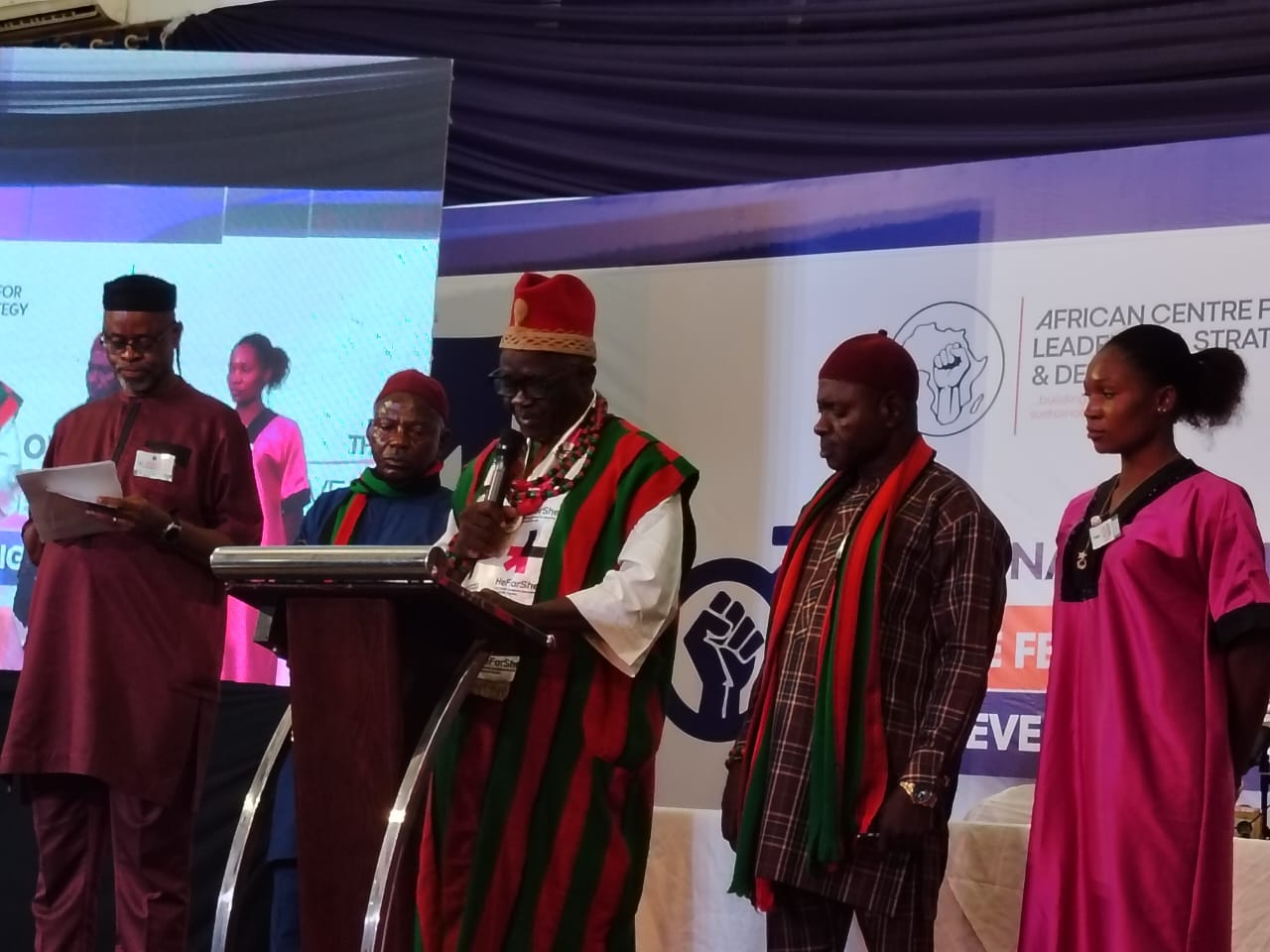
The announcement was made at the National Summit on Male Feminism and Gender-Based Violence Prevention in Nigeria, convened on Tuesday in Abuja by the African Centre for Leadership, Strategy and Development (Centre LSD), under the theme: Give to Gain: Men Confronting the Root of Gender-Based Violence.
Becheve is a large community in Obanliku LGA comprising 17 tribes and situated near the popular Obudu Cattle Ranch and Resort. Despite its proximity to a globally recognized tourism destination, men in the community have for generations practised what they call ‘Money Marriage,’ in which girls — often at extremely vulnerable ages — are sold into matrimonial bondage for cash as low as ₦10,000, tubers of yam, goats or pigs, depending on the bargaining power of the so-called groom. The victims of this arrangement are called “Money Women” or “Money Wives.”
The Paramount Ruler of Obanliku, HRM Amos Uyumulam Item, attended the summit alongside clan heads, acknowledging plainly that “the tradition is as old as the community.”
The practice was formally abolished on August 20, 2020, when Centre LSD, working through the UN Women-funded Spotlight Initiative, engaged the Paramount Ruler, the Becheve Traditional Council of Chiefs, and local government authorities.
A local bye-law prohibiting the practice was enacted across affected communities — a step Dr. Otive Igbuzor, Founding Executive of Centre LSD, described as “bold and commendable,” saying it “demonstrated that culture is not static and that harmful practices can be challenged and redefined from within.”
However, years after the ban, a painful paradox persisted. “While the practice had been outlawed,” Dr Igbuzor said “many girls and women who had already been given out before the ban remained trapped in these arrangements”.
According to him, many had grown into adulthood within these unions, some with children and with little or no means of securing their freedom.
Attempts to free the women were met with what the Centre described as “inflated financial demands from their so-called husbands — amounts far beyond what families could afford.”
Following a sustained process of community dialogue, a landmark stakeholder meeting was held on March 12, 2026, in Becheve. The meeting brought together traditional rulers, clan heads, community members, affected families, and survivors. After extensive deliberations, a unanimous agreement was reached.
The communiqué signed at the meeting states that the parties “agreed and reaffirmed that the ‘money woman’ tradition and culture is totally abolished and banished in Becheve ward of Obanliku Local Government Area in Cross River State.”
Crucially, the meeting resolved that “the bride price be returned to the man — that is, the husband of the girl — in order to set the woman/girl free,” and pegged that amount at ₦100,000 only, irrespective of whatever items were involved.” The agreement was signed by the Paramount Ruler and four clan heads: HRH Ushen Pius U. of Bukemaya/Bayam Clan, HRH Sylvester Abila of Otale Clan, HRH Sunday Chile of Becheve Clan, and the Traditional Ruler’s Council Secretary, Comrade Siwhan Noah U.
Dr. Igbuzor described this as “a turning point — moving the process from uncertainty and exploitation to clarity, fairness, and dignity.”
He added; “It removes one of the biggest barriers preventing survivors from regaining their freedom and replaces arbitrary and exploitative demands with a clear and agreed framework.”
The work of mapping survivors is already underway. “We did the first set of mapping in Becheve and we have identified 57 persons, and to free them is ₦5.7 million,” Dr. Igbuzor disclosed. In a striking act of solidarity, he revealed that “our staff at Centre LSD decided to make personal contributions” toward the fund needed to secure the women’s release.
The Obanliku Local Government has also enacted a bye-law backing the decision to support the girls, lending institutional weight to what had previously been a civil society-led effort.
The March 12 communiqué went beyond freedom alone. It agreed that the ₦100,000 framework could also “be used to empower the woman who is old and cannot leave the marriage again, but to stay with her children.”
For those who choose to leave, the meeting called for support from NGOs and individuals, and issued “an appeal that survivors be given adequate skill training and empowered by NGOs and foreign donors to enable them meet up certain challenges of their lives.”
Dr. Igbuzor described this as a deliberate dual approach of “emancipation — securing freedom for survivors — and empowerment — providing economic support, skills, and opportunities,” acknowledging that “many survivors have lived for years without access to education or livelihoods.”
The summit at which these announcements were made represents the wider architecture of change being built by Centre LSD.
Dr Igbuzor recalled that at a previous press conference on January 29, 2026, the Male Feminists Network (MFN) had reported key milestones: “the development of Nigeria’s first structured knowledge products on Male Feminism; the building of a national pool of 52 trained male feminist trainers; the launch of the world’s first online course on Male Feminism and GBV Prevention; and the training and certification of over 3,150 Nigerians on male feminism and gender-based violence prevention.”
“These were not just numbers. They represented the beginning of a national movement — one that recognises that men must move from being passive observers to becoming active participants in ending gender-based violence”, he said.
The Becheve breakthrough, he argued, is living proof of that vision. “When men, especially those in positions of influence, take responsibility for challenging harmful norms, real change happens. This is the shift we are building nationwide: men moving from bystanders to accountable actors for gender justice.”
“We call on the media to amplify these stories responsibly, on policymakers to strengthen protections for women and girls, and on partners to support the next phase of this work. What we present today is not just a resolution. It is a restoration of dignity”, the Centre declared.
Disclaimer
Comments expressed here do not reflect the opinions of Vanguard newspapers or any employee thereof.