By Gabriel Ewepu
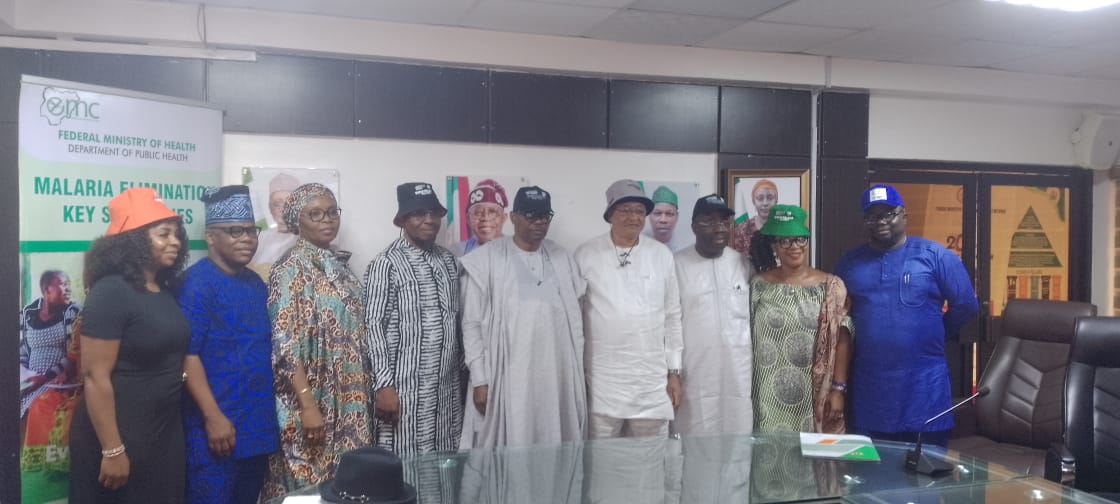
AHEAD of the 2026 World Malaria Day, the Oloja-Elect of Lagos, Prince Jide Kosoko, Friday, partnered with the Federal Ministry of Health and Social Welfare under the IMPACT Project.
Prince Kosoko who was on a visit to the Minister of State for Health and Social Welfare, Dr Iziaq Salako, at the Ministry’s headquarters in Abuja.
Kosoko expressed concern over the challenges affecting complete elimination of malaria in Nigeria, which he asked some pertinent questions on what is been done to ensure Nigeria attains the free malaria status.
PJK has been touring schools and health facilities in Lagos and Abuja to sensitize students.
The Minister used the opportunity to also address activities for the World Malaria Day.
In attendance was the representative of the Permanent Secretary, the Director, Public Health and the National Coordinator of NMEP.
He said: “Let me seize this opportunity to thank the Honorable Minister for getting me involved in this Programme and accepting us to meet him this morning in what is a tight schedule.
“Yes, we have heard a lot about what malaria has been doing to our people and the importance of government but I am here today representing the community.”
Meanwhile, the Minister of State for Health and Social Welfare, Dr Iziaq Salako who was elated by the visit of Prince Kosoko and his team, explained that, “Government has been very, very frontal in addressing the challenge of malaria.
“You will recall that when this government came to finish in 2023, one of the first things that we did with the approval of President Goland met in New York is to develop what we call a ‘Rethinking Malaria Strategy’. That means let us take a look at it again, deviate from the conventional way that we used to look at it.
“And within that rethinking strategy, we also decided to put a lot more emphasis on prevention. So as a result of that, we also decided to have it include some other parts of the world that have been able to eliminate malaria, and we therefore set up what we call the Advocacy Committee on Malaria Elimination in Nigeria, ACMEN, and that advocacy committee is a global committee that’s able to bring experience from across the world.
“So as a result of all this effort, you will see that between 2010 and 2022, the prevalence of malaria fell from about 42% to about 22%, at about a 20.4%. In the last three years, we have been able to also reduce that burden from about 22% to 15%. That means we are at, in 20 years, we are able to achieve only about 20% for in three years under President Bola Tinubu met in New York, we have been able to reduce the prevalence from 22% to about 7%, which means that, averagely, to go into any community now, to do a malaria test, seven out of 100 are likely to be positive, which I think is an immeasurable milestone that we are able to make.
“You also see that across Nigeria now, based on WHO guidelines, there are two states in Nigeria today that you can classify as high transmission states.
“All states in Nigeria have less than one, and we have some states who are already in pre-elimination states, like Lagos state, for example, that is now having prevalence in the region of 1.3, 2.6, which is a significant milestone, it means that some of the things that is happening in Lagos are things that we can actually scale up, and Nigeria can rapidly move to elimination.”
He further stated that, “Beyond that, you also see that the use of insecticide nets, in terms of compliance to the use, has also significantly improved, and today, we have asked the matter of data that 64.3% of our people now use their nets when it’s provided, and when it comes to priority groups, pregnant women, children, the rate is even higher, which is also a reflection of the consistency of the advocacy, of the messaging that the malaria programme is doing.”
Meanwhile, according to the Minister of State, National Malaria Strategy Plan, has improved to cover from 2026 this year to 2030, well aligned with the Health Sector Strategic Renewal Investment Initiative as a sector-wide approach.
“So, I would say that, by and large, if you look at each of these parameters, the government is playing its role”, he maintained.
On prevention, the Minister of State called on Nigerians to play their part – clear and keep surroundings clean including drainages, no stagnant water, use of treated mosquito nets “then we can be sure that we are on our way to eliminating malaria”, and advised that, “it is important that when they have fever, they should not just assume that every fever is malaria.
“Every fever is not malaria, and the strategy now is that before you get treated for malaria, you must be tested, and when you get tested and malaria is diagnosed, ensure you follow through to treatment.”
Disclaimer
Comments expressed here do not reflect the opinions of Vanguard newspapers or any employee thereof.