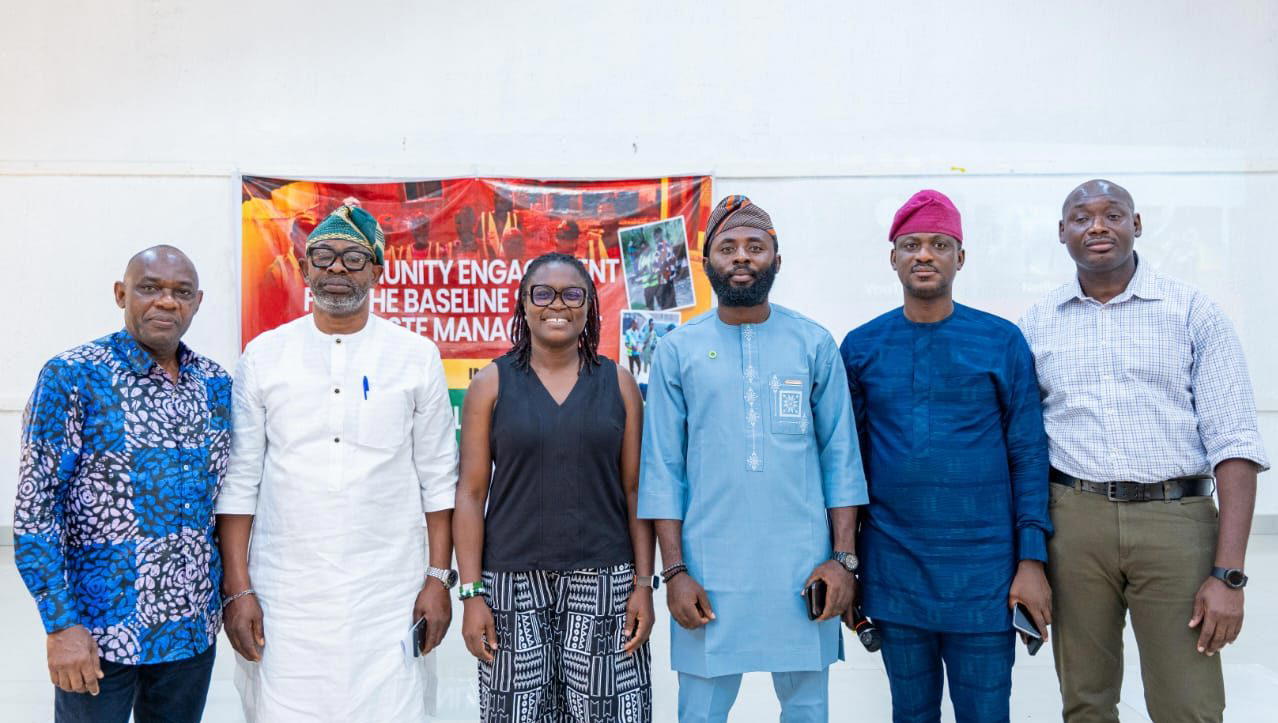
Co-Director, Centre for Housing and Sustainable Development, University of Lagos, Prof. Peter Elias (left); Supervisor, Environment, Agboyi-Ketu LCDA, Lagos State; Mr Innocent Osakwe; Lagos City Manager, African Cities Research Consortium(ACRC), Dr Temilade Sesan; Communications Lead, Lagos Office of Climate Change & Circular Economy, Mr Adebote Mayowa; Cofounder, Rethinking Cities, Mr Deji Akinpelu and Community knowledge Lead, ACRC, Mr Aro Ismaila, during Community Engagement on Waste Management in Ajegunle-Ikorodu, Lagos State.
By Elizabeth Osayande & Ifunanya Ndigwe
The project lead and co-founder of Rethinking Cities, Mr Deji Akinpelu, alongside the City Manager of the African Cities Research Consortium, Dr Temilade Sesan, and other waste management officials, have called for a multi-faceted approach to waste management in Lagos to curb health and environmental challenges facing residents.
Speaking at community engagement on waste management in Ajegunle-Ikorodu on Tuesday, April 28, 2026, Akinpelu and Sesan noted that creating local waste collection points and officially recognising informal waste pickers were the only ways to keep the community clean and protected from future environmental problems.
Akinpelu, while presenting the synthesised findings of the study: “Baseline Study Report: Waste Management Practices in Ajegunle-Ikorodu, Lagos” where he revealed that approximately 65 per cent of the population in the area lacked access to official public sector participation waste collection services.
Akinpelu noted that, “The survey also shows that, sadly, a number of people burn their waste as a recurring practice.”
The co-founder further explained that some of the remains of that burning exercise are actually used to fill potholes in the absence of proper road maintenance.
He further explained that residents have resorted to using the very waste that plagues them as a tool for survival, pointing out that “People pack waste into large sacks and store them in strategic areas to create makeshift barricades and sub-pits, which act as barriers to prevent floodwaters from flowing into their homes and shops.”
He pointed out that because the community lacked clean drinking water, residents relied heavily on pure water sachets.
He explained that, “Since each person drinks five or six of these sachets a day, the total number of empty plastic bags is massive, and these are the primary materials clogging the drainage systems.”
Representing the Special Adviser to the Office of Climate Change and Circular Economy, Mrs Titilayo Oshodi, the communications lead, Mr Adebote Mayowa, emphasised that waste should be viewed as a resource rather than a burden.
He added that, “Waste is no longer an environmental burden, but it is an economic opportunity that we must harness through the circular economy.”
Mayowa stressed that the collaboration between the government, social enterprises, and the informal sector was the only way to build a Lagos that can withstand the pressures of rapid urbanisation and climate change.
The City Manager of the African Cities Research Consortium, Lagos, Dr Sesan, highlighted the need for collective action between the government and the governed. Sesan remarked that, “The problem of waste management is a multifaceted one that requires a multifaceted solution, and we cannot just rely on the government to do everything as we need the community to be involved.”
The City Manager further noted that the informal sector was doing a lot, but they needed to be better organised and supported while also looking at the health implications, such as the prevalence of malaria and other diseases, which were a direct result of poor waste management.
She argued that, “Without addressing the root cause of these environmental hazards, the economic potential of the youth in the community would continue to be stunted by preventable illnesses.”
The Chairman of Agboyi-Ketu Local Government, Honourable Adetola Adunni Abubakar, who was represented by the Supervisor for Environment, Mr Innocent Osakwe, pledged the support of the local council for alternative collection models.
Osakwe stated that, “Honourable Adetola is very much aware of the challenges being faced by this community.”
He mentioned that the issue of waste management is a priority for the local government, and they understand that there are gaps, especially in areas with poor road networks, and are looking at alternative ways to reach those areas.
Osakwe further encouraged the community to continue their efforts in waste sorting and recycling, noting that “The idea of community-based collection points is a very good one which the council is willing to support.”
Speaking in Yoruba language, the Baale of Ikorodu Ajegunle, Chief Moyosola A.O. Oladunjoye, expressed the readiness of the community to cooperate with the research and intervention teams. The Baale thanked the organisers for bringing this to the community because they have lived with these challenges for a long time.
He stressed that, “Flooding is not just the rain but the waste that blocks the ways and as the Baale, I am giving my full support to this project.”
He stated that he would talk to the landlords and the youths to make sure they cooperate with the waste investigation team because they want a clean Ajegunle.
He noted that, “The community wants their children to be healthy and whatever is needed from the community, the leadership is ready to provide.”
Reiterating the importance of sustainable waste management, the project lead and co-founder of Rethinking Cities, Akinpelu, also explained that residents have found a way to earn an income from their rubbish by sorting it.
He disclosed that, “By collecting and selling just a single sack of pure water sachets to recyclers, individuals can earn between N500 and N900.”
He concluded that they strongly believe that the community can establish a partnership with the formal speakers to actually do the right thing.
He highlighted that while the community has its own plans to turn plastics into towels and chairs, the immediate goal is to exemplify to all stakeholders that, “Open spaces can be redefined as low-cost collection points and community gardens.”
Disclaimer
Comments expressed here do not reflect the opinions of Vanguard newspapers or any employee thereof.