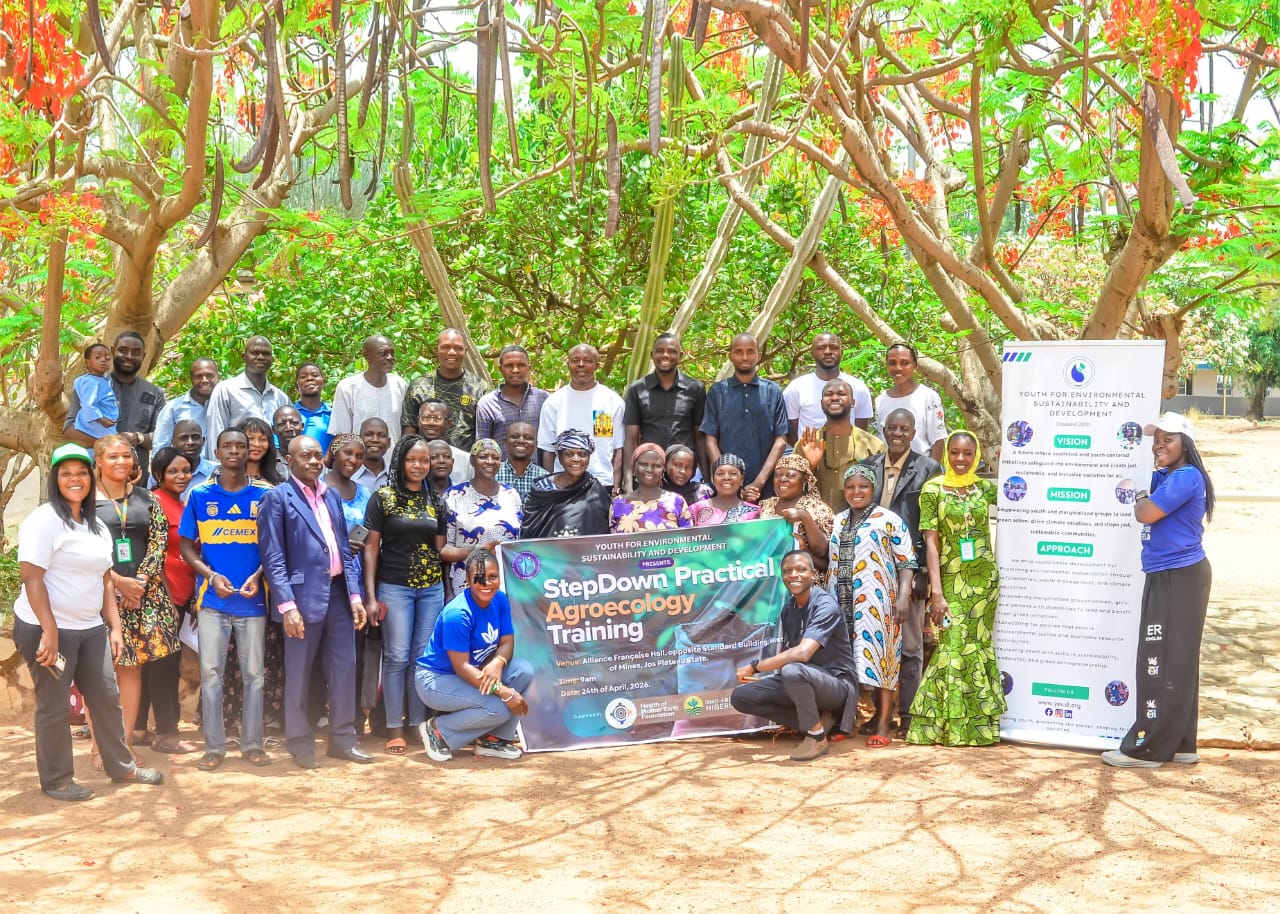
Youth for Environmental Sustainability and Development, YESD, has expressed commitment to empowering communities, especially smallholder farmers, with practical, sustainable solutions that improve livelihoods while safeguarding our ecosystems.
Founder/Team Lead of YESD, Mrs Adesuwa Jang, said this was necessary because of the critical role farmers play in ensuring food security.
Jang spoke at a one-day step-down training workshop themed: ‘Promoting Agroecology through Biofertilizer and Biopesticide Production for Food Security,’ held by YESD, in collaboration with the Coalition for GMO-Free Nigeria Campaign and the support of the Health of Mother Earth Foundation.
Her words: “Today is not just another training—it is a deliberate step toward transforming how we produce food, protect our environment, and secure our future. As an organization, YESD is deeply committed to empowering communities—especially smallholder farmers—with practical, sustainable solutions that improve livelihoods while safeguarding our ecosystems.
“We recognise the critical role you, our farmers, play in ensuring food security. Yet, we are also aware of the growing challenges you face—from declining soil fertility to the high cost and harmful effects of chemical inputs, to the increasing threats posed by climate change. This workshop has been carefully designed to respond to these realities.
“The key objectives of this workshop are:
To build the capacity of smallholder farmers on the principles of agroecology and the importance of soil health for sustainable and climate-resilient food production.
“To equip participants with practical, hands-on skills in the production and use of biofertilizers and biopesticides as safe, affordable, and locally adaptable alternatives to synthetic inputs.
To promote knowledge sharing and community action by empowering participants to transfer skills, make informed decisions about seeds and inputs, and champion agroecological practices within their communities.
“Flowing from these objectives, our expectations for today are clear and intentional:
First, we expect active participation. This is not a one-way learning process. Your experiences, questions, and insights are just as valuable as the knowledge being shared. Engage fully, ask questions, and contribute to the discussions.
“Second, we expect practical learning. The sessions, especially the hands-on components on biofertilizer and biopesticide production, are meant to equip you with skills you can immediately apply. By the end of today, you should not only understand these concepts but feel confident to replicate them within your farms and communities.
“Third, we expect knowledge transfer. This is a step-down training, which means each of you is an ambassador of this knowledge. We encourage you to share what you learn here with other farmers, cooperatives, and community members. The impact of this workshop should extend far beyond this room.
“Fourth, we expect a shift in mindset. Agroecology is not just a technique—it is a way of thinking about farming that respects nature, protects biodiversity, and prioritizes long-term sustainability over short-term gains. We hope today inspires you to embrace and champion this approach.
“Finally, we expect action. During the action planning session, we encourage you to think about concrete steps you will take after today. What will you do differently? How will you apply what you’ve learned? How will you influence others?”
Disclaimer
Comments expressed here do not reflect the opinions of Vanguard newspapers or any employee thereof.