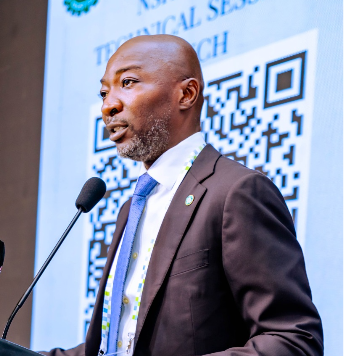
— As NSITF hosts international seminar on social Security
—Demand for stronger social protection system inevitable…NSITF MD
By Johnbosco Agbakwuru
ABUJA— THE Federal Government on Wednesday, reiterated its commitment to implementing policies that safeguard the welfare of Nigerian workers.
This is as the Managing Director of the Nigeria Social Insurance Trust Fund, NSITF, Oluwaseun Falaye, has said that due to the expansive and growing population coupled with a dynamic labour market in Nigeria, the demand for a responsive and strong social protection system is inevitable.
The duo spoke at the International Social Security Association, ISSA, West Africa Seminar, held in Abuja.
In his remarks at the seminar, the Minister of Labour and Employment, Dr. Muhammad Maigari Dingyadi, said the ministry remained
committed to its constitutional mandate of formulating and implementing policies that safeguard the welfare of Nigerian workers.
The Minister said the seminar hosted in Nigeria by the NSITF was a clear indication of the Nigerian government’s commitment to providing good governance on social security for its citizens in line with international best practice.
While welcoming international guests and technical partners to Abuja, Nigeria’s capital to share insights from their wealth of knowledge and experience, Dr. Dingyadi said the theme of the Seminar “Improving Inclusiveness and Accessibility of Social Security Services Through Effective Communication in West Africa” was apt coming at a critical period in the national development journey.
“The theme not only reminds us that social security is not merely a safety net, but a fundamental pillar for social justice, industrial harmony and sustainable economic growth.
“In a rapidly changing world defined by technological advancements, the expansion of the informal sector and evolving employment relationships, the urgency to adapt and strengthen our social protection systems cannot be overemphasised.”
The Minister said the theme resonated the principles of the Renewed Hope Agenda of the President Bola Tinubu’s administration.
“This is with particular regards to inclusivity, social investment and social cohesion which are geared towards national growth and development, as well as delivering the gains of democracy to the good people of our great nation,” he said.
According to him: “The Federal Ministry of Labour and Employment remains committed to its constitutional mandate of formulating and implementing policies that safeguard the welfare of Nigerian workers.
“Central to this mandate is our supervisory role over key institutions, particularly the Nigeria Social Insurance Trust Fund (NSITF). The NSITF, as empowered by the Employees’ Compensation Act, 2010 serves as a critical vehicle for delivering social security to workers by providing compensation for workplace injuries, disabilities and death.
“Through effective oversight, we ensure that the Fund remains aligned with international best practices, including those championed by ISSA, while fulfilling its statutory responsibility of protecting Nigeria’s valued workforce.
“I wish to state unequivocally that the Federal Government is committed to continual strengthening NSITF to ensure that no worker is left vulnerable in the face of occupational risks or left uncatered for following unavoidable workplace hazards or fatalities.”
In his welcome address, the NSITF MD,
Oluwaseun Falaye, said: “The Nigeria Social Insurance Trust Fund, under the Employees’ Compensation Act of 2010, carries a statutory responsibility to provide protection against work-related injuries, occupational diseases, disabilities, and death. This mandate is not theoretical. It is about real people, real risks, and real consequences for families and communities.
“Nigeria’s context makes these conversations particularly urgent. With a large and youthful population, a dynamic labour market, and one of the largest informal economies in Africa, the demand for responsive and strong social protection systems is undeniable”.
He further said: “At NSITF, we have come to recognise that delivering on this mandate in today’s environment requires deliberate transformation.
“Over the years, we have embarked on a progressive digital journey, moving away from fragmented, paper-based processes toward more integrated systems that enhance integrity, improve service delivery, and strengthen public confidence.
“We are investing in platforms that support faster claims processing, improved data management, stronger actuarial planning, and more transparent engagement with employers and beneficiaries.
“At the same time, we remain clear-eyed about the challenges. Digital transformation is not a one-off project; it is a continuous process that demands skills, governance, cybersecurity, and above all, institutional culture. This is why gatherings such as this Technical Session are invaluable. They allow us to learn from one another, to adapt tested solutions, and to avoid costly missteps”, he stressed.
While speaking on the seminar, Faleye noted that “The ISSA has long provided a vital platform for this exchange. Through its standards, guidelines, and knowledge-sharing mechanisms, it has helped social security institutions navigate complexity with confidence.”
The MD said the gathering represents an important moment of continuity within the ISSA West Africa family.
“Many of us will recall that in 2025, our colleagues in the Republic of Guinea graciously hosted the annual Technical Session of the ISSA West Africa Region in Conakry. My team and I were privileged to attend that meeting, which brought together sister institutions from across the sub-region in a spirit of openness, peer learning, and regional solidarity.
“He nnotehe discussions were open and deeply reflective of our common realities, coverage gaps, informality, financing pressures, and the accelerating pace of change in the world of work”.
He collaborated with Mr. Marcelo Abi-Ramia Caetano, Secretary General of the ISSA, who observed that social security systems do not earn public confidence merely by adopting technology, but by using innovation to strengthen governance, expand inclusion, and uphold human dignity.
“It is therefore fitting that this session sits at the intersection of both experiences: firmly grounded in the realities of West Africa, yet informed by the global insights and strategic directions discussed at the World Social Security Forum.
“Our theme speaks directly to this moment, accessibility, effectiveness, inclusiveness, and the strategic use of digitisation in social security administration. These are not abstract ideals. They are practical measures of whether our institutions can keep pace with the changing lives and livelihoods of the people we exist to protect.”
Disclaimer
Comments expressed here do not reflect the opinions of Vanguard newspapers or any employee thereof.