…Demand action beyond policy
By Luminous Jannamime
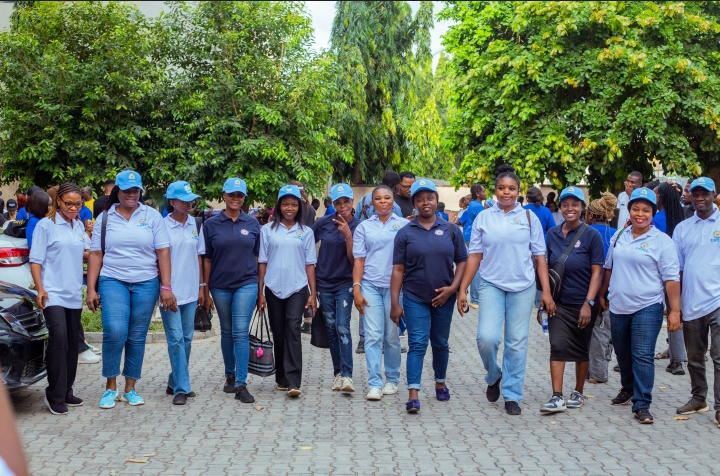
ABUJA — More than 200 people, including children with autism, their parents and advocates, have staged a four kilometres walk through the Federal Capital Territory, demanding action to bridge the gap between disability rights on paper and everyday reality.
The walk, organised by Special Needs Education Consult (SENCO) in partnership with Hope for African Children Initiative and other civil society groups, formed part of activities marking World Autism Awareness Month.
Participants moved from the premises of the National Commission for Persons with Disabilities to the Unity Fountain, a route organisers deliberately chose to symbolise what they described as the distance between policy commitments and lived experience.
Children with autism walked alongside caregivers, teachers and volunteers, holding placards calling for early intervention, inclusive education and stronger community support.
Mr. Manji Danjuma, Founder of SENCO and convener of the walk, said stakeholders must move beyond awareness campaigns and invest in systems that make inclusion real, including accessible schools, trained teachers and early identification services.
The event also featured a free medical outreach, where trained health practitioners provided screenings and consultations for families of children with disabilities.
At the closing programme held at Unity Fountain, speakers reiterated calls for early intervention, inclusive education policies and stronger community-based support systems.
Hope for African Children Initiative, which works across 43 schools in Nigeria through its Learning Without Limits programme, said its participation reflects its core mission.
“Inclusion is not something we add to our work. It is the foundation of it,” the Communications Lead, Chisom Idoko, noted. “Every child, including children with autism and other disabilities, deserves access to quality education, early support, and a community that sees their potential, not just their diagnosis.”
Organisers and partners urged government at all levels to strengthen policy implementation, increase funding for disability-inclusive education and support organisations working directly with affected families.
Participants described the walk as a milestone for disability advocacy in Abuja, and a call for sustained collaboration to turn awareness into measurable change.
Disclaimer
Comments expressed here do not reflect the opinions of Vanguard newspapers or any employee thereof.