Chioma Okoye
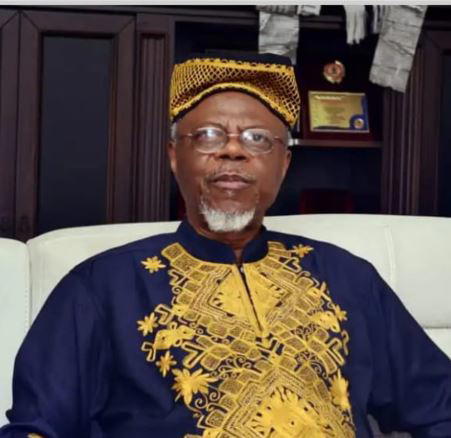
Oyo State marked a defining moment in its Golden Jubilee celebrations with the conferment of an honorary award on Professor Toyin Falola, the eminent historian whose work has shaped African historical thought for more than four decades. The recognition, presented during the grand finale of the anniversary events, placed scholarship and intellectual labor at the center of the state’s reflections on its past and future.
Governor Seyi Makinde presented the award on Tuesday at the Banquet Hall of the Oyo State Government House, Agodi. The ceremony formed the climax of activities commemorating 50 years of the state’s existence. Through the honor, the state acknowledged Falola’s enduring contributions to African history and his role in advancing African-centered interpretations of the continent’s experiences and intellectual traditions.
In his acceptance message, Falola described the award as both personal and symbolic, underscoring the deep connection between his scholarly journey and the society that nurtured his earliest intellectual consciousness. Reflecting on his career, he said, “The work that I have pursued over the decades, in the classroom, in books and in print, in the role of a mentor to younger scholars, in the public sphere, has been informed by a simple but demanding imperative: that knowledge should serve society. I have consistently believed that knowledge should not be isolated from the realities of people, and that the historian has a responsibility to assist societies in understanding themselves, their pasts, and the possibilities of their futures.”
Falola emphasized that the recognition transcends individual achievement, pointing instead to the broader importance of ideas, education, and cultural investment. “Thus, this recognition is not only a personal one for me. It recognises the importance of intellectual work, investing in education and culture, and ideas in development. It recognises that intellectuals, artists, teachers, and thinkers are essential actors in the nation’s development. I would like to salute the vision of the Oyo State Government for not only looking back at this historic event but also for realising the importance of knowledge for the future.”
Placing the award within the wider context of the Golden Jubilee, Falola called for sober reflection and long-term planning. “This Golden Jubilee of Oyo State is an opportunity for us to pause and reflect, to take stock of our successes, our challenges, and our tasks yet to be accomplished,” he said. “As we in Oyo State look to the years ahead, I hope that education, history, and the development of our youth will remain part of that future. A nation that neglects its thinkers and teachers undermines the foundation of its future; a nation that supports them sows the seeds of future growth.”
He described the honor as a renewed source of motivation, not only for himself but also for others committed to intellectual and cultural work. “I should note, as an aside, that I am very pleased to receive this award, as it is also an inspiration to all. It reconfirms my dedication to mentoring the next generation, to expanding the world of African thinkers, and to continuing to engage the world as a writer, a conversationalist, and an institution builder. It also reconfirms that the service of knowledge is also the service of people, and that the link between the two must never be broken.”
Falola concluded by dedicating the award to those who have shaped and supported his journey. “I dedicate this honour to all students, colleagues, and communities who have walked this journey with me, and to the people of Oyo State, who have inspired my life and work. May Oyo State’s next fifty years be marked by wisdom, inclusiveness, and a continuing quest for knowledge. Ase.”
The award highlights Falola’s vast scholarly output, which includes hundreds of books and academic articles covering African history, politics, religion, culture, migration, and intellectual life. His work has consistently argued for Africa to be understood as a thinking continent, with Africans positioned as authoritative interpreters of their own histories.
For Oyo State, the honor carries added resonance. Ibadan, the state capital, was a leading center of African intellectual life in the mid-twentieth century, producing generations of influential scholars and thinkers. Falola emerged from this tradition and has carried its intellectual imprint across the global academic landscape.
Disclaimer
Comments expressed here do not reflect the opinions of Vanguard newspapers or any employee thereof.