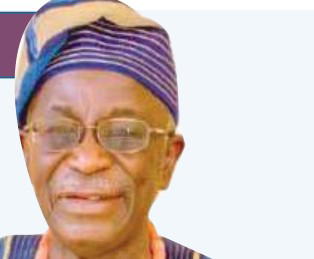
Prof Kehinde Olupona
By Prisca Sam-Duru
Professor Jacob Kehinde Olupona is a Nigerian-born American professor, writer, and scholar of religious studies. He is Hugh k. Foster Professor of African and African American Studies and Professor of African Religious Traditions, Harvard Divinity School, Harvard University.
Born on February 5, 1951, prof Olupona, a native of Ute in Ose Local Government, Ondo State, earned his first degree in Religious Studies in 1975 at the University of Nigeria Nsukka. He also has an M.A History of Religions, Boston (1981) and a PhD, History of Religions, Boston University, Boston in 1983.
In the course of his academic life, Prof Olupona has received several honorary awards from revered institutions both at home and abroad including the University of Edinburgh, Scotland.
To celebrate his 75th birthday, Prof Olupona who was in Nigeria during the holidays, shares some of his achievements and projects with Prisca Sam-Duru in Lagos, before leaving for the US where he is based.
In general, Prof, how is life at 75?
Life has been great, particularly in the context of my academic and intellectual journey. Last year 2025, was the 50th year of teaching and research for me and 20years with Harvard. I began my career in 1975 during my Youth Corps which I did at Kwara College of Technology, Ilorin. That was after I graduated from the University of Nigeria Nsukka in 1975.
From that year, till now, I can say that it’s been a blessing for me. I’ve had the opportunity to pursue my interest in education, especially in teaching and research.
As I reflect on my career at every point, I realise that I’ve succeeded in making a significant impact in my chosen field of Interest.
I remember when at the beginning of my career I was asked to teach social studies in the NCE program at Ilorin. There was no religious studies in that school at the time, so the best they could give me was social studies. I took the syllables from the head of the department. After going through it, I told him it was too elementary for the NCE program. I asked if I could revise it and make some suggestions. So, I revised the syllables. Thereafter, I invited important players in the federal government establishments in Ilorin to speak to my students; as guest lecturers. Representatives from the police, Central Bank, Fire Brigade, Prison, etc, were invited to share with them what they normally do as part of the federal government structure, so that they can know the institutions around them.
As Elementary as those things were, Nigerian students had no idea of what they did. It was unbelievable. That subject- social studies was relevant to society.
The people I invited felt so honoured. Don’t forget there was no University of Ilorin; Kwara College of Technology was the highest in town. So, they started paying attention to me. That was just the beginning of my career.
Also, I remember those who taught me in Gboluji Anglican Grammar School, Ile Oluji.
where I began. The caliber of teachers we had at that time, were like professors, considering the depth of knowledge that they brought to bear, the teaching, and the way they moulded us to be citizens of the country.
They took seriously what we call learning and character; some of the things that we have lost in Nigeria today.
So, when I look at my life, my career from that time to this point, that’s what I could see. And as a Christian, an Anglican, I have every reason to thank God for showing me the way and leading me in my career.
Are you saying sir, that we no longer have such a calibre of teachers?
No, no, we don’t have that calibre of teachers. And maybe we don’t even deserve to have those calibres of teachers.
I was listening to a sermon by an Imam. He was saying, “all of you student associations contributing money and going to your school, building schools and classrooms, etc, you should stop doing that, nobody sent you. The government is not interested. You need to take care of your teachers.”
The Imam complained that some of them had not been paid their pensions. And even when the pensions are paid, what they are paying them after 55 or 40 or 35 years of work, is less than what a senator earns in a month. I could identify with that, though I disagree with him that we should not help to build classrooms or help our alma mater. But he was calling attention to the poverty in the land and the fact that these teachers that should be enjoying after their retirement live in total abject poverty.
So that’s why I said sarcastically, that maybe we don’t deserve them. This calibre of teachers I’m talking about, I can write a whole book on them. There are some I still remember today. Like the one that taught me history, I keep asking, why is it that this man didn’t study law, given how he delivered his subject. I talk about them at Harvard. There were times my students would ask me to tell them about my formation. So, I gave them examples about my teachers. And they were like, wow! That era is gone. And I was hoping that when private institutions started in Nigeria, they would begin to show us the way because we had neglected state schools. The military did a bad job and civilians joined them to further destroy our schools. They took away the mission schools for one reason or the other; some out of envy, some out of malice. They destroyed the educational system.
Today, the government seems to be spending a lot of money, I believe, in public education, particularly university. I read about it, let us hope it is true. We should expect some changes in the universities because the universities, let us face it, are like glorified high schools. And it should not be.
When I went to University of Nigeria Nsukka a few years ago when they gave me an honorary degree, I couldn’t believe what I saw. I wondered, ‘Is this the same university that I schooled in 1971 to 1975; What is going on here?’ This is the story in a number of places.
How was the university exactly?
Well, I noticed degeneration in virtually all things, especially structures.
I’m grateful for the honorary degree but I was expecting something stronger and higher than what I saw. I recall talking to some alumni on the need for us to rescue our university from decay.
I will later tell you some of the things I’m doing in terms of my program, to support education. I believe that we should also be actors.
Would you mind telling us about some of the programmes?
About 10 years ago, I had a series of meetings with Nigerian professors in the diaspora. I came home to also have meetings with colleagues here. I unveiled to them my plan to start a summer institute programme where we bring together mid-career scholars who had in mind to be lecturers in the universities; post and pre Doc, for two weeks of intensive training. I told them that I would bring scholars from abroad to join their colleagues to handle the two weeks of intensive training. Each year, we would design a kind of syllabus based on the theme they want to teach. My appeal to the diaspora was successful; no single person turned me down. This year is the 10th anniversary of the Institute.
When it grew, and we saw the success we created, we called it the Institute for Advanced Studies in Ile Ife. It is not part of the university; it is totally independent of the university. We don’t give degrees, we simply empower the young scholars, teach them what they should know to be successful in their career as lecturers.
We began with Social Sciences and Humanities. Then a few years ago, we expanded it to STEM because of the interest in science and Technology. The STEM programme has been successful.
How affordable is the institute?
We don’t charge money, maybe this year will be the first. We will probably ask them to pay for some few things, but we raise the money. The two-week programme is free. The professors who were invited to participate for years never asked us to pay them. They buy their air ticket. They are committed. Nigerians all over the world are very much interested in reviving things in this country.
The programme began as a Nigerian thing, but when we noticed that some of the professors are Africans from African Countries, we decided to expand it to an institute. So far, we have trained close to 700 scholars. When we were young, we had similar opportunities. In the 70s, and 80s, quite a number of Nigerian scholars who were trained abroad came back.
When I was in Boston doing my doctorate in the 70s and early 80s, there were close to 15 Nigerians around the Boston area, and we returned home. There was no reason to stay behind. The Nigerian naira was stronger than the U.S dollars. There were great opportunities to do great things at home. You were challenged because you’re fresh. Some of us were responsible for almost single handedly revising the syllables for departments. Most of these professors are doing very well all over the world.
Talking about coming home, now that you’ve hit 75, any plan to come home after retirement?
Of course. If you ask any of my colleagues in Ife or America, they’d be surprised at the question because they know that my heart is in Nigeria. If not, I would not have been able to pursue the programme I told you about. It’s interesting you’re asking this question because I’m going to retire very soon. I have a sabbatical leave this year/next year; one year leave. That’s when I’ll assess everything and prepare for retirement. Then of course I will have time to focus on this project I described to you. And we are really building. We need our own space so we have acquired ten hectares of land in Ife. The architects have designed something like a mini campus. So, I’m getting ready for that. I’m hoping this one year, we’ll raise funds seriously so that we can have an independent program. If the government is willing to join us it’s fine and I hope they’ll be interested.
You spoke some time ago about issues in your diocese in America, have they been resolved?
Well, the issue has been resolved somehow though not in a way that satisfies everybody. We have our diocese; we are running our diocese. We want to focus on evangelism and worship God. The case went to court and in the context of the American law and American situation, they often don’t dabble into the issue of the church because of the Church-State relationship thing. However, they told us that they have no right to dissolve the diocese which was our primary reason for going to court. It may not be a total victory in the way we wanted it, but at least, the primary reason has been clear to them. Unfortunately, there is confusion among our people.
When we look at what they did to us, it is a very painful thing. How can you dissolve a diocese that has been in existence for 13 years? A diocese we all laboured to maintain. We supported the priest; some of them came to America to study with me. There was one of our Bishops whose duty was to help with immigration matters. He spent his personal money. He also helped in the building of religious centers. We decided that we will leave everything to God and just do our own thing. So, that’s where we are right now. The purpose of coming there is to serve God.
Disclaimer
Comments expressed here do not reflect the opinions of Vanguard newspapers or any employee thereof.