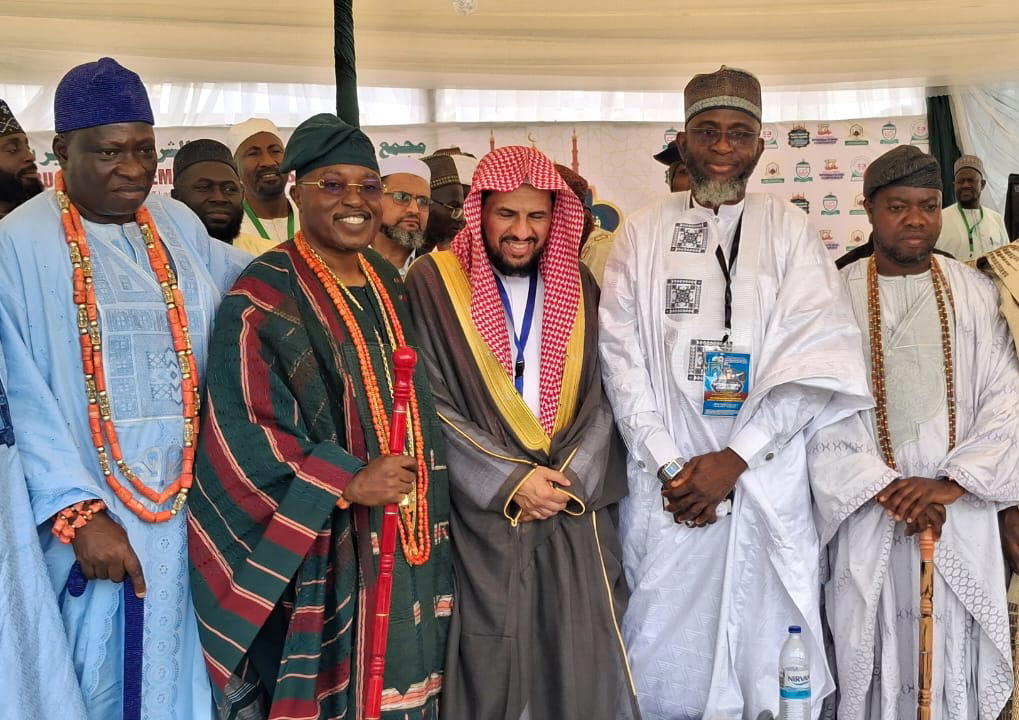
L-R: Akire of Ikire Kingdom , Oba Olatunde Falabi; Oluwo of Iwo Land, Abdulrasheed Adewale Akanbi; Representative of the Deputy Minister, Ministry of Islamic affairs, call and guidance, Saudi Arabia, Hamad bin Muhammad Al-Wuhaybi; Conference Convener, Sheikh Imran Abdulmojeed Eleha; and Oba Isheri-Olofin Kingdom, Oba Ibrahim Olasunkanmi Lawal Bello at the 17th annual Islamic International conference organized by Daaru Na’im Academy for Sharia Science of Nigeria
By Tunde Oso
Speakers at the 17th Annual Islamic International Conference of Daaru Na’im Academy for Shariah Sciences, Lagos, have urged Nigerians of all faiths to embrace religious tolerance and peaceful co-existence, stressing that national unity is essential to effectively address the widespread insecurity facing the country.
The conference, held from January 1st to 4th, 2026, rallying over 20,000 participants and international scholars to promote sound Islamic belief as the panacea for social instability the four-day event addressed the critical theme, “The Jurisprudence of the Sound Creed and Contemporary Challenges,” drew attendees from within Nigeria, the United States of America, Saudi Arabia, Africa, Asia, and Europe.
Islamic scholars and clerics present unanimously declared that criminal violence, including banditry and terrorism, has no link with Islam. The speakers also condemned all attempts to associate crime, injustice, and evil with the religion, warning that such links not only misrepresent Islam but also fuel prejudice and religious intolerance.
The Deputy Mufti of Uganda, Sheikh Mohammad Ali Wahiso, and representatives from Saudi Arabia emphasized that Islam is founded solely on the principles of peace, justice, and the sanctity of human life.
The conference focused heavily on addressing contemporary challenges, including extremism and moral decay, by promoting cohesion and reinforcing the basic principles of the religion.
The Director-General and Chief Imam of Daaru Na’im, Sheikh Abdul Mojeed Imran Eleha, stated that the conference was aimed at examining the importance of sound Islamic belief across African societies in view of evolving social practices and behaviors that contradict the principles of authentic Islamic creed.
Sheikh Abdul Mojeed Imran Eleha, convener of Daaru Naim, further identified the source of confusion.
“This challenge is further compounded by discourses hostile to the sound creed, propagated by groups that claim affiliation with Islam and the qiblah, yet remain far removed from the true methodology of Islam in belief and actions.”
He stressed that the bedrock and basis of religion is the creed, which is the oneness of Allah, a principle which all subsequent teachings are built upon for spiritual development. He also called upon scholars in Nigeria to unite upon the word of Allah, overcome fragmentation, and prioritize collective scholarly engagement over social media discord.
Professor Abdul Mojeed Rasaq Alaroof, the Islamic Law Department, University of Ilorin, delivered a powerful message on civic responsibility and tolerance.
“I’m calling on all Nigerians irrespective of your faith, irrespective of your tribe. We don’t have any other country except this one and we must preserve and protect it. We are brothers. We are citizens. We can sit on the round table and find solutions to our problem.”
He reminded participants that mutual respect is foundational, stating that solutions lie in tolerance and understanding, not external intervention.
“You don’t necessarily impose your faith on me and I don’t have and I don’t have to impose my faith on you and that is basically categorically stated in the glorious book of Islam. The verse of Quran states clearly that there should be no compulsion in religion. We need to tolerate one another. We need to respect one another.”
Justice Kamaldeen Abdulateef, Grand Kadi Kwara State Sharia Court of Appeal, highlighted the expected long-term impact on the youth, emphasizing moral character and civic duty.
“I believe that our entire upcoming generation will learn from this international conference by emulating, as they say, our good practices in Islam. They will imitate many positive aspects demonstrated at this conference. It will help our future generations to foster strong relationships between Muslims and non-Muslims, as well as good relations between ourselves and the government. In particular, it will teach the incoming generation that we need to stay away from corruption and promote discipline within our society, especially concerning the environment.”
To ensure the sound creed reaches the next generation, Sheikh Mohammad Ali Wahiso, Deputy Mufti of Uganda, emphasized the necessity of modern methodologies to counter misinterpretation.
“Therefore, it is important that we build the capacity of the Muslim scholars in addressing the needs of the society in a contemporary way and especially using online and technological approaches to be able to reach the societies at large. Otherwise, the youth will always be dependent on the misinterpretations that are rendered through Google and others which are not appropriate.”
The conference successfully gathered key stakeholders—including government institutions, ambassadors, traditional rulers, and academic experts—to reinforce the message that the pristine Islamic creed is the necessary foundation for moral order and stability in society.
Disclaimer
Comments expressed here do not reflect the opinions of Vanguard newspapers or any employee thereof.