By Vincent Ujumadu, Chidi Nkwopara, Steve Oko, Dennis Agbo and Chimaobi Nwaiwu
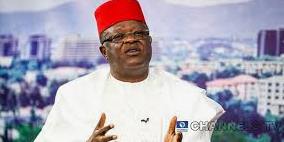
Prominent Igbo people have reacted angrily to the statement made by the Minister of Works, David Umahi, who claimed that President Bola Tinubu has addressed the issue of the marginalization of Ndigbo through infrastructure development and appointments, telling him to shut up because he has no mandate to speak for the Igbo.
Umahi, while inspecting federal road projects in the Southeast geopolitical zone recently, incurred the wrath of his people when he said that sentiments of marginalisation have significantly eased due to substantial federal investments in roads and other critical infrastructure across the region.
Umahi had said: “There will be no need for Biafra again. In the past administration, our people felt very much marginalized and that was the reason some people were agitating for Biafra. But I can say today that we are well integrated into the mainstream of the nation, Nigeria. Under President Tinubu, Southeast is “comfortable” and very happy with the integration.”
Reacting to the Minister’s statement, the respondents urged Umahi to keep quiet and enjoy whatever benefits he is getting from the present administration, rather than insult the sensibilities of the people who have been enduring the worst marginalization under the present administration.
A chieftain of All Progressives Congress, APC, in Imo State, Prof. Vitalis Orikeze Ajumbe said he was not surprised that such a statement could come from Umahi. “The Minister can say whatever he likes to keep his job, but he has to realize that he has no mandate to speak for Ndigbo. He may be enjoying the pecks of office now, but I sincerely advise him to resist the temptation of being carried away by the euphoria of his office.
“He has a job and doesn’t want to lose it. So, he can say anything he likes. He can go ahead and announce that there is no hardship and nobody is dying in Igboland, just to justify his ministerial position.
“He simply made the vexation outburst to please his employer. He didn’t represent the feelings and realities on ground, in Igboland. He took sycophancy to the highest decibel”, Ajumbe said.
He listed some of the obvious areas of marginalization of Ndigbo to include state creation, representation in the National Assembly, employment, infrastructure development and more.
He added: “How many plum positions were given to Ndigbo in the present federal administration? This explains why he is talking to hold tight to his office.
“ Look at our roads. Which federal road in the South East is fine? How many years have they given contract for Enugu-Port Harcourt road and Enugu-Onitsha road? Mention one good road in the South East. I am surprised that Umahi is talking this way.
“Look at the seaports that are supposed to be developed at Orashi and Ihiala. What has happened to them. They wouldn’t want them opened, so that Ndigbo will continue to move long distances for port services! It is a way to stifle Igbo businesses, but God is on our side..”
Elder statesman and Senior Advocate of Nigeria, SAN, Chief Mike Ahamba, who also reacted said Umahi knows too well that there are palpable traces of marginalization in Igboland.
Chief Ahamba said: “To start with, who was Dave Umahi before he became governor? Is it not a case of somebody, getting to the middle of the road, jumps into the bush, bets himself a walking stick and finally made a governor by his kinsmen?
“We keep having this type of tantrums, from time to time. If he says we are not marginalized, it is his personal opinion. It is not the majority opinion in Igboland.
“We have freedom of speech. So, let him say whatever he likes. So long as we keep choosing just anybody for public offices,, or persons who will not serve us diligently, we will keep making mistakes.
“We cannot easily forget that Umahi came to Imo State and condemned the roads built by Governor Hope Uzodimma, on behalf of the Federal Government. It is sad that Umahi keeps talking as if he has Igbo mandate to speak on our behalf .
“Look at the reconstruction of the rail lines. Did they not marginalize Igboland? Is it twice? Nothing has been done in this direction and South East is carefully and deliberately excluded, and somebody is carelessly saying we are not marginalized.”
A former Minister of Education during the Shehu Shagari administration, Professor Ihechukwu Madubuike, also tackled Umahi, for saying that the current administration had, with appointments and road projects, ended all the issues of marginalization against Ndigbo.
He also disagreed with Umahi that the challenges of Ndigbo had been addressed, stressing that the problem of Ndigbo is not limited to infrastructural deficit and decay alone, but extends to exclusion and imbalance in state creation, federal constituencies, senatorial districts and council areas.
The elder statesman also noted that even the existing federal roads in the South East, construction of which started over twenty years ago, are still replete with pot holes, and cautioned Umahi against unguarded utterances which insult the sensibility of Ndigbo just for personal political gains.
The octogenarian who had participated in several national conferences, wondered why the long agreed parity state for the South East had not come if truly Ndigbo were no longer marginalized as Umahi would want his audience to believe.
He said:”Dave Umahi has no mandate to speak on behalf of Ndigbo. He has no mandate to speak for us. He’s a Minister representing a department of the Presidency which is the Ministry of Works.
“The Ministry has not even addressed the pothole issues on our roads. The bad roads still litter the entire Southeast. Umahi and his masters are busy building coastal road that has only a spur in Ebonyi, and avoided Enugu, Abia , Anambra, and Imo. Yet he claims we’re no longer marginalized! That’s a contradiction.
“Secondly, road issues, infrastructural issues, do not suggest that the problems of Ndigbo or their marginalisation have been addressed. We still have the issue of parity of states, parity of legislations, and parity of local governments to deal with.
“We still have the monumental psychological problem that state exclusion has cost a generation of Ndigbo. It’s all these that led to their constant agitation because these issues have not addressed the fundamental issues of nationhood.The gaps that exist between the marginalized, the accepted, and the tolerated in the Nigerian polity are still there.”
Another resident of Owerri, Mr. Ikechukwu Chukwuka, described Umahi’s outing on television as “largely infantile, disgraceful, unfortunate and a bad testimonial for a supposed Minister of Igbo stock.
Chukwuka said: “Ordinarily, the live television programme was supposed to be a public accountability forum, but what did the viewers eventually get? We saw a man that was full of himself; we saw a man who branded himself as a professor of infrastructure; we saw a man who illicitly brought in respected personalities like Rufai Oseni of Arise TV and Senator Enyinnaya Abaribe into his show.
“It was very shameful and infantile of him, to have brought in people, to say what he said about them, behind their back. For me, this is what uneducated village women in polygamous homes do. The office of a Minister shouldn’t have been dragged to that gutter level, for whatever reason.
“Will anybody blame Senator Enyinnaya Abaribe or Rufai Oseni if they decide to fire back? For me, the Minister simply brought home, ant-infested firewood, and lizards will definitely come to feast on them.
“I don’t want to waste my time on his thought and pronouncement that Ndigbo are no longer marginalized in Nigeria. Umahi knows that he is not serious about it. I expect he should know that not even his employer took him seriously, because the evidence of Igbo neglect remains visible and palpable.”
For Mrs. Agnes Chika Osuji, Umahi’s outing was a big shock to all discerning minds. “I am still shocked by what I heard the Minister say on the live television programme. He should have limited himself to what his Ministry did, to improve transportation and communication by road. We expected him to tell us what the government he is serving, has done in Igboland, instead of jumping into the fantasy of psychology.
“We expected him to also tell us what programmes government was planning to execute in Igboland, instead of trying to wear the toga of an Igbo spokesman.
“Who told him that Ndigbo are happy? Who told him that there is no more marginalization of Ndigbo? How many local government areas do we have in Kano State alone and what is the difference between it and what we have in the entire South East geo-political zone? Umahi should please, go and rest”, Osuji added.
The National President of Igbo Women Assembly, IWA, Lolo Nneka Chimezie, expressed disappointment over Umahi’s utterance, saying he spoke out of selfishness.
She further dismissed Umahi’s opinion that Biafra agitation should be discarded, noting that the fundamental issues that gave rise to the agitation are yet to be addressed.
She told Umahi to use his position to advance the cause of Ndigbo, and not to ridicule them like a rented traitor. “Umahi is simply selfish and he is one of those that brought Igbo people down out of his own selfishness. How can Umahi say at this time of APC rule which has shown unhidden bias against the Igbo, that we are no longer marginalized?
“Is Umahi aware that even with the least number of Ministers in the Federal Executive Council, two out of the five serving Ministers from the South East are junior Ministers. Nigeria has three major ethnic groups, but where’s Ndigbo in political offices in Nigeria?
“Umahi doesn’t believe in Biafra because he is part of the Federal Government, and maybe after his tenure he will run abroad to stay with his family. How can he claim that Ndigbo are no longer marginalized when our own son was jailed for merely speaking out for his people?
“He was given life imprisonment for merely using his mouth to speak. Umahi never saw the injustice. But bandits who have killed people and did all manner of things, were rehabilitated some absorbed into the military under Umahi’s watch. Umahi can only say he doesn’t want Biafra because he is comfortable and benefits from the continued oppression of Ndigbo
“It’s regrettable that self -acclaimed Igbo leaders cannot speak for the people they claim to be representing because of their selfish interests. Instead of amplifying the agitation of our youths for federal attention and solution, these short-sighted leaders will rather choose to collude with the enemies against their own people”, Chimezie said.
An Awka resident, Chief Cletus Odikaesieme accused Umahi of lacking tack, recalling that despite the fact that he was governor for eight years, his people are among the least educated because he did not understand what human development meant.
He wondered how the likes of Umahi feel in government whenever skewed appointments that do not accommodate the interest of Ndigbo are made by the administration he is serving as a senior Minister.
A former member of the House of Representatives for Ohaozara/Onicha/Ivo federal constituency of Ebonyi state, Hon. Linus Okorie also tackled Umahi for saying that justice has been served on the Igbo cries of marginalization with roads construction, describing the Minister as a dangerous Igbo who, because of personal compensation, feels that the rest of the Igbo have been settled.
Stressing that the Igbo quest for fairness did not begin with roads, and cannot end with them,
Okorie said roads, no matter how well built or how long they are projected to last, are not favours.
“They are funded by national resources to which the Igbo contribute significantly. They are part of the basic obligations of government, not proof of justice, equity or full integration. To equate the rehabilitation or construction of long-abandoned roads with genuine inclusion in the Nigerian project is to dangerously lower the standard of citizenship and to misunderstand the deeper grievances that have lingered for decades.
“If road construction alone were the true test of justice, then the President’s South-West—with the Lagos-Ibadan Expressway, Lagos-Abeokuta Road, Lekki Deep Sea Port access roads, Lagos-Badagry Expressway, extensive federal flyovers, rail projects and the multi-trillion-naira Coastal Highway—would qualify as not just integrated, but overwhelmingly favoured. Yet no serious observer argues that roads alone resolve questions of equity. Why, then, should the Igbo be asked to accept that logic? True integration is reflected in who occupies the commanding heights of the state and how power opportunity and justice are distributed.
“On this score, the publicly available facts remain uncomfortable. The South-East continues to be largely absent from the leadership of Nigeria’s core security, economic and regulatory institutions. The armed forces, police, intelligence services, customs, immigration, revenue agencies, oil and gas institutions, ports and aviation authorities remain overwhelmingly dominated by other zones.”
“Ministerial appointments tell a similar story. The South-East remains the only geopolitical zone with five states instead of six—a historical injustice that continues to translate into fewer representatives at the federal level. Even among the limited number of ministers appointed from the five Igbo states, only Engr. Umahi presides over a core ministry. None of the others controls a strategic portfolio that shapes security policy, fiscal direction, energy control or national economic planning. Presence without power is symbolism, not inclusion.”
According to Okorie, budgetary patterns further expose the gap between official rhetoric and lived reality, lamenting that year after year, projects in the South-East are under-captured, under-funded and poorly released.
“Announcements are made, figures are quoted and ceremonies are held, yet actual disbursements lag behind, projects stall, costs escalate and timelines shift endlessly. When compared with other regions—particularly the South-West—where budget capture is stronger, releases are quicker and delivery more consistent, it becomes clear that what is often presented as generosity is, in truth, delayed restitution for years of neglect.
“Policy design and implementation deepen this imbalance. Major transport corridors, ports, rail lines, energy hubs and industrial zones are consistently structured to reinforce existing regional advantages.
“Despite its population density, entrepreneurial drive and strategic location, the South-East remains boxed in by weak federal presence and limited policy imagination. A nation cannot credibly claim integration while maintaining systems that routinely sideline one of its most productive regions.
“No honest conversation about marginalisation can avoid the question of justice and the rule of law. Across Nigeria, armed agitations in other zones have been met with dialogue, amnesty and political accommodation. Yet in the South-East, the case of Nnamdi Kanu—whose agitation was largely unarmed—has evolved into a defining symbol of unequal treatment. Following a prolonged and controversial legal process, he has now been convicted and sentenced to life imprisonment and therefore faces the prospect of spending the rest of his life in custody. Regardless of differing opinions about his methods or message, the handling of his case continues to raise profound questions about proportionality, consistency and equality before the law. This is not an endorsement of separatism. It is a call for equal justice under the law. A country that treats comparable grievances differently cannot reasonably expect trust or loyalty to endure”, the former federal lawmaker said.
He added that beyond politics and security, the everyday economic experience of the Igbo tells its own story, highlighting that Igbo traders and businesses continue to face disproportionate demolitions, weak compensation regimes and regulatory hostility in major commercial centres.
“Markets are destroyed, livelihoods disrupted and communities impoverished, often without the empathy or remedial support extended elsewhere. Economic equity is not an abstract concept; it is felt daily in markets, transport corridors, ports and industrial zones. On this front too, the imbalance remains glaring.
“It must therefore be said, with respect and clarity, that personal access to power must never be mistaken for collective progress. Engr. Umahi’s current position as a powerful minister is a personal achievement and a testament to his abilities. But the fortunes of one individual—no matter how prominent—cannot substitute for the wellbeing of an entire people. History offers many examples of individuals who thrived within unequal systems while their communities remained excluded. Silence, or excessive optimism, does not heal injustice; it merely delays accountability”, Okorie stated.
He said that although an Igbo son, Air Vice Marshal Sunday Kelvin Aneke, currently serves as Chief of Air Staff, one appointment, however prestigious it is, cannot mask a broader and persistent pattern of exclusion.
“Token gestures do not cure structural imbalance, just as the Ministry of Works—important as it is—cannot compensate for systematic absence from the centres where national power and resources are truly controlled”, he said.
The chairman of Osakwe Industrial Cluster, Awada near Onitsha, Chief Johso Okolo, regretted that the problem Ndigbo are facing in Nigeria since after the Nigeria Biafra civil war has been the deliberate action of picking sycophants and wrong people to represent them.
According to him, the choice of Umahi is part of that same problem successive governments created in dealing with Ndigbo.
“There has been the track record maintained by the government of Nigeria to never recruit those who love Ndigbo in appointment of positions. They prefer to recruit people who will work against Ndigbo in all aspects of their lives and at all times.
“For me David Umahi is speaking as it concerns him, his pocket and his position. His pocket is rich today and his position guaranteed and that is why he talks uncontrollably about achievements of the present administration only him is seeing
“What Umahi is saying is what he should say, it is not strange to us. His predecessors in praising non performing government, have done the same and when such governments leave office, they see themselves in prison.
“Umahi is using roads and appointments into positions to measure the marginalization or not for Ndigbo, but he is wrong. If you even check roads from Abuja to Sokoto and those from Kano to Maiduguri and what the Federal government is doing in South east, you will see that there is nowhere the federal government has done up to 100 kilometers of road without abandoning it.
“Addressing the claims of marginalization is not about rehabilitation of road and appointment of people into positions; there are more to that. Look at Nnamdi Kanu in prison and Sheikh Gumi is moving everywhere” Osakwe said.
Disclaimer
Comments expressed here do not reflect the opinions of Vanguard newspapers or any employee thereof.