…Says Nigeria must “customise its democracy”, restructure federalism and treat education as key nation-building wheel
By Efe Onodjae
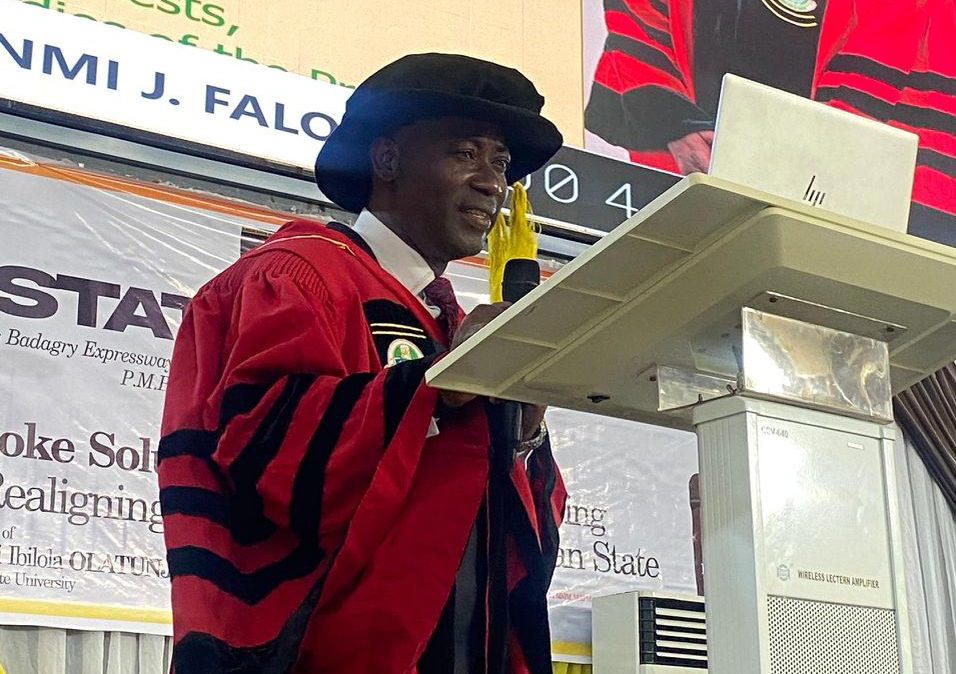
Nigeria’s democratic and governance architecture will remain unstable, wasteful and politically combustible unless the country adopts a single, non-renewable seven-year tenure for Presidents and Governors, a renowned scholar, Professor Adewunmi James Falode, declared at Lagos State University (LASU) during the institution’s 115th Inaugural Lecture.
Delivering the lecture titled “Bespoke Solutions: Reimagining, Reifying and Realigning the Wheels of the Nigerian State,” Falode argued that the nation’s political system has been trapped in a cycle of unproductive governance, excessive election expenditure, divisive politicking and prolonged litigation since independence.
According to him, the current two-term, four-year presidential model Nigeria borrowed “wholesale” from the United States has proven ill-suited, expensive, elitist, and disruptive to effective governance.
Falode said Nigeria’s political class spends almost half of every four-year cycle pursuing court cases or fighting for re-election, leaving very little time for governance.
“The presumed winner uses two out of four years fending off petitions, five months to govern, and the remaining one and a half years preparing for reelection,” he lamented.
Citing the astronomical rise in election costs—from N2bn in 1983 to N305bn in 2023—he argued that this cycle fuels instability and diverts national resources from development. He maintained that a single seven-year tenure would give leaders four uninterrupted years to govern effectively, one year to settle litigations and two more for transition-related activities without the pressure of re-election.
The LASU don emphasised that Nigeria must move away from “textbook democracy” and instead customise a homegrown model that reflects its socio-political realities.
“Nigeria’s democracy is alien, expensive and exclusionary. It has failed to deliver its dividends in the First, Second, Third and Fourth Republics,” Falode said.
Drawing comparisons with countries such as Ethiopia, Egypt, Liberia, Mexico and Armenia, he noted that several nations with colonial histories similar to Nigeria have successfully adopted single-tenure systems to stabilise governance.
Federalism must be restructured into ‘competitive federalism’
Falode also advocated a weaker centre and stronger states, stressing that Nigeria’s future depends on decentralised governance that encourages state-level innovation and equitable development.
“Nigeria adopted federalism hook, line and sinker without customising it. What we need is competitive federalism, strong states, a decentralized centre, but NOT regionalism,” he said.
He cited the historical evolution of Nigeria’s constitutional wheels, from the Clifford Constitution of 1922 to the 1979 Presidential Constitution, as evidence that the country had repeatedly attempted, but failed, to realign its governance structure.
Falode identified education as the single most critical tool for forging national unity, combating extremism and promoting economic development.
Comparing Nigeria with China, he explained how education produced a unified national identity and helped contain large-scale extremism among minority groups.
He said Nigeria must implement compulsory and free primary and secondary education, stressing:
“A society that deploys adequate resources to combating ignorance will find it difficult to breed religious extremism.”
Falode’s lecture traced Nigeria’s nation-building challenges from independence through the civil war and successive military regimes, highlighting how various leaders introduced different “wheels”from Gowon’s 3Rs to Obasanjo’s anti-corruption reforms, yet structural misalignment persisted.
He argued that Nigeria’s current insecurity, ranging from banditry to terrorism, is symptomatic of deeper structural failures that only comprehensive constitutional realignment can address.
Falode’s scholarly track record
Professor Falode, who is LASU’s pioneer Director, Centre for Peace and Security Studies, is one of Nigeria’s leading security scholars with over 50 academic publications and the highest citation record in LASU’s Faculty of Arts.
In his concluding remarks, Falode declared that Nigeria’s challenges, ethnic divisions, corruption, weak federalism, insecurity and governance failures, are surmountable: “There is nothing wrong with Nigeria that cannot be fixed, provided the leaders and citizens are willing to realign and reify the wheels.”
He said his proposals, single seven-year tenure, competitive federalism, and compulsory education constitute the “bespoke wheels” needed to finally make Nigeria’s political vehicle stable, cohesive and development-driven.
Disclaimer
Comments expressed here do not reflect the opinions of Vanguard newspapers or any employee thereof.