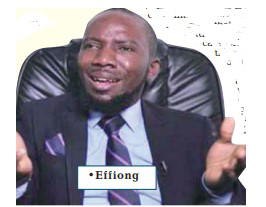
…says Nnamdi Kanu’s no-case submission a risky legal gamble
By Dickson Omobola & Matilda Ikediobi
Inibehe Effiong is a human rights activist. In this monitored interview, Effiong spoke about the controversy that trailed the announced lists of those granted presidential pardon and the decision of President Bola Tinubu to review the list. The rights activist also spoke on the detention of human rights activist, Mr Omoyele Sowore, in Kuje Prison, Abuja, for three days and Nnamdi Kanu’s decision to enter a no-case submission in his ongoing trial. Excerpts:
President Bola Tinubu has not only reviewed, he has also revised the previously announced lists of those granted presidential pardon. How happy are you to hear him bow to public pressure?
To President Bola Tinubu’s credit, it is good that that list has been reviewed. The initial list that was published was an embarrassment. It was a dent, not only on this country, but also on the character of government itself. When some of us came out publicly to distance ourselves from it, to deprecate the names that appeared on that list, we expected that something would be done. Now, there is an argument that some lawyers are making – whether the president can review that list or not. Initially, I had taken a more cautionary approach by saying that yes, Mr Bayo Onanuga, the special adviser to the president on media and strategy, had published a list which he said the president had granted pardons, to the extent that what was done at the time was limited to a public statement.
We can say that the process of pardon was incomplete, because for a presidential act in the nature of a pardon to have been fully exercised, there has to be an instrument evidencing the exercise of that power. That is what President Bola Tinubu has done. We have now seen certain instruments, various instruments that have been issued for various categories of beneficiaries of this prerogative of mercy. Now that there is an instrument evidencing the pardons, the pardons have become absolute, or the prerogatives of mercy so granted are now irreversible. But we now further interrogate how come that the previous list even came to public light. If you look at the process for issuance of pardon under the Constitution, I cite specifically Section 175 of the 1999 Constitution of the Federal Republic of Nigeria as amended. It involves three institutions, the president, the Council of State and the Presidential Advisory Committee on the Prerogative of Mercy.
Now, before an announcement is made, it is expected that the Presidential Advisory Committee on Prerogative of Mercy, headed by no less a person than the Attorney General of the Federation and Minister of Justice, would have scrutinised the list, vetted the profile, records of the individuals who are to be recommended to the president for pardon, or commutation of sentence, or whatever aspect of prerogative of mercy is to be exercised. Now, when the president receives the report or recommendation of the Presidential Advisory Committee, the Constitution mandates that the president will, in consultation, go before the Council of State and say, these are the persons that I want to exercise the power of prerogative of mercy in their favour, and what is your opinion on this? I am making a case that while it is commendable that the president had tinkered a bit with the list, we must now ask a legitimate question about the manner in which decisions are being taken by this government.
What this speaks to is that either this was done intentionally to send a message to Nigerians that as far as the issue of pardon is concerned, these are the categories of offenders that the president has interest in, or those who have a responsibility to advise the president may have either been compromised or grossly incompetent. But whatever position one decides to take, I am not satisfied that the president has not taken action regarding the membership of that committee.
You are saying that perhaps heads should roll. Can you give us some of those persons who you think that Mr President should be questioning or relieving of their duties over this issue?
If you read the statement of Mr Bayo Onanuga, there is a paragraph that I found rather interesting. That is a paragraph where he said that in order to avoid this kind of embarrassing episode in the future, the president has now directed that the secretariat of the Presidential Advisory Committee on the Prerogative of Mercy should be relocated from the Ministry of Special Duties to the Ministry of Justice. Does that mean that the president has found that the Ministry of Special Duties was compromised or that the Ministry of Special Duty is inefficient? It is not enough to simply make this announcement. I am saying that if truly the president is remorseful, if truly the president has now admitted that he was wrong and is now making this concession in favour of public opinion, it is not enough to simply make certain reversals. Who made these recommendations? At what instance were these names put on the list?
The president should be interested in addressing that. There is one point that we have to make and stress very seriously, and that is that when the president exercises the power of the prerogative of mercy. It speaks eloquently to the character of the president. If you have a president say, the person that I want to exercise this very unique power that the constitution has vested in me, in favour of, and you now choose that there are going to be persons convicted of hard drugs, engagement in trafficking of cocaine, committed grievous murder, notorious kidnappers, persons who stole public funds, does that not say a lot about the thinking of the president? Does that not say a lot about the priority of the president? This is not just about exercising power, because in exercising that power, the constitution demands that the president should act in the public interest. Whose interest is the president advancing? Look at the case of Maryam Sanda. We are now being told from what we have seen that her sentence has now been reduced from death by hanging to 12 years imprisonment. She has already served about six years and eight months. What is the reason given? It is in the interest of the children, she has become a model for other prisoners, a changed character, among others. But guess what? There are thousands of Maryam Sanda across custodial centres in Nigeria.
She is not the first woman who has been convicted and sentenced to death for killing her husband. Why is her case special? Nigerians deserve some explanation. I concede that this is a matter of discretion. In exercising this discretion, the president has to demonstrate to Nigerians that he is acting in good faith. This woman has only served for about six years and some months for taking the life of her husband, Bilyaminu Bello, in a very dastardly way. Read the judgement of the court. I am not certain that 12 years is sufficient for the grievous crime that she committed and the manner she committed it. I am not even sure whether she is truly remorseful, but I leave that for the president.
Now, in the list that has now been published, people should not assume that persons convicted of drugs are not beneficiaries. They are. It seems a section of the media is conveying that persons convicted of drugs are completely excluded. I have looked at the list even as I am talking to you. I could count in total about 86 names. Some of those persons whose sentences have been reduced were convicted of engaging in illicit drugs.
If the intention, I want to emphasise, is to decongest our custodial centres, how about persons convicted of petty offences? Have Nigerians asked that question? How about persons who are victims of political persecution? How about persons who are convicted of stealing money that are not significant? How about persons that were given options of fines that may even be less than a million? How come the president has not deemed it fit to exercise his power of prerogative of mercy in their favour? That is persons convicted of federal offences. I am saying that something fundamentally went wrong, and the president has the responsibility to address that. What he has done is applaudable, but it is not sufficient.
You raised a very critical question about the statement released by Mr Bayo Onanuga, which is the movement of the Secretariat from the Ministry of Special Duties to another ministry. Why is that not sufficient to ensure that in the future the process of granting the prerogative of mercy is transparent? Who do you think should be taking the heat at this point in time from Mr President in terms of not having advised him accurately on this list of prerogatives of mercy that has stirred controversy?
The answer is certain. It is the Attorney General of the Federation. This is because when you say you are moving the secretariat, is it the chair? Is it the books? The records? What is the secretariat? When the secretariat was in the Ministry of Special Duties, who was the head of the committee? It was still the Attorney General of the Federation? In practical terms, what difference will it make to say you have relocated? Of course that may have certain advantages in terms of proximity to the Attorney General. But given the importance of the prerogative of mercy, the Attorney General has a responsibility to advise the President properly. He is the Chief Law Officer of the country.
That is what Section 150 of the Constitution says. The only ministerial position that is created under the Constitution expressly is that of Minister of Justice. There is no other ministerial position in Nigeria under our Constitution that is expressly created under the Constitution. Section 150, along with Section 174, creates the office of the Minister of Justice and Attorney General. That shows how important that office is. So, the Attorney General has a responsibility to account for what has happened. But there are other members of the committee. What was their position in making the initial recommendation to the President? They are telling us the President consulted with the Council of State in reviewing the list. Was the Council of State reconvened? Did it consult with them virtually via Zoom, via telephone? Did it call all the former heads of state individually to consult with them? I have not seen any evidence that the Council of State met. I know that the Council of State traditionally converges at the Presidential Villa. There is no evidence that the Council of State was actually convened to reconsider this list. The President, constitutionally speaking, cannot exercise the power of the prerogative of mercy in favour of any person without consulting with the Council of State.
Are you suggesting that there has been political interference that has shaped that list?
Of course, that is what it is. It is political. Was former President Goodluck Jonathan consulted in reviewing the list? Did he call former President Olusegun Obasanjo? Did he call former head of state, Ibrahim Babangida? Did he call all the Chief Judges of the Federation? Who are the members of the Council of State that were consulted in reviewing the list? How did he consult with them? They should tell us. I have doubts, and I believe it is a reasonable doubt, on whether the constitutional process for awarding this pardon and commutations have been satisfactorily met. But to the extent that instruments have been issued, the principle of regularity in law maybe can avail the President. Because that presumption of regularity says that acts of government of this nature are presumed to be regular. I am saying that that presumption is done without exception. Did the President actually convene the Council of State to consult before reviewing the list? Why has the Attorney General not made a statement to explain his role and apologise to Nigeria? We live in a country where public officers seem to be allergic to accountability and offering apologies. It is not enough to simply say you have reviewed the list.
Finally, your associate (Omoyele Sowore) has been released from Kuje Prison after three days. He put out a post talking about being illegally detained. Can you provide insights to his case? On the sidelines of that is Nnamdi Kalu’s case, who has now decided to enter a no-case submission, saying there is no need for a defence. From where you stand, is that a strategic legal move?
On the Sowore matter, it is a historic mistake for the Inspector General of Police, Mr Kayode Ebetokun, to assume or believe or convince himself that he can subdue Sowore. This is not an act of hero worship. I just want the IGP to know that Sowore is a veteran of the struggle for democracy in our country. Sowore has been imprisoned, not only under the current civilian dispensation, but even by military regimes. As President of the Student Union in UNILAG, Sowere led the struggle for the rights of Nigerian students and for the reinstatement of the mandate of Moshood Abiola. This is not someone that one inspector general of the police can assume that he can use his men to subdue.
He is making a mistake, and he has personalised the matter. And that is what I find very appalling. Under the Police Act of 2020, it is prohibited for a police officer to use his position in pursuit of personal objectives. If Sowore says you are an illegal IGP, and your response to that is to act illegally, as a lawyer, I may not want to call you an illegal IGP, because the National Assembly said they had passed a law extending your tenure, even though that is of doubtful legality. But if I am reluctant to call you an illegal IGP, will I be reluctant to call you an IGP of illegality? What he has now done is a clear case of illegality.
You have said Sowore violated a court order, yet you did not go to the court to complain. The order you claimed he violated, you never served it on him, even as I speak, which was a precondition for that order. You arrested him, took him to court. The court granted him bail, remanded him in the custodial centre in Kuje. The correctional service did not take custody of him. You (the IGP) decided to send your men to witch-hunt him and attack him. This is condemnable. On the Nnamdi kanu matter, I had cause to make a post on social media, saying I think it is a risky gamble. I do not understand the strategy of his defence at this time. The issue of whether he has a case to answer or not has been settled, subject to an appellate review. The court has ruled that he has a case to answer, so he has to put up his defence either he enters his defence or he rests his case on the case of the prosecution.
But to say that the issue of jurisdiction will be recontested, which the Supreme Court, in some way, seems to have taken a position on, of course the party has the right to raise objections at any time. And the law is that no matter how stupid, no matter how frivolous an objection is, a court has to entertain it and rule on it one way or the other. So I believe that Justice Omotosho is going to rule on this his latest objection. But I think it may be more expedient for him to open his case and give evidence in his trial. But this is not for me to decide, because he has fired his counsel, led by a former senior advocate of Nigeria, but I am just saying that I do not understand the strategy at this point.
Disclaimer
Comments expressed here do not reflect the opinions of Vanguard newspapers or any employee thereof.