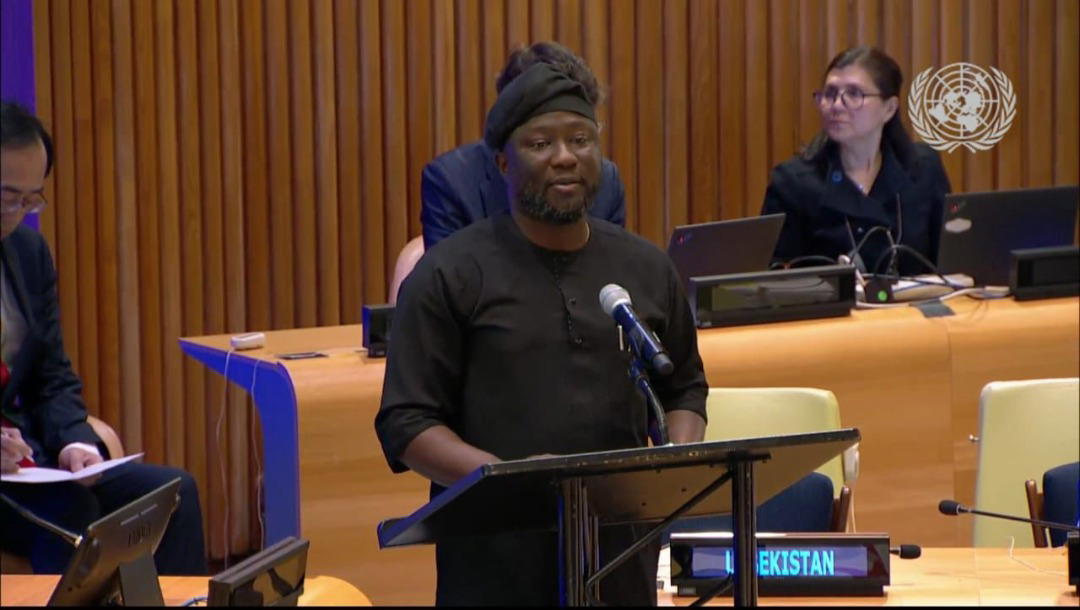
Oluwaseun Dania
By Juliet Umeh
Managing Director of Alpha-Geek Technologies and African technology advocate, Oluwaseun Dania, has declared that Africa’s 1.4 billion people cannot be excluded from the global conversation on Artificial Intelligence, AI.
Dania made the declaration last week while speaking at the United Nations General Assembly High-Level Meeting for the launch of the Global Dialogue on AI Governance in New York.
He insisted that Africa, which boasts the world’s youngest workforce, must have its voice amplified in shaping the future of AI.
According to him, “The success of the AI revolution should not be measured merely by GDP spikes but by lives uplifted. Africa is not just an early adopter of mobile-first AI, we are poised to be a co-creator of its future. In a world where AI is reshaping destinies, this dialogue must ensure no continent or community is left behind.”
Dania acknowledged the transformative promise of AI for Africa, noting its potential to leapfrog infrastructure gaps and power secure digital economies. He pointed to the continent’s thriving fintech ecosystem and stablecoin initiatives as examples of how AI could accelerate inclusive growth.
However, he also raised concerns about what he called the “shadows” of AI. “We cannot ignore the risks—deepfakes that erode trust, biased algorithms that perpetuate inequality, and unchecked data monopolies that widen the North-South divide,” he warned.
Dania commended Nigeria’s proactive steps under President Bola Ahmed Tinubu’s administration, particularly through the Minister of Communications and Digital Economy, Dr. Bosun Tijani, who in April 2025 launched the National AI Strategy. He described the policy as a “collaborative blueprint that places Nigeria at the forefront of ethical innovation.”
He explained that the initiative, developed with the Nigerian Artificial Intelligence Research Scheme, NAIRS, and the National Centre for Artificial Intelligence and Robotics (NCAIR), aims to “harness AI for economic growth, ethical innovation, and skills development, with projections of a 27 percent annual market expansion through 2030, $15 billion in GDP contributions, and the empowerment of 70 percent of our young workforce with AI skills by 2030.”
While calling for global inclusivity, Dania stressed that governance frameworks must not be designed in isolation. “Global governance cannot be drafted in the echo chambers of Silicon Valley or the closed boardrooms of Geneva. It must reflect diverse perspectives, especially those from Africa,” he said.
He further argued that equitable access, ethical safeguards, and resilient infrastructure must underpin the global AI agenda. “We must ensure open access to innovation, African-led ethical standards that address bias and privacy, and strong systems that apply AI for good—predicting pandemics, optimizing energy, and safeguarding against weaponized misuse,” he said.
Dania, however, urged international stakeholders to treat the Global Dialogue on AI Governance as a covenant for fairness and justice.
“Africa is ready to co-create, not merely comply. This is our moment to shape the future together,” he declared.
Disclaimer
Comments expressed here do not reflect the opinions of Vanguard newspapers or any employee thereof.