By Sola Ogundipe
A renowned Consultant Ophthalmologist and former Registrar of the Medical and Dental Council of Nigeria, Dr. Festus Oshoba has decried harmful traditional eye remedies and tasked Nigerians to go for regular medical checks even when they are not sick because many eye conditions are preventable and curable when detected early.
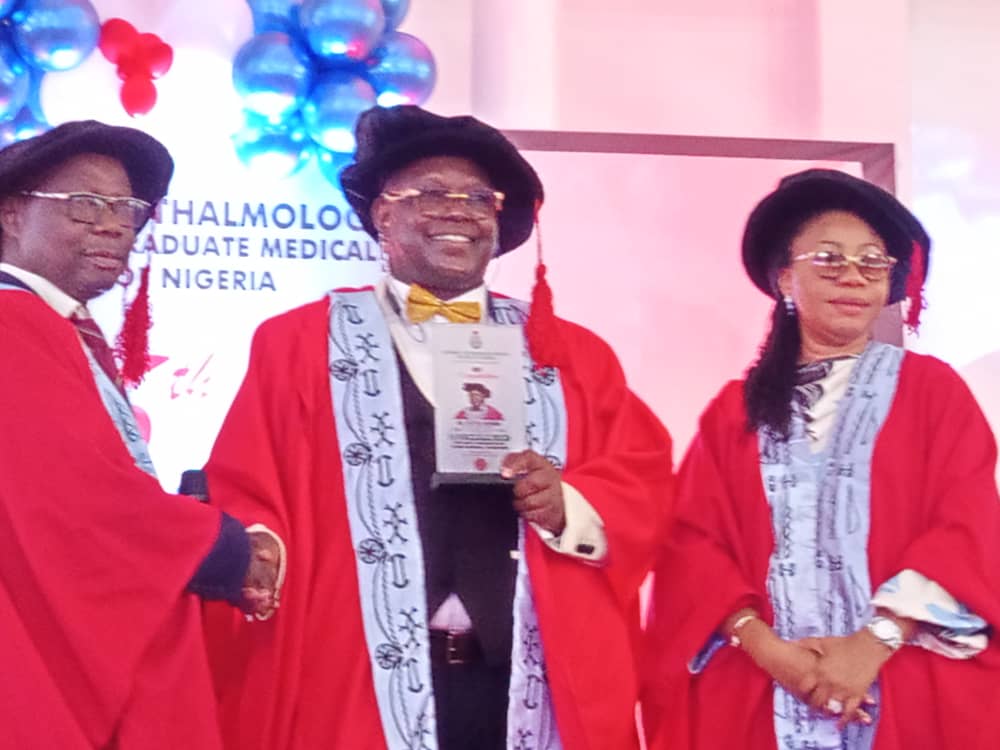
Making the call in Lagos at the 26th annual faculty lecture of the Faculty of Ophthalmology, National Postgraduate Medical College of Nigeria, Oshoba, who is also Chairman, Board of Governors of the Eye Bank of Nigeria.
In his lecture titled “Force Majeure, Masquerades, and the Attainment of Universal Eye Care in Nigeria” Oshoba highlighted that the eye contributes over 50 percent of sensory input to the brain, making it central to productivity, learning, and national progress.
“I want to talk about glasses because now we use a lot of computers and some people when they use their computers and they don’t get their eyes tested, the eyes gets discomfort and that can lead to problems.
“So if you use computers a lot make sure you see your eye doctor, let them check you and see whether you need an aid so that you can be able to perform better.”
Urging Nigerians to prioritize eye health, Oshoba described sudden, treatable eye conditions-like red eyes, itching, and infections-as “force majeure” events, even as he warned against harmful traditional remedies such as applying breast milk or urine to the eyes, which often lead to irreversible damage.
“The eye is the light of the body, and it is through the eyes that we can appreciate the world around us and be productive.
“In Nigeria we want to be among the world’s best economies by 2030, so everybody needs to see what they are doing to be very efficient at their work and contribute to the financial capability of themselves, their families, their local development, the society, the country and the world in general.
“Therefore, this lecture is about force majeure, mass races and the assessment of universal eye care in Nigeria. These are things that happen to us that we really may suddenly like we have red eyes sometimes there’s Apollo and then some people have itching of the eyes and all that, and these things can be easily treated.
“But some people use things like breast milk and urine in the eyes, and when they apply them, they cause damage to the eyes. So we are trying to let the public know that they should use protective covering, something that is photochromatic or at something to protect their eyes because we are in a sunny environment and the sunshine causes cataracts in the eyes and also keratitis in the eyes.”
Urging policymakers, practitioners, and the general public to ensure greater focus on eye care in Nigeria’s development goals, he said that eye health is not just a medical issue, but a national imperative.
Oshoba emphasized the importance of good eye health for individual well-being and Nigeria’s economic goals, calling for universal eye care and preventable eye conditions and the challenges in providing adequate eye care services in Nigeria.
In a landmark gesture aimed at improving healthcare outcomes in the Nigerian health sector, a donation of $125,000 has been made to enhance the training of doctors and bolster diagnostic capacity at the College.
The Chancellor of Ekiti State University, Dr. Tunji Olowolafe, who made the donation on behalf of himself and late wife said it will fund the establishment of a state-of-the-art surgical simulation centre equipped with high-fidelity tools.
Speaking at the lecture, Olowolafe emphasized that eye health is not just a medical issue but a national imperative.
“I understand the faculty plans a surgical simulation center, a critical gap in improving cataract surgery and training. This center will have optomic skills as well as high fidelity tools, high surgical simulator, which is estimated at $100,000 and microscopes estimated at $25,000.
“This lab will enable world-class training in cataract, oculoplasty surgery and refraction. This lab will facilitate the world-class training in cataract surgery, oculoplasty procedures and clinical refraction techniques.
“I was recently made chancellor of Ekiti State University. So I hereby commit to associate with the simulation center in honor of my late wife in pursuit of our mission, that is the true love of excellence in education, healthcare and sustainable development in Nigeria.
“The facility is geared toward elevating the standard of cataract, oculoplasty, and refraction training, tackling the growing burden of irreversible blindness—largely caused by a shortage of ophthalmologists in a country of 220 million people.
“Cataract remains the leading cause of irreversible blindness in Nigeria, largely due to shortage of well-trained ophthalmologists and also the number of 454 out of 220 million Nigerians,” he asserted
Disclaimer
Comments expressed here do not reflect the opinions of Vanguard newspapers or any employee thereof.