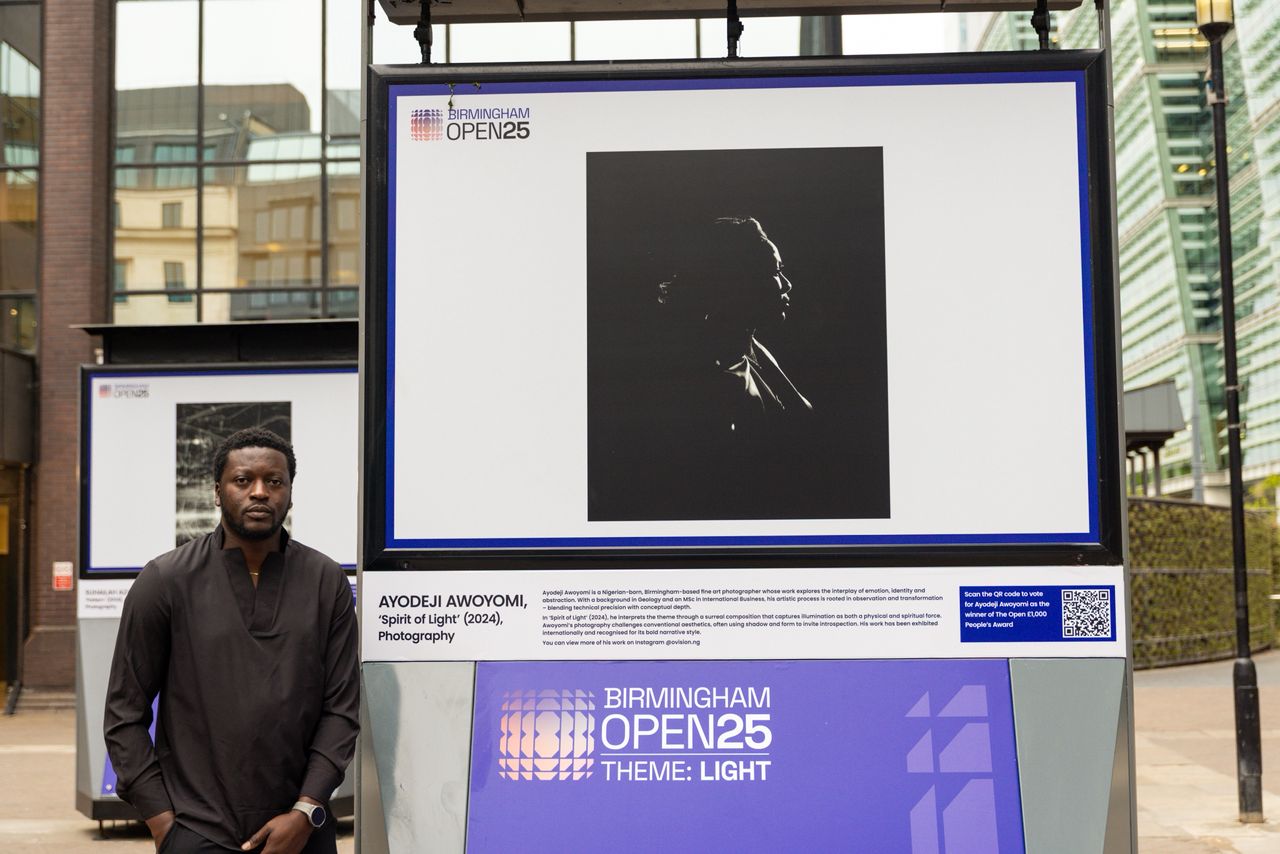
By Jimoh Babatunde
In the heart of Birmingham’s cultural revival, against the buzzing backdrop of Snow Hill Square and Victoria Square, Nigerian-born fine art photographer Ayodeji Awoyomi has captured not just an award, but the imagination of a community.
At the Birmingham Open 25 art exhibition held in the United Kingdom earlier this summer, Awoyomi clinched the People’s Choice Award, a distinction bestowed not by a panel of judges alone, but by the collective will of the public who voted for art that resonates and lingers.
The Birmingham Open 25 is an open call competition inviting artists to explore the theme of light. The exhibition drew over 150 entries across disciplines, challenging creatives to respond to one of art’s most elusive yet foundational elements. For weeks, visitors wandering through the outdoor displays, bathed in natural and reflected illumination, were invited to vote for the work that moved them most. When the ballots closed, it was Awoyomi’s work that emerged triumphant, a testament to its emotional accessibility, aesthetic depth, and compelling visual language.
This accolade adds a significant chapter to Awoyomi’s unfolding narrative as a global creative force. Already recognised internationally, notably as the first Nigerian to win the British Photographer of the Year award in 2023/24, Awoyomi has long challenged conventional visual storytelling by weaving threads of identity, memory, and cultural nuance into his compositions.
His victory at Birmingham Open 25 signals something more expansive: an artist whose work does not simply earn critical acclaim, but speaks directly to the sensory and emotional experience of diverse audiences.
The People’s Choice Award carries particular cultural weight. Unlike juried honours, it reflects collective engagement and shared perception. It marks the rare intersection where local engagement meets creative expression, creating a space where art becomes a shared conversation rather than a closed adjudication.
Awoyomi’s success suggests that his exploration of light, both literal and metaphorical, resonates beyond gallery walls and specialist circles.
Critics and art enthusiasts have noted Awoyomi’s ability to use light as both material and metaphor. His compositions balance illumination and shadow with precision, operating in a space between memory and imagination, probing layers of individual and collective identity. Rather than presenting images as static objects, he invites viewers into a dialogue, a negotiation of presence and absence, gaze and reflection, self and other.
For Nigerian art watchers, his win is significant in multiple dimensions. It amplifies a discourse that places African creators not on the periphery of the global art conversation, but at its vibrant centre. It also reflects how diasporic artists continue to shape and transform visual culture across continents. In an era where narratives about Africa are often externally framed, Awoyomi’s lens asserts a profoundly internal logic rooted in heritage, introspection, and aesthetic rigour.
Speaking through his work rather than words, Awoyomi’s trajectory challenges persistent binaries between local and global art. That his light-infused vision drew enthusiastic public support in a cosmopolitan British city suggests a universal quality, an ability to bridge cultural particularities with shared human perception.
As Birmingham Open 25 draws to a close, Awoyomi’s recognition stands as both a personal triumph and a broader symbolic moment. It is a reminder that contemporary African artists are not only participants on the world stage, they are actively shaping its contours. The People’s Choice Award is not merely an affirmation of artistry, but evidence that art rooted in specificity can achieve resonance without compromise.
For Nigeria’s creative community, the implication is clear: when vision meets voice and craft meets context, the world listens and votes.
Disclaimer
Comments expressed here do not reflect the opinions of Vanguard newspapers or any employee thereof.