By Ibrahim Hassan-Wuyo
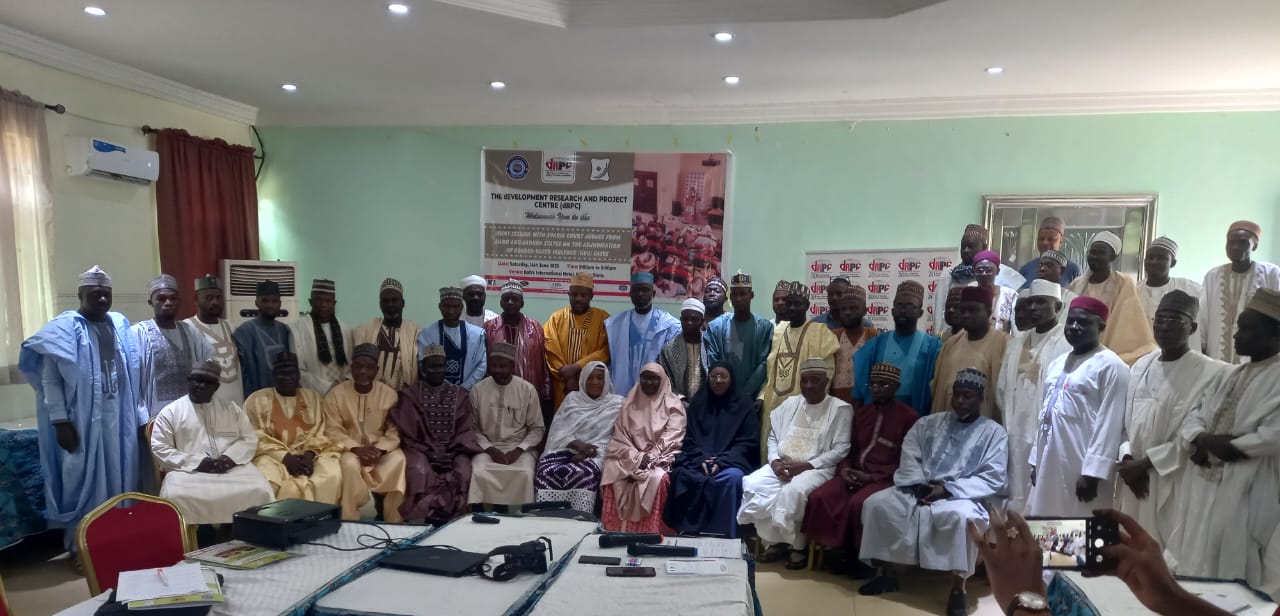
Shari’a Court Judges from Kaduna and Kano States have convened in Kaduna to deliberate on a new practice direction designed to improve access to justice and address the rising cases of Gender-Based Violence (GBV) in both states.
The workshop was organized by the Development Research and Projects Centre (dRPC) in partnership with the Centre for Islamic Civilisation and Interfaith Dialogue (CICID), Bayero University, Kano. It was supported by the Ford Foundation.
Speaking at the event, the Acting Grand Khadi of Kano State, Kadi Mukhtar Muhammad Kunti, noted that the new practice direction—gazetted on February 25, 2025—aims to enrich the civil procedure laws of the states. It introduces reforms to ease the burden on survivors, especially in cases where abuse occurs in private or without witnesses.
“The new law applies to all Upper and Shari’a Courts in the state and covers all civil cases. It provides an alternative to address abuse where there are no witnesses,” Kadi Kunti explained.
He also urged the Kano State Government to join the 35 other states that have domesticated the Violence Against Persons Prohibition (VAPP) Act to further reduce the incidence of GBV.
Representing the Kaduna State Commissioner for Women Affairs, Children, and the Disabled, the Director of Planning, Alhaji Yakubu Muhammad, encouraged Shari’a Court Judges to respond more decisively to the increasing cases of GBV.
“This joint session is a collective testimony to our shared responsibility to foster an environment where every woman and child feels safe, respected, and protected,” she said.
Also speaking, the Commissioner for Human Services and Social Development in Kaduna State, Hajiya Rabi Salisu, highlighted various interventions the state has implemented to support GBV survivors and prevent further cases.
Dr. Terngu Gwar, State Coordinator of the National Human Rights Commission, emphasized the Commission’s ongoing collaboration with stakeholders to ensure justice for survivors. He urged the judiciary to improve mechanisms that protect victims and ensure timely adjudication of GBV cases.
Earlier, the Director of Partnerships and Communication at dRPC, Hassan Aliyu Karofi, reaffirmed the centre’s commitment—backed by the Ford Foundation—to engaging judicial stakeholders in strengthening justice systems and curbing gender-based violence in the two states.
Disclaimer
Comments expressed here do not reflect the opinions of Vanguard newspapers or any employee thereof.