By Luminous Jannamike
ON 29 May 2023, Benue State stood on the edge of change. A Catholic priest, respected for his spiritual authority and trusted by a tired people, was sworn in as governor. In churches and busy markets, hope stirred. People believed this man of God could finally bring an end to insecurity, hardship, and corruption.
“At last, a leader with divine backing,” many said, their words filled with hope.
A Fleeting Hope in a Troubled Land
But that hope quickly faded. Bandits still roamed the highways. Markets burned. Schools shut down due to violence, IDP camps increased . Across the country, inflation made life harder, and corruption remained untouched. A painful question began to echo through Benue; at village meetings, in town halls, and across homes: Why does Benue remain broken, no matter who leads?
A System Designed to Fail
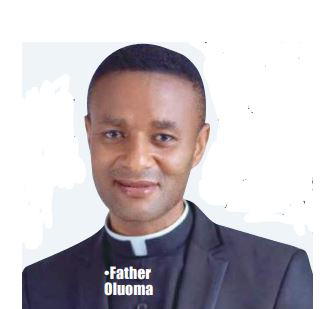
The problem lies not in the character of those who lead, but in the system they inherit. Nigeria’s so-called federalism is, in reality, a unitary structure that cripples state leadership. Governors are called ‘chief security officers,’ yet they cannot deploy a single police unit without approval from Abuja. This contradiction leaves even the most committed leaders powerless; trapped in a cycle of promises they cannot keep, and failures they cannot avoid. In the midst of this despair, a voice rises; firm, clear, and uncompromising. Father John Chinenye Oluoma, a priest of the Catholic Archdiocese of Abuja, uses his Facebook page to deliver messages that transcend ethnic and religious lines. His words confront Nigerians with a hard truth: the nation’s crises are not just about bad leaders, but about a broken system.
Father Oluoma’s
Unyielding Diagnosis
The words of Father Oluoma are a searing indictment of Nigeria’s governance.
He wrote: “We had a pastor as VP in the last administration, we still saw shege banza. We have a priest as Executive Governor in Benue State, they are still seeing shege banza. The First Lady in this administration is a pastor also, the shege banza hasn’t ceased. The EFCC chairman is a pastor, corruption is still showing us shege banza.
“Lesson 1: A bad system or structure cannot produce results of good governance even if good people manage it. A good system can manage to churn out good results even if managed by bad people. A bad structure managed by bad people is Nigeria. Call any governor any name you want, it is simplistic to think he can do anything to stop the insecurity in his state under this unitary system.
“The best a governor can do about insecurity in his state is to lead protests like VDM to call the attention of the Federal Government. On this, you may criticise or condemn, but remember that others did that and their states are still bleeding. A governor should be in control of his state’s security from A to Z.
“Every crisis is an opportunity. We’ve had these crises too many times and allowed them to slip by. I’m afraid this too will slip by because after all these cries and agitation, the Federal Government will ‘dress the wound with geevee’ for momentary reprieve. We will forget and go back to our sedated state and another one will happen. “If you want the bloodletting in states across Nigeria to be curbed, let’s march for state police. This is how it is in America, UK and most other places. The argument against state police is that governors will abuse them for political reasons. This is about a stupid reason against state police. Is the presidency not abusing it and still no security? We can deal with our governors more easily than the president in case of abuse. State police is long overdue. Let’s get our lawmakers to push for it now more than ever.
“Lesson 2: There is a reason the Church forbids her clergy from partisan politics. The Church has seen it before, experienced its murky waters, and discovered she can do better as moral voice than executive officer. There’s no good governance a clergy can offer that an ordinary person can’t. All the countries enjoying good governance aren’t governed by ‘anointed men and women of God.’
“A clergy is also not immune to the corruption and unpredictability of politics. There is no governance mistake ordinary people make in office that a clergy cannot make, albeit unwillingly or inadvertently. It is even worse for a clergy because his status puts him under pressure to perform magic or miracle to meet the people’s unrealistic expectations. This is besides his naivety in political hanky-panky that those around him can exploit and manipulate.
“So, stop looking for political messiahs. Be realistic. What you should expect your religious figures to do is join you in civic actions for good and effective policy formulations and implementation. Once more, I’m asking you, both Christians and Muslims, who are sincerely interested in seeing your country get better to put pressure on clerics to reject government-sponsored pilgrimages to Saudi Arabia and Israel. This is official government bribery to religion in Nigeria.
“If our clerics put an end to government-sponsored pilgrimages, they will help you put an end to other structures of corruption in Nigeria — because he who comes to equity must come with clean hands. The government that splashes billions of naira on religious adventures yearly cannot take leaders of those religions seriously when they make feeble cries against corruption and incompetence.
“If we can collectively get state police and end government-sponsored pilgrimages before 2027, you will be pleasantly surprised at the leap Nigeria will make.”
His message is a call to action: Nigeria’s hope doesn’t lie in spiritual saviours, but in fixing a broken system. Having state police would give governors real power to protect their people. Stopping government-sponsored pilgrimages would help restore the moral authority of religious leaders, so they can speak out against corruption without being compromised.
A Chorus of Voices, A
Path Forward
Father Oluoma’s words have sparked a national conversation, bringing in different perspectives that deepen the discussion.
Pastor (Dr) Simon Dolly, Secretary of the Christian Association of Nigeria (CAN) in the North-Central region, reflects on the need for empathy in policy: “Insecurity persists because our systems lack compassion and foresight. The ban on open grazing in Benue, while well-intentioned, displaced Fulani herders without offering viable alternatives, fuelling resentment and conflict. State police could help, but only if paired with equitable policies that address the needs of all communities; Christian, Muslim, farmer, and herder alike. Governance must unite, not alienate, our diverse peoples. Without inclusive solutions, we risk perpetuating cycles of violence and mistrust.”
Sheikh Sani Yahaya Jingir, a prominent Islamic scholar, warns of the risks of decentralisation: “Security is a sacred trust, a covenant to protect all Nigerians equally, regardless of faith or tribe.
State police could deepen divisions, with governors wielding them as tools for political gain or tribal favouritism. This could fracture our fragile unity, leaving Nigeria weaker. Instead, we must reform the national police, equip them with resources, train them to serve impartially, and root out corruption. A unified force, answerable to the people, is the surer path to stability.”
Ayogu Ohagwu, a public affairs analyst, counters with urgency: “Nigeria’s unitary system is a chokehold on progress. Governors are called chief security officers, but they are powerless, forced to beg Abuja for action while their states bleed. State police is not just a solution, it’s a necessity. It would empower local leaders to respond swiftly and effectively to threats, tailoring security to their communities’ unique needs. The fear of abuse is real, but safeguards can be built; local accountability mechanisms, oversight bodies, and clear legal frameworks. Waiting for federal solutions that never come is no longer an option.”
Architect Shefiu Olanrewaju, a social commentator, highlights existing efforts: “States like Lagos, Oyo, Ondo, and Ogun have already taken steps toward localised security with initiatives like the Lagos Neighbourhood Safety Corps and Amotekun. These are not perfect, but they prove communities can protect themselves when empowered. Formalising state police with constitutional backing would transform these ad-hoc efforts into robust, accountable systems. Local hunters in some regions are already filling gaps left by federal forces. A structured state police framework would harness this potential, reducing reliance on distant, overstretched federal interventions.”
General Christopher Musa, Chief of Defence Staff, emphasises training and innovation: “The military’s strength lies in its rigorous, consistent training, despite our limited numbers. The police must adopt a similar approach; intensive training, modern equipment, and a commitment to professionalism. Beyond policing, we must address root causes like herder-farmer conflicts. Modern ranches, supported by investment in grasslands and infrastructure, would provide herders with sustainable livelihoods while protecting farmers’ lands. These are practical steps that, if implemented, could halt the violence and foster coexistence.”
These voices, from pulpits to policy desks, agree on one thing: Nigeria’s problems are structural and require bold reforms that focus on systems, not sentiments.
A Call to Rebuild Nigeria
Nigeria stands at a crossroads. Father Oluoma’s words expose a painful reality: no leader, however anointed, can overcome a system designed to fail. Insecurity, corruption, and division are not the work of devils but of defective structures. State police could empower governors to protect their people. Ending government-sponsored pilgrimages could restore integrity to religious voices. Inclusive policies could transform conflicts into opportunities for unity.
The responsibility now falls to Nigerians. Demand state police from lawmakers, press for it relentlessly before 2027. Urge religious leaders to reject government handouts and champion accountability. Support policies that bridge divides, offering solutions like ranches and equitable resource allocation. Your vote, your voice, and your resolve can reshape this nation. The time for prayers alone has passed. Act now to build a Nigeria where systems serve, not shackle, its people.
Disclaimer
Comments expressed here do not reflect the opinions of Vanguard newspapers or any employee thereof.