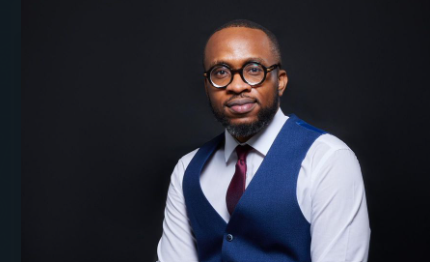
Ever Obi is a fiction writer and business executive based in the Netherlands and Lagos. His debut, the acclaimed mystical novel Men Don’t Die was published in 2019, exploring themes of death and spiritualism, and has been discussed on several forums, including the Oxford Literary Festival.
His second book, Some Angels Don’t See God, was released in Nigeria and the UK in 2022, and was shortlisted for the ANA Prose Prize. His writing has been categorised as a hybrid of speculative and literary fiction, probing into spiritual concepts of immortality and the afterlife, as well as more existent themes of money, love and friendship.
He is a recipient of the 2024 Global Recognition Award.
In this interview, he talks about growing up and living as a writer.
Tell us about your childhood. What was growing up like for you?
My family is originally from a place called Awka-Etiti in Anambra state, but I was born on March 8, 1989, in Aba, a city in South-Eastern Nigeria, famed for its enterprising people and their commerce. I was born into a family of six children: five boys and a girl. My parents were staunch Catholics. We prayed the rosary every night before we slept. Despite their busy business schedules, my mother was a leader in the Catholic Biblical Instructor’s Union (C.B.I.U) and my father was a master and legend in the church choir; a musician with a powerful singing voice, who wrote songs with musical notation and could also play the guitar. My nursery and elementary education were all catholic schools, named Ave Maria Nursery School and Daughters of Mary Mothers of Mercy (DMMM) Primary School respectively.
My parents were not wealthy — I would say we were a middle-class family — but they were hardworking. I never saw my father take any break. He was always working. They made sure we did not lack. I grew up in a very normal household. It was a home filled with love and peace, fun and laughter. I never saw my parents fight or quarrel, not for a single day. I don’t want to believe that they never fought—they must have—but I think they understood the need to keep their matrimonial issues away from the eyes of their children. I had assumed that was the same for every child, until I went to boarding school in Federal Government College Ikot Ekpene, and started hearing stories from other kids, of the chaos they lived in, of how their parents fought all the time. As I get older, I appreciate my parents more for making our childhood stable, for ensuring that we did not have to grow up amid any confusion that could arise from domestic disorder.
Which writers influenced you when you were growing up?
Growing up, I was a curious boy. I would spend time in my mother’s room, rummaging in her cabinet. Then I found copies of books she read when she was in secondary school. I found Thomas Hardy’s The Mayor of Casterbridge, Chinua Achebe’s Things Fall Apart and The Jero Plays by Wole Soyinka. I would also later read works of Cyprian Ekwensi; The Passport of Mallam Illia and An African Night’s Entertainment.
But the biggest influence was before I turned 10, that my sister started giving me books written by Adaeze Atuegwu. Atuegwu was a gifted teenager who had written 17 books at the age of 17. I read most of her works; Fate, Tears, Chalet 9, My Husband’s Mistress, The Adventures of Nnanna and The Bina series. I have always said that reading Adaeze Atuegwu made me realize that young people could write too. That was when I became interested in creative writing, that was when I started writing my own stories, digging into my imaginations.
So, I did not wake up one day and decided to be a writer. It was something that came to me through African fiction, through falling in love with the works of Atuegwu. It was something I found my happiness in and had to do it alone, not minding if people around me cared about it or not. It comes with a must-write feeling; one begins to feel that one must write to stay alive.
What inspires your writing?
It has always been a difficult question to answer, when people ask what inspires my writing. There is no one answer for that. I am inspired by everything. I am writing about life; and we are all students of life. I get inspired by everything that happens in life, by my own experiences, by the experiences of others, by things I feel and the things that people feel that I feel through them. It is limitless. I am just inspired by life.
What else do you do asides writing?
I am a financial risk manager and a business executive. I have always been in the financial services sector. I started my career in Zenith Bank in 2011. I spent a year there before I moved to Skye Bank in 2012. By 2014, I was still working in risk management, but with Access Bank. It was not until 2017 that I became Head of Risk Management in Zedvance, and eventually the managing director in 2020. But I have always said that I am a writer before I am anything else. So, I like to see myself as a writer that moonlights as a risk manager/business executive.
And do you have any business degrees?
Yes, of course. I am an alumnus of the Lagos Business School. I also have a master’s degree in risk management from the University of Lagos. Then I have an MBA from the TIAS School for Business and Society in the Netherlands. But what most people don’t know is that I actually graduated from Nnamdi Azikiwe University in 2009, with a degree in Industrial Chemistry.
And how do you manage both worlds, business and creative writing?
It has always been tough; I expect it to be tough. Growing up, whenever I was feeling indignant or bad about something, my mother would always say to me, “Man that is born of woman is of few days and full of troubles.” As I grew older, I learnt that she was speaking from Job 14. I also understood that she was trying to say: “Nobody promised you that life was going to be easy.” With that acceptance, you get to handle these things better. Yes, it comes with sleepless nights and takes a toll on you, but you need to be able to magic that ability to strike that balance between being a professional, being good at what you do and being able to tell all the stories that burden your heart. The truth is that writing does not hold any solid promise of financial stability. Writers often find themselves needing to keep other jobs.
Are there other things you do for fun?
Not sure if I would call them fun, but asides working in the financial services sector and writing, I read when I have the time. I also sometimes indulge in a beer or two with my friends, Lawson Omiunu and Desmond Enechi, whenever I am in Nigeria. I enjoy watching Mixed Martial Arts, and I practice Brazilian Jiu Jitsu. It is such a beautiful sport, and I have found a great family that I train with from time to time.
How many of your books have been published so far?
Two. My debut is Men Don’t Die, published in 2019, and Some Angels Don’t See God, published in 2022. When I wrote Men Don’t Die, I was driven by my fascination with death and the afterlife, the fact that we don’t know why we must die or what happens to us after we are gone. This has always followed my mind, even when I was a boy. Men Don’t Die was my own way of raising more questions. While Some Angels Don’t See God was created out of a need to address uncomfortable topics, vices that are prevalent in our societies that we do not talk about enough. There are other works we have in the pipeline. As writers, we can only hope that we remain alive to finish telling all the stories that we are pregnant with.
What about songwriting? We learnt that you worked on a project with Naomi Mac.
Yes, when my second novel, Some Angels Don’t See God, was released, I wrote a song with the same title, and we were able to get Naomi Mac to bless my words with her amazing voice. It’s a beautiful song that everyone should listen to.
Any last words for emerging writers?
Read. Read. And write. One of the headaches of being a writer is having to explain to people that even for writers, writing is difficult. And the truth is that most fiction writers will never have their works published traditionally, because the publishers are few, and they get thousands of manuscripts. But you must keep writing, be ready for your opportunities when they come. Our struggles are the same. A good piece to read is A. Igoni Barrett’s essay, Be Careless with Your Wishes. It is a piece that has always seen me through my most difficult moments as a writer. Let the travails of Barrett, as he matures and navigates the writing life in Nigeria, guide you, and give you solace and lessons in patience.
It was Rainer Marie Rilke who once wrote, in one of his letters to Young Kappus: “Being an artist means not numbering or counting, but ripening like a tree which doesn’t force its sap…”
Writing must teach you patience.
Disclaimer
Comments expressed here do not reflect the opinions of Vanguard newspapers or any employee thereof.