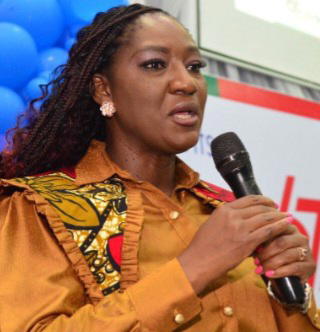
Vanessa Phala Moyo is the Director of the ILO Office for Nigeria, Ghana, Liberia and Sierra Leone at the International Labour
Organization. She tells BL why Nigerian Child Labour laws are derelict, unfit for purpose and require urgent updates.
You are a highly versatile and cerebral individual who could have entered any field of endeavour. Why did you choose the Development space?
I love people. I love to see people happy. My work allows me to fulfill my passion and I am grateful. I am inspired by the late Kofi Annan, the first African to head the United Nations. I have seen how development has evolved with many lessons, challenges, and opportunities. I want to be amongst the change makers.
An 85-year-old ongoing Harvard University study found strong connections between doing chores and later success in life. Are such studies somewhat contradictory to anti- child labour legislation, particularly as it relates to the African context?
Let me start by stating that, to the best of my understanding, the findings are not contradictory. The findings showed that shared responsibilities help children develop greater self-worth, confidence, work ethic, and empathy for others.
The campaign against child labour does not rule out socialising children or children doing chores around the house. The challenge is when the chores or work children do affect their development and health.
The term child labour, is often defined as work that deprives children of their childhood, their potential and their dignity, and that is harmful to physical and mental development. It refers to work that is mentally, physically, socially or morally dangerous and harmful to children; and/or interferes with their schooling by depriving them of the opportunity to attend school, obliging them to leave school prematurely, or requiring them to attempt to combine school attendance with excessively long and heavy work.
Whether or not particular forms of “work” can be called “child labour” depends on the child’s age, the type and hours of work performed, the conditions under which it is performed, and the objectives pursued by individual countries. The answer varies from country to country, as well as among sectors within countries.
Further to this, how can international concepts be more aligned with our cultural contexts where it relates to child labour, considering child labour is an established part of many African cultures?
Eliminating child labour is within the culture of every community. I am not sure there are communities or cultures set to abuse or reduce the capacity of their future—the children. Thus, reducing or eliminating child labour ensures that the workplace is well positioned to ensure the continuity of its effective labour force and also create an environment to promote decent work.
To discuss child labour through a child protection lens is to state that philosophies, policies, standards, guidelines, and procedures should protect children from both intentional and unintentional harm in the workplace.
To align international concepts to cultural context is to ensure that the basic principles of ensuring the development of a child are strengthened.
Any work a child should participate in must consider: the survival – health, protection, and development of the child. The work should not discriminate against any child.
The participation of the child in the decisions of their work is very important and the best interest of the child should be paramount.
You are concerned that for more than 50 years, Labour Act of 1971 has remained unchanged apart from small changes in 2004 and 2014. What are the implications of this and how will the passing of the proposed Labour Standards Bill better reflect evolving dynamics of Nigerian economy and workforce?
Indeed, the current Labour Act, primarily based on the 1971 legislation, has not kept pace. Despite some updates in 2004 and 2014, it remains inadequate in protecting workers, especially those in the informal sector, and addressing critical issues like child labour.
The enactment of the Labour Standard Bill (LSB), pending with the Ministry of Justice, has closed gaps to ensure decent work and alignment with international labour standards- it has provisions such as Enforcement of the Hazardous Child Labour list and Minimum Age for Employment
The enactment of the Labour Standard Bill will indeed promote decent work.
Can you highlight ways by which bureaucracies in many African civil services get in the way of labour law enhancements especially as relating to child labour, which is more urgent?
Following established procedures is important to ensure due diligence and consultation, among other things. However, bureaucracies can be a challenge, sometimes impeding progress. The ILO is providing the required technical support to the government to accelerate actions towards enacting the Labour Standards Bill.
Disclaimer
Comments expressed here do not reflect the opinions of Vanguard newspapers or any employee thereof.