By Osa Mbonu-Amadi, Arts Editor
Today, history is made as the legendary King Jaja of Opobo, through a debut solo exhibition of paintings by Ibim Cookey, makes a comeback at Alexis Galleries, Victoria Island, Lagos.
The exhibition, titled KING JAJA and curated by Sabo Kpade, runs from January 18, 2025 – February 1, 2025.
Patty Chidiac-Mastrogiannis, founder and director of Alexis Galleries, describes Ibim Cookey as “one of the most interesting artists working in Nigeria today”, and the exhibition as “the first exhibition in Nigeria to explore in depth the life and times of King Jaja of Opobo of the Niger, Delta.”
Situating the exhibition’s theme, the curator, Sabo Kpade, said, “At the Berlin Conference of 1884, European nations designated Nigeria as British territory. In Opobo (River State, South-South Nigeria), King Jaja refused and insisted on taxing British traders. Deposed in 1887, King Jaja was jailed in Ghana and exiled to the United Kingdom. Cookey’s compositions capture key events in King Jaja’s armed resistance and in Nigeria’s modern history.”
Speaking with Vanguard on the challenges he faced in capturing such a long history of Opobo kingdom in just 11 paintings, and whether he thinks he succeeded in summarizing that history, the artist, Ibim Cookey, said: “I did a lot of research before I began the paintings, and one book that helped me in my research is the book titled “King Jaja of the Niger Delta…His Life and Times (1821-1891)”. It’s a book by Professor S.J.S Cookey, my uncle. That book broke down the story into multiple parts. This show is actually touring exhibition. This is just one part of the show. There will be one in Berlin Germany. There will be another one in South-Africa, and there will be one in London. So, I decided that the one in Nigeria I want to summarize the story, to tell the story for us here first. When I go into the other exhibitions I will now focus on different parts of the story. The one in the UK will focus on the civil war. The one in the U.S is going to focus on Jaja’s tussle with the British people and the palm oil trade, and another one will focus on the boat regatta.”
Ibim said the exhibition was inspired by the history, culture and identity of his people. “I am from Opobo, Cookey-Gam working house. I feel that this is the history of my people that has been either untold or ‘mistold’ by westerners and it is time to correct and explore that history and expose it to the world.”
Ibim is showcasing 11 works at the KING JAJA exhibition. “I have one of the works that is titled “The Deposed Jaja” (charcoal on paper), “The King’s Storyboard” (ink and coffee on paper) and “Boat Regatta” (charcoal and acrylic on paper).” Other paintings at the exhibition are “Waterside Economy”, “Mr. Ozurumba”, “Civil War”, “The New Order”, “Jaja is Lost”, “King Jaja’s Throne”, “King Jaja’s Bell” and “URU”.
Ibim says of the painting titled “The Deposed Jaja”: “That particular painting is a painting of King Jaja that was taken in the late 18th century after he was deposed as the king by the British, and he was sent on exile to West Indies. His crown was taken from him and given to one of his chiefs who was in partnership with the British.”
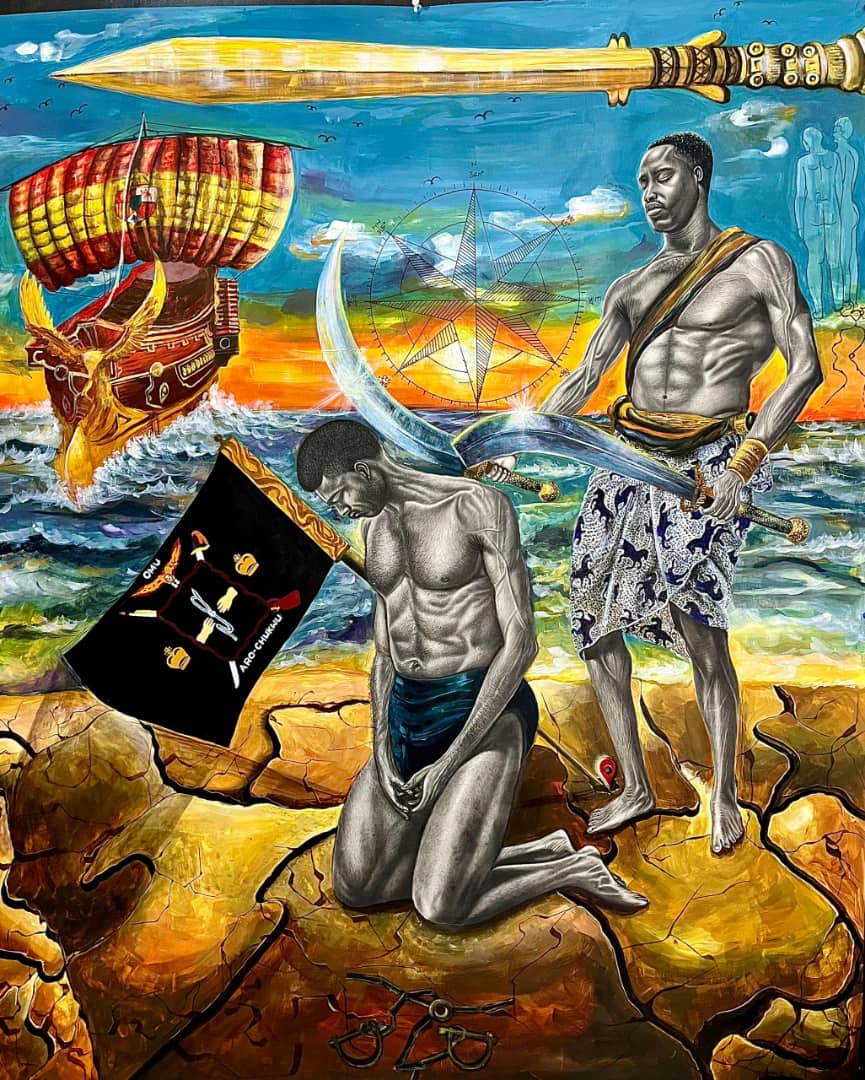
For his “Jaja is Lost”, the artist said: “King Jaja was originally from Amaigbo in the present Imo State of Nigeria. It was recorded that he was a very stubborn child. His father, as it was customary in Igbo tradition at that time, gave him to one of his uncles who was staying at Nkwere (near Amaigbo). As a young boy, Jaja was always going to the farm on his own to hustle to make a living for himself. On one of his trips, he was kidnapped.
“During that time there was this thing like a cult group called Arochukwu Confederacy. They were notorious for picking up people and selling them into slavery, because then, the British had abolished slavery in 1808, so Europeans, mostly Spaniards, Portuguese; they would capture slaves that were taken from war or people that were kidnapped and then sold them to their European counterparts or to some rich kings from other communities.
“So king Jaja was taken and sold to Anna Pepple House of Bonny. Because Bonny was far from Imo State and Nkwere which were landlocked, they would take the slaves and trek down to Calabar and Ikot-Ekpene that had a port for them to take the slaves to other parts of Nigeria. So this painting represents that.”
Ibim explains that the cracks seen on the floor of the painting, “Jaja is Lost”, represents the present-day Imo State. “The flag is pointing at where Arochukwu is presently in Imo State. And then you can see the charcoals that represent the slave trade, and then the compass that shows the sea and how they navigated back to the place. “If you look behind the man, you will see a silhouette of people that were also captured. The sword on top was the original bronze crafted sculptural sword used by the Arochukwu people then.”
Ibim says he explored this important history of his people to make sure that this history is documented (in visual art) before they are lost.
The story of how Ibim Cookey became a painter whose theme is steeped in history is similar to the story of how Fela Kuti was transformed into Afrobeat king. Ibim was a portraitist before his encounter with the art historian, Dr. Ugochukwu-Smooth Nzewi, curator at the Museum of Modern Art, USA.
“I was predominantly known for portraiture,” Ibim told Vanguard. “Then I went on an artist residency in New York with Dr. Ugochukwu-Smooth, and we had conversation on the direction I wanted my art to go. I told him I wanted to go into storytelling. He said I needed to represent my culture. I travelled down to Opobo to get more of the history, knowledge and culture about my place. That was what brought the idea of these paintings.”
Artist’s profile
Ibim Cookey is a Nigerian mixed-media artist whose practice delves into the intersections of art, architecture, and cultural commentary. Born in Port Harcourt, Rivers State, Cookey earned a Bachelor’s degree in Architecture from the University of Nigeria, Nsukka, a foundation that informs his multidisciplinary approach to visual storytelling. Over the years, Cookey has garnered significant recognition for his artistic contributions.
Notable among his accolades are the Nigerian Hype Awards’ Most Artistic Personality and a Special Recognition Award from the Nigerian Festival of Awards, both underscoring his innovative vision and creative excellence.
His work has resonated across borders, featuring prominently in international exhibitions. Recent highlights include Art Basel Miami under Fabrik Gallery; Context Art Miami in the United States, and the Athenaeum Hotel’s Colors of Resilience in Athens, Greece. His participation in London’s Disrupt Space Gallery exhibition at St. James Market Pavilion (2024) and a phenomenal showcase of his works at the West ham Olympic Stadium in United Kingdom marks yet another milestone, further affirming his presence in the global contemporary art.
Locally, Cookey has been an integral part of Nigeria’s evolving art ecosystem, from being under the mentorship of Renowned Nigerian Artist and Architect, Demas Nwoko, through a residency at New culture design studios to exhibiting in spaces such as Alexis Gallery, Gallery at the Landmark, Delaroke, Art Gallery and contributing to significant cultural dialogues through group and solo showcases.
With a practice that bridges local narratives and international relevance, Ibim Cookey continues, to inspire through thought-provoking works that challenge perspectives and celebrate the vibrancy of Nigerian art.
King Jaja is sponsored by News Central, Artcafe, Macallan, Mikano, Coca-Cola, Tiger, Aina Blankson Global, Haier Thermocool, Shoedinho, Digi Millennials, Cobranet, Schweppes, Champ, and The Guardian.
Disclaimer
Comments expressed here do not reflect the opinions of Vanguard newspapers or any employee thereof.