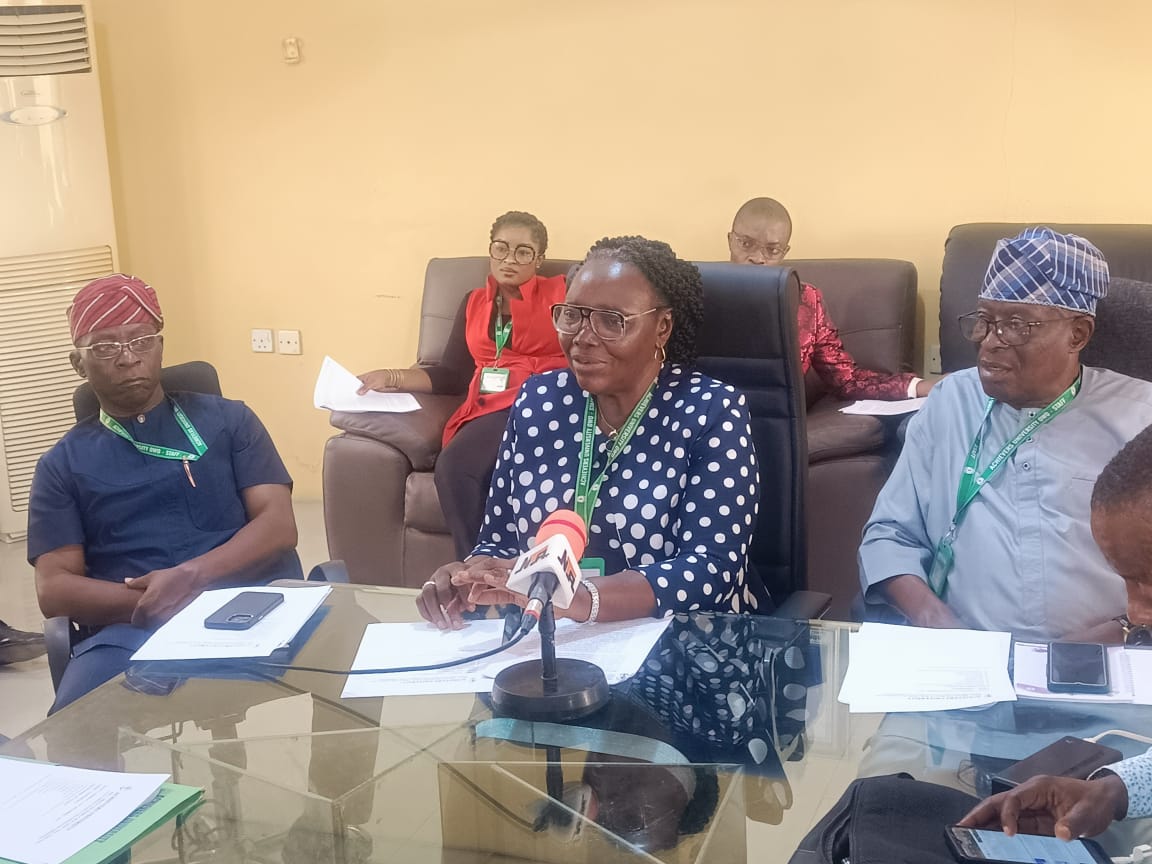
—–We’ll turn brain drain to ‘brain gain’ – VC
By Dayo Johnson, Akure
Seventy one out of the 700 students of Achievers University, Owo, Ondo state, will graduate from the institution with first class division during its 14th convocation ceremony.
654 of the students will on Saturday, receive their first degrees, while 46 others will be graduating from the School of Postgraduate Studies.
The Vice-Chancellor of the University, Professor Omolola Irinoye, said this at a Press conference held to herald the convocation ceremony.
Professor Irinoye, said that 303 had second class upper division, 243 received second class lower division, and 35 graduated with third class honours.
Speaking on brain drain, the Vice Chancellor, said that *the university is leveraging Technology and Collaboration, to tackle the challenge posed by working towards
to turn the brain drain into a ‘brain gain’.
“We are looking to turn the brain drain into a ‘brain gain’ by leveraging technology to connect with Nigerians abroad who can contribute remotely. Our soon-to-be-completed ICT building is a step towards fostering these collaborations, enabling us to mitigate the effects of the Japa Syndrome on our academic staff and programs.”
The university, according to her, will confer honorary degrees on the Governor of Niger State, His Excellency, Honourable Muhammed Umar Bago; the Managing Director of Fidson Healthcare, Lagos, Dr Fidelis Akhagboso Ayebae; and the Orangun of Oke-Ila, Oba Adedokun Abolarin.
The Vice Chancellor added that ” the university will, on Tuesday, 10 December 2024, present 143 graduate nurses to the Nursing and Midwifery Council of Nigeria as registered nurses and midwives.
“On Wednesday, 11 December 2024, 12 graduates from the engineering programmes will be presented to the Council for the Regulation of Engineering in Nigeria (COREN) for registration as engineers.
“Additionally, the university will present 17 Public Health graduates to the African Institute of Public Health Professionals (AIPHP) for induction.
“On Thursday, 12 December 2024, 65 graduates will also be inducted and registered by the Medical Laboratory Science Council of Nigeria as Medical Laboratory Scientists.
“The 14th Convocation Ceremony is not only a significant milestone for the graduating students but also for their families, the university, and society at large, highlighting the resilience of the Nigerian people.
Irinoye said that 319 students have benefited from the institution’s 12 tuition-free academic programmes.
This initiative, according to her “is part of the university’s commitment to increasing access to higher education for young people, particularly those unable to afford tuition costs.
She added that “the university’s Governing Council has approved a tuition scholarship range of 65% to 80% for UTME and Direct Entry candidates in 20 other academic programmes.
On challenges facing universities in the country, Prof. Irinoye said “We are facing significant economic challenges, and no organization, institution, business, family, or individual in Nigeria remains unaffected.
” This is particularly true for educational institutions, which require substantial resources—many of which are not locally produced. The escalating costs of importing these resources and operational expenses have severely impacted our capacity to function optimally.
“Our university’s growth has slowed significantly over the last two years. Budget constraints have forced us to scale back planned initiatives.
“Often, our annual budget only suffices for three months of operations. These financial challenges make it difficult to provide adequate support for both our institutional growth and corporate social responsibilities.
“Despite offering tuition-free programs in response to economic hardships faced by Nigerians, the constraints remain. Many of our activities have been moderated to ensure we operate within available resources.
” This also limits our ability to engage in international collaborations, which often require counterpart funding.
“The ‘Japa Syndrome,’ where professionals leave the country for better opportunities abroad, has had a profound impact on health care delivery and the educational sector.
“Many health facilities are understaffed, leading to poor health outcomes for patients. Meanwhile, educational institutions are losing skilled lecturers to international offers.
“While the federal government has attempted to increase student admission quotas and institutions to address this challenge, these efforts are undermined by a shortage of qualified staff.
” Even during recruitment efforts, many candidates express their intention to leave the country within a year or two. It is challenging to blame them, given the financial realities of working in Nigeria.
“Increasing the number of students and graduates to address these shortages must be approached cautiously.
” We need to maintain high-quality education standards to ensure our graduates are competitive internationally.
“Producing poorly trained professionals will not only harm the country’s reputation but could result in international accreditation setbacks.
“We understand the financial difficulties faced by parents and have adopted flexible payment plans, allowing tuition fees to be paid in installments.
“While this helps families, it also poses challenges for the university, as we must continue to provide services and meet operational demands despite delayed payments.
“The government must reconsider the tax burdens placed on educational institutions and extend access to programs like the National Education Fund to students in private institutions.
” Many families take loans or sell property to fund their children’s education. Denying them access to government education loans is unfair, especially when public institutions cannot meet the overwhelming demand for higher education in the country.
“Despite these challenges, we remain committed to ensuring our institution thrives. We will continue to explore innovative solutions, collaborate with stakeholders, and advocate for better policies to support education in Nigeria.
She noted that “While the road is tough, Nigerians are resilient, and we will survive and thrive.
Meanwhile, the convocation activities will climax on Saturday, 14 December 2024, with the main convocation ceremony.
The programmes include a convocation lecture, Jumat service for thanksgiving, foundation-laying and launching of the Yakubu Dogara Institute of Legal and Democratic Studies, a variety night on Friday, 13 December 2024 and a thanksgiving service at the Chapel of Grace and Glory.
Disclaimer
Comments expressed here do not reflect the opinions of Vanguard newspapers or any employee thereof.