By Prisca Sam-Duru
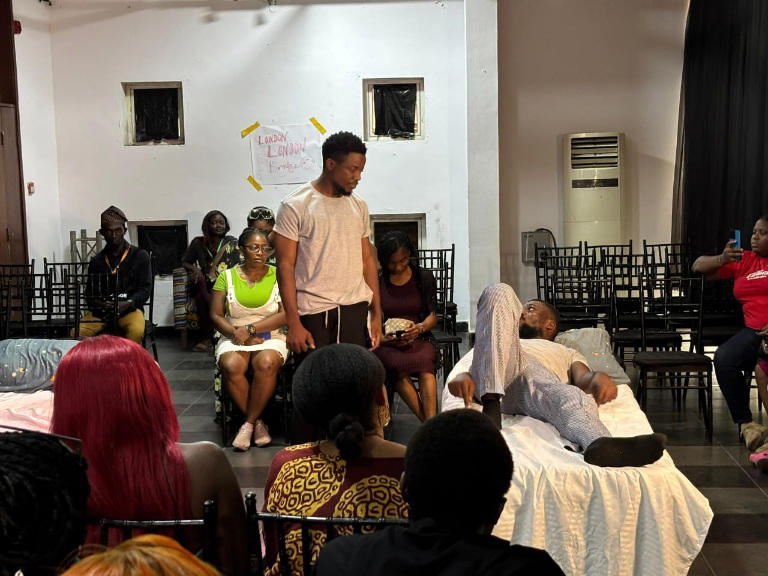
One of the most anticipated productions at the Lagos Fringe 2024, ‘A Palm Tree In London’, was finally staged on 23rd and 24th November, 2024 at Freedom Park, Lagos.
Written by Chris Iheuwa and produced by Emmanuel Okocha, “A Palm Tree In London”, was extremely expository and at the same time super entertaining. The play is typical of productions by Okocha who describes himself as a producer who loves to deal with very interesting, topical and controversial themes. The desire to address issues arising from subtle divisions, racism and neo-colonialism despite the end of slavery and colonialism, inspired him this time to shift from mental health related themes to cultural dichotomy, with more focus on unity in diversity.
The two-character play featuring Chukwu Martin(Carpenter Stone) and Kelvinmary Ndukwe(Nwarusi Ogbuediabali Dibiaukwu), who was also the play director, explores themes of racism, corruption, unity, impact of colonialism and neo-colonialism on Africa.
‘A Palm Tree In London’, which came from the stable of Instinct Pictures, examines the intersections of cultural identity and human connection, particularly, how the two characters; one Africa, the other, from the West, navigate the complexities of race, perception, and self-awareness in a shared space. With an apt title that stands as a metaphor for resilience, rootedness, and adaptability, ‘A Palm Tree In London’ is heavily loaded with thought-provoking messages which ordinarily could ignite serious tension but are masterfully doused with humour.
The plot which invites the audience to ponder on the challenges of reconciling different identities as well as the role empathy and understanding could play in bridging cultural divides, revolves around the two actors who embody the respective cultural backgrounds and experiences of the white and black communities. Their dialogues and conflicts provide a thorough chronicle of the tensions and misunderstandings that have historically plagued societies, revealing how deeply rooted prejudices and historical injustices can impede progress toward true unity.
The palm tree, a symbol of resilience and growth, embodies the hope for a future where cultural differences are not just tolerated but celebrated. The play also, celebrates the richness in the diverse heritage of each character.
Nwarusi Ogbuediabali Dibiaukwu (Kelvinmary Ndukwe), acted as a proud Nigerian student obviously from the South East, who is in London to study to become a doctor. He humorously tells his white roommate who couldn’t answer questions on why people still die of diseases in spite of their claims of advancement in medicine, that he is there to ‘study why white medicine kills people’, so that he ‘can use black medicine to cure them’. He claims Africans live longer that whites because they feed on nature. To the question of why he is in London to study since he claims his country is better, Ogbuediabali replies that it is because Nigerian employers love British certificates. The Briton with his annoying questions then, asks what it feels like to be black. Ogbuediabali seizes the opportunity to flaunt the beauty of his fatherland. According to him, Africa is a symbol of strength, courage, and resilience.
The need to tell our stories as Africans was also emphasised during their interaction. Carpenter Stone reveals he has never travelled outside his country; yet he has opinion about Africa. Little wonder he never lets go of his Encyclopaedia.
And while priding in the fact that he lives in a country where the systems work, he refuses to let Britain take any blame for Africa’s under development. Stone actually claims that ‘without colonialism, Africans would still be swinging between trees’; like we see in the movie, ‘George of the Jungle’.
He however, has a point when he insists that Africa is the architect of its own misfortune considering that they sold their people to the slave masters in exchange for petty materials. Also, till date, most African heads are still ruling as mere puppets in the hands of Western Puppeteers.
Speaking about the success of the production which will be heading to the Brighton Fringe from May 23rd to 26th, 2025, as well as the Wandsworth Fringe, Emmanuel Okocha said that the festival “Is a crucial stepping stone for Instinct Pictures and ‘A Palm Tree In London’, adding that “Lagos Fringe gave us the platform to showcase our work not just to Nigerian audiences, but also to an international community. The exposure has been invaluable, as ‘A Palm Tree in London’ is a direct result of the kind of opportunities the Lagos Fringe offers to emerging artists and productions.”
He also spoke about the amazing performance of the actors saying, “Working with Kelvinmary Ndukwe has been a great experience. As the director, he brought a vision that elevated the entire production. What made it even more dynamic was his role as an actor in the play. Having him on both sides of the production allowed him to infuse his directorial decisions with a personal understanding of the performance. Also, Martins brought depth to his character, and his interactions with Kelvinmary on stage made for some truly memorable moments.”
Regarding the challenges he encountered while trying to bring ‘A Palm Tree in London’ to life, Okocha stated, “Every production comes with its challenges, and ‘A Palm Tree in London’ was no different. The main challenge we faced was ensuring the play’s themes; racial identity and the tension between cultures, were handled with the sensitivity and depth they deserve, while still keeping the audience engaged.”
On his part, the actor cum director, Ndukwe who disclosed that it took him and Martins a month of reading to master their lines which they executed with professionalism, described the play as one of the most challenging work he’s done as an actor. His reason being that its difficult to undermine the brilliance of the work, adding, “It’s a very intelligent work.”
Ndukwe who said he enjoyed great work chemistry with Chukwu Martin, further explained that he “decided to work with the producer because it was an interesting topic on the irony of cultures, how we perceive it, human belief systems, how we allow ourselves to form ideologies that are not original to our core identities. It was a fascinating topic for me.”
Disclaimer
Comments expressed here do not reflect the opinions of Vanguard newspapers or any employee thereof.