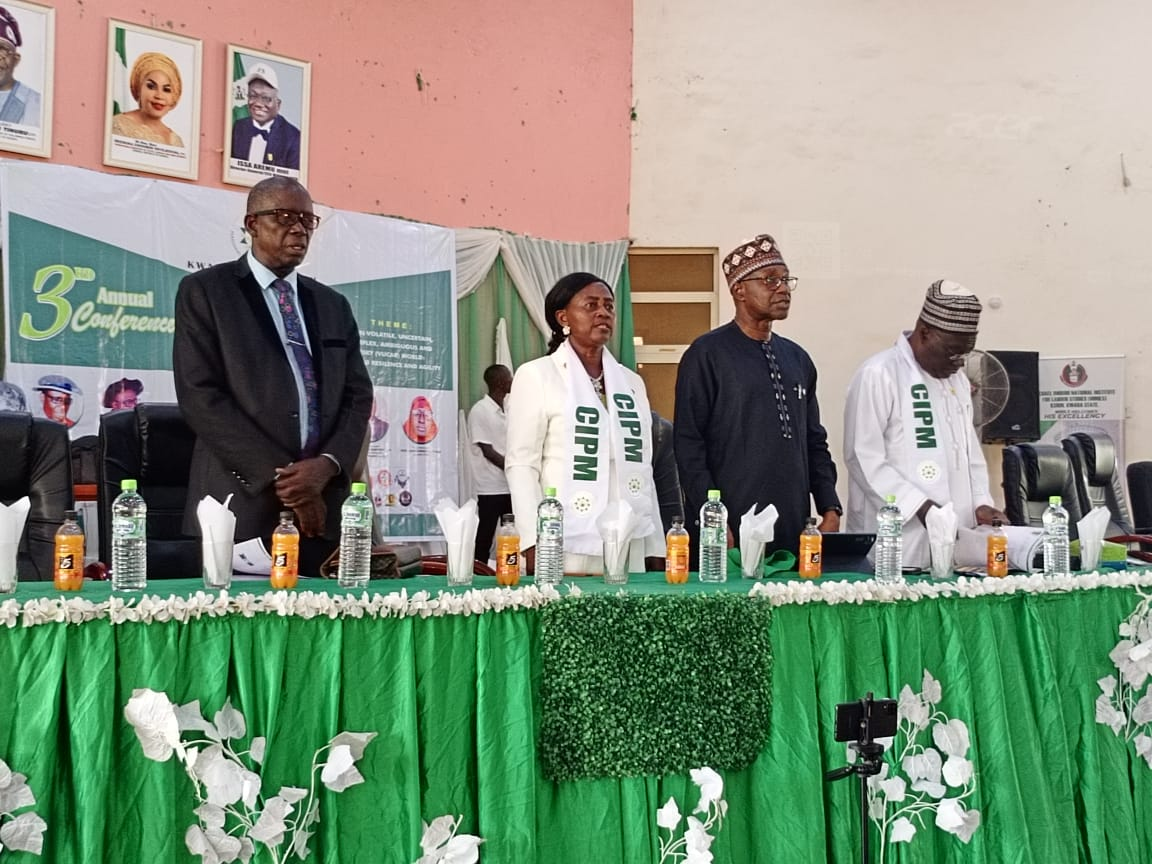
From right, The Director General/Chief Executive of MINILS Ilorin Comrade Issa Aremu, CIPM President,Mallam Ahmed Ladan Kwara state Chairperson of CIPM Mrs Olaide Ajiboye and another guest at the Third Annual Conference of the institute held in Ilorin.
By Demola Akinyemi, Ilorin
President and Chairman of Governing Council of Chartered Institute of Personnel Management of Nigeria (CIPM) Mallam Ahmed Ladan Gobir, has tasked the government at all levels and other stakeholders to concentrate more on human capital development in the overall interest of the country, rather than dissipating energies on issues surrounding wages,or factors of production.
Gobir speaking with journalists at the Third annual conference of the institute held at Michael Imoudu National Institute for Labour Studies(MINILS) in ilorin said that, “if you have capital, resources, skills and all that, you still require a human resource to harness all these to get intended and expected results”.
The CIPM boss, who advised the Federal Government and all sub nationals to make not only paying salary, minimum wage or living wage to employees the priority, said that they should encourage re-skilling and up-skilling of employees by way of training.
According to him,”as Human Resources (HR) professionals, our focus is always around human capital development. Often times we talk about factors of production, finance, capital, machinery, land, entrepreneurs, but we de- emphasize human capital and human resources.
” If you have capital, resources, skills and all that, you still require a human resource to harness all these to get intended and expected results.
“So, we encourage the Federal Government and all sub national to make not only paying salary, minimum wage or living wage to employees, but we also encourage re-skilling and up-skilling of employees by way of training. “
He further said that”people would say there’s need to first satisfy the biological needs or that an hungry man cannot think about training, but we always say that no matter what you are paid, you must also think about your own growth and development.
He stressed that,”what training, retraining, re-skilling ans upskilling does is equip workers with resources to be able to foray into other areas of growth and development.
“That’s why in the CIPM, we go from state to states to partner with federal and state governments to provide training and learning opportunities for civil servants”, he said.
Chairman of the CIPM in Kwara state, Mrs. Olaide Ajiboye, also speaking at the event complained about current challenges being faced by Nigerian workers, including insecurity, rising fuel prices, and fluctuations in dollar exchange rate.
Speaking on the annual conference that was in hybrid form, themed, “Human Resource Management in a VUCAR World: Building Resilience and Agility”, Ajiboye said that the theme addresses the challenges of operating in a volatile, uncertain, complex, ambiguous and risky environment (VUCAR).
“This theme is apt and timely considering the increasing rate at which companies are shutting down production in Nigeria due to high operating cost. This was buttressed in the recent release by Manufacturers’ Association of Nigeria (MAN) which states that about 737 companies have shut down in Nigeria from 2023 till date or relocated to other countries”.
Ajiboye also harped on the need to make environment conducive for business in Nigeria to thrive.
“That is why we have gathered here from various corners of the industry, united by a shared commitment to advancing
the field of human resources and finding solutions to underlying socio-economic challenges confronting our country as professionals.
“We will explore the innovative practices and emerging trends that are shaping how we operate in a turbulent environment. Our collective goal is to equip ourselves with the insights and tools necessary to navigate the evolving workplace landscape”.
Disclaimer
Comments expressed here do not reflect the opinions of Vanguard newspapers or any employee thereof.